Modified on: 10/09/2026
Plant Vocabulary That Makes Flower Pages Clearer
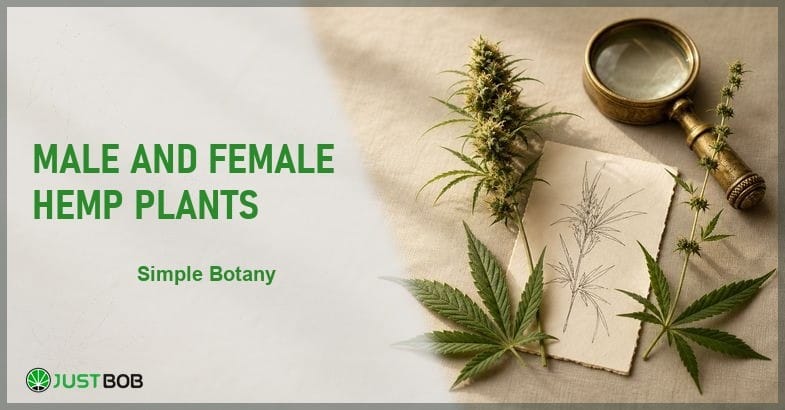
Male and female hemp plants may sound sound like straight out of a school biology class. But this simple distinction explains a surprising amount of the language you will come across on a hemp flower page.
When a listing refers to flowers, buds or a registered variety, it is drawing on basic plant botany whether it says so explicitly or not. This Justbob guide explains what male and female hemp plants actually are, why the female side shapes much of the vocabulary used for flowers, and how these botanical terms connect with product labels and documentation. The focus stays firmly on botany, not cultivation.
-
 Max CBDAMNESIA CBD BOOST
Glasshouse | CBD<40%
Starting from:FLASH SALE -10%
0,85 €0,75 €/gGrams5 10 20 50 100 200 400 -
Max CBDAK47 CBD BOOSTStarting from: 1,45 €/g
Indoor | CBD<47%
Grams5 10 20 50 100 200 -
Max CBDCHARASStarting from: 0,90 €/g
CBD HASH | CBD<45%
Grams5 10 20 50 100 200 -
JB OIL 25%Starting from: 14,90 €
CBD Oil 25%
The aim is simple and consists in making product pages easy to read. After a quick introduction to the basics, words like flower, bud and variety should feel less technical jargon and more like straightforward botanical terms.
What we mean by male and female hemp plants
Hemp is Cannabis sativa L., and the plant is usually dioecious. In simple terms, this means that an individual plant is normally either male or female, rather than having both sexes on the same plant. Botanists refer to this as plant sex, and it is a natural characteristic of the species rather than something unique to a particular variety.
The easiest way to think about it is that male and female plants are two forms of the same species, with different reproductive roles. Female plants develop the flowering structure that are most often described as flowers or buds on product pages, while male plants develop pollen-producing structures. The other develops the pollen structure that botany textbooks describe. Holding that difference in mind makes the rest of the vocabulary fall into place.
Why the female flower carries the product vocabulary
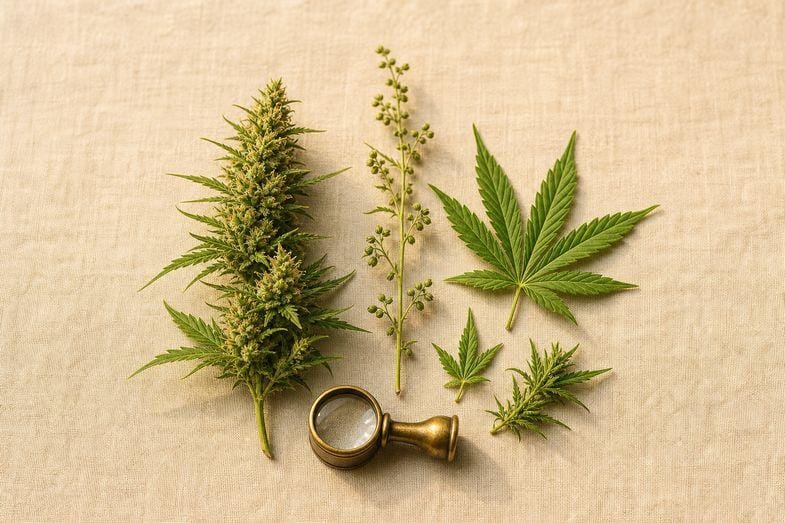
The female plant develops the inflorescence, the dense flowering cluster that most people simply call the bud or the flower. When a hemp flower page uses the word flower, it is pointing at this female structure. That is why the female side carries almost all of the product vocabulary you read on a listing.
The wider catalog connects here too. The CBD flower category groups these female inflorescences by registered variety, and the page language (variety name, appearance, aroma family) describes the female flower rather than the plant as a whole. The botany and the product page are describing the same thing from two angles.
The male plant and its botanical role
The male plant has a different structure. Instead of dense flowering clusters, it develops small pollen sacs, and its botanical role is reproduction. In product terms, the male plant is not the flower material on a catalog page, so it rarely appears in product photos or descriptions.
That contrast is the whole point of the vocabulary. Female means the flowering structure behind the product language; male means the pollen structure behind the botany. Naming them clearly keeps a product page honest about what it is showing.
How the two plants got their names
Telling plants apart by sex is older than modern botany. The German botanist Rudolph Jakob Camerarius described plant sexuality in 1694, showing that plants have male and female reproductive parts. A few decades later, in 1753, Carl Linnaeus formally named Cannabis sativa in his Species Plantarum, placing the plant inside the naming system botany still uses today.
That history gives the vocabulary a long shelf. When a 2026 catalog names a registered variety and describes a female flower, it is using a framework that took shape across the seventeenth and eighteenth centuries. The words are modern, but the botany behind them is not new at all.
How the vocabulary lines up with labels and documents
On a product page, the plant botany meets the paperwork. The label names the registered variety, the flower refers to the female inflorescence, and the certificate of analysis carries the cannabinoid panel and the THC reading against the 0.3 percent threshold harmonised at European level. Each of those points connects back to the female flowering structure.
For a wider botanical map of the plant, our guide on Hemp Plant Anatomy: A Simple Botanical Guide sets out stems, leaves, flowers and trichomes in order. Read alongside the male and female distinction, it turns a product page into something closer to a labelled diagram.
The same words on a product page
At Justbob, every commercialised product is analysed batch by batch. Every commercialised product keeps its documents on its own page. A reader who wants to confirm the registered variety or the cannabinoid breakdown for a specific lot can open the certificate of analysis without stepping off the listing.
Every flower listing sits inside the EU industrial hemp framework, produced by EU producers from registered hemp varieties, with THC kept at or below the 0.3 percent threshold harmonised at European level. Hemp flower is offered for technical, scientific and ornamental purposes only. The male and female distinction is botanical vocabulary that supports the listing; it is not a directive and not a growing guide.
What this guide does not cover
This article stays on the botany and the vocabulary. It is not a cultivation guide, it does not cover germination or pollination steps, and it does not give seed advice. Those topics belong to growers and agronomists working inside their own national rules, and they sit well outside a product-reading guide.
The useful takeaway is narrow on purpose: knowing that flower means the female inflorescence, and that male plants carry pollen rather than product material, is enough to read a hemp flower page with more confidence.
Putting the two words to work
The botany-to-label check is quick. When a hemp flower page uses plant language, a reader can run three quick checks. Confirm that flower or bud refers to the female inflorescence. Match the registered variety on the label. Open the certificate of analysis for the cannabinoid panel and the THC reading. Those three points connect the botany to the document in a few seconds.
For official background on how hemp is defined in agriculture, the European Commission page on hemp gives a neutral outside view, independent of the catalog and apart from any single listing.
Frequently asked questions about male and female hemp plants
What are male and female hemp plants?
Hemp is Cannabis sativa L., a usually dioecious plant, which means a single plant is normally either male or female. The female plant develops the dense flowering cluster (the inflorescence or bud) that hemp flower products are based on. The male plant develops pollen sacs and its botanical role is reproduction. The two are versions of the same species with different structures, which is why product pages describe the female flower while botany texts describe both.
Why do flower pages mention plant parts?
Because the product vocabulary is built on plant botany. When a listing says flower or bud, it points at the female inflorescence; when it names a registered variety, it names the genetic baseline of that plant. Reading the plant parts behind the words makes a catalog page easier to follow, and it lines the description up with the label and the certificate of analysis.
Is this a cultivation guide?
No. This article explains male and female hemp plants as botanical vocabulary that helps readers understand product language. It does not cover germination, pollination or seed selection, and it gives no growing instructions. Cultivation sits outside a product-reading guide and inside the national rules that apply to growers.