Modified on: 04/08/2026
Two plant parts, two very different roles: seeds and flowers
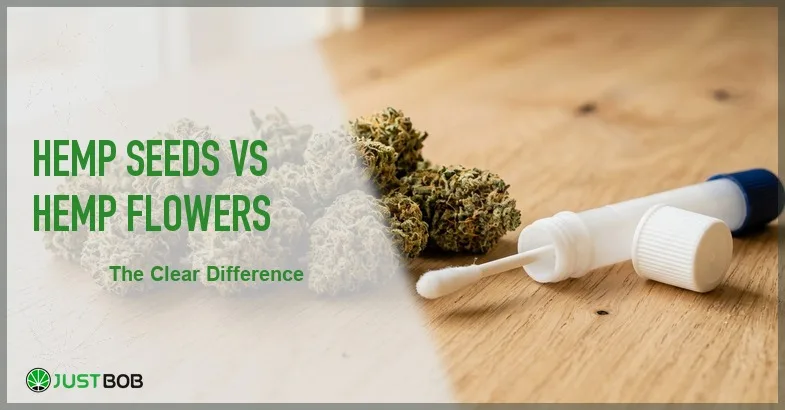
A seed and a flower are easy to mix up in a search bar. On the plant, though, they have completely different jobs. One is the tiny starting point of a future plant, the other is the resin-rich flowering part that appears in CBD flower product descriptions. That is why this guide keeps the comparison botanical. No old risky query, no practical routine, no dramatic promise. Just plant parts, product language and the small pleasure of putting the right label on the right thing. Hemp content becomes much easier when the names stop pretending to be interchangeable.
Hemp seeds vs hemp flowers: it forces the article to compare two plant parts without sliding into product confusion. Seeds are one structure, flowers are another, and CBD product pages need the flower context to stay precise.
-
 Max CBDAMNESIA CBD BOOSTStarting from: 0,85€/g
Glasshouse | CBD<40%
Grams5 10 20 50 100 200 400 -
Max CBDAK47 CBD BOOSTStarting from: 1,45€/g
Indoor | CBD<47%
Grams5 10 20 50 100 200 -
Max CBDCHARAS
CBD HASH | CBD<45%
Starting from:FLASH SALE -10%
0,90€0,80€/gGrams5 10 20 50 100 200 -
JB OIL 25%Starting from: 14,90€
CBD Oil 25%
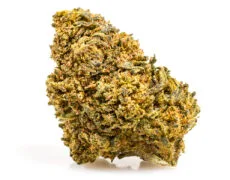
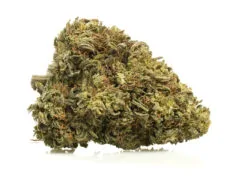
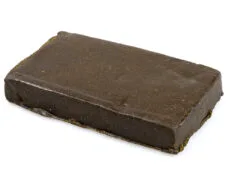
At Justbob, commercialised CBD flower products are produced in the EU. All commercialised products and all batches are analysed on an ongoing basis, with the relevant lab documentation available inside each product page. That matters here because a CBD flower page should identify the flower product, not blur it with hemp seeds, stalks, leaves or any other plant part.
Hemp seeds vs hemp flowers in plain botany
This is a comparison between two plant structures. Hemp seeds are the small seed part of the hemp plant. Hemp flowers are the flowering tops, usually discussed through buds, resin, aroma, trichomes, cannabinoids and visible plant structure.
In other words, hemp seeds vs hemp flowers is not a small wording detail. It is the difference between the starting part of the plant and the flowering part that a CBD flower page actually describes. If the plant were a little theater, seeds would be the tickets waiting in an envelope. Flowers would be the stage set, lights and all. They belong to the same botanical world, but they do not perform the same role.
That simple distinction prevents a lot of confusion. Hemp seeds are not CBD hemp flower. Hemp flowers are not seed products. Cannabis seeds vs flowers is the same basic comparison in broader vocabulary: seed part on one side, flowering structure on the other. The words can look similar because hemp, cannabis and CBD content often recycle the same plant vocabulary. But the product meaning changes completely when the plant part changes.
Read also: Hemp Flower Aroma And Texture: What To Notice – Justbob
Why hemp seeds and hemp flowers get confused
The confusion usually starts with the broad use of the word hemp. People often encounter terms like hemp plants, hemp-derived products, hemp flowers, hemp seeds, CBD hemp, CBD flower, and hemp buds in the same context. As a result, search engines and online content frequently group these terms together, even though they refer to very different parts of the plant.
Another reason is that “seed“ and “flower“ both sound botanical and are often perceived as closely related. It’s easy to assume that because they come from the same plant, they must be similar products. In reality, they serve entirely different purposes. Leaves, stalks, seeds, flowers, and resin-rich buds are all distinct plant parts with different characteristics and uses.
Product pages can make the distinction even clearer. A CBD hemp flower page typically focuses on appearance, aroma, trichomes, CBD content, THC compliance, and batch documentation. By contrast, a page about hemp seeds discusses a completely different product category and would not include those flower-specific features.
The key takeaway is simple: just because two products come from the same hemp plant doesn’t mean they are the same product. A shared botanical origin does not mean a shared identity or purpose.
What hemp seeds are
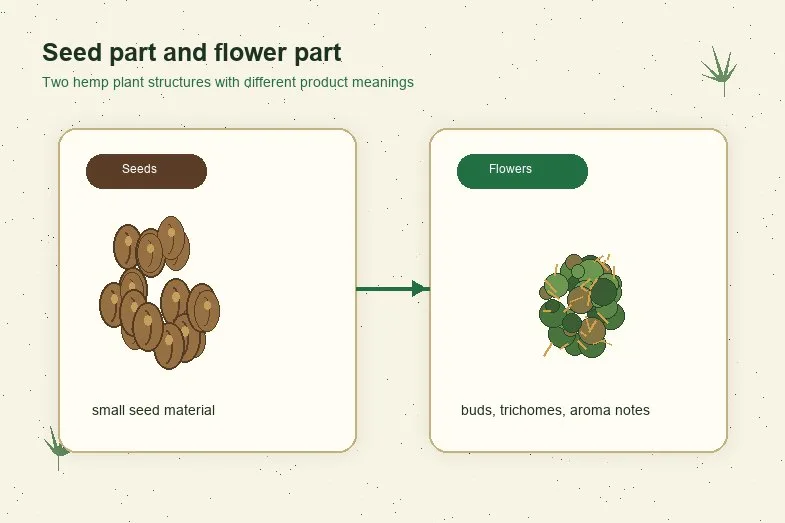
Hemp seeds are the reproductive part of the hemp plant. From a botanical perspective, a seed is responsible for plant reproduction and future growth, making it fundamentally different from a flower or bud. For the purposes of this article, the key point is simple: hemp seeds are not CBD flowers. Although they come from the same plant, they are different plant parts with different structures and functions.
Unlike hemp flowers, hemp seeds do not display the visual characteristics typically associated with CBD buds. They lack trichomes, resin, flower structure, leafy bracts, and the distinctive appearance of mature hemp buds. In other words, they are an entirely separate type of plant material.
Search results often mix hemp seed terminology with CBD flower content, but this can be misleading. Seed-related vocabulary belongs to a different category of hemp products, whereas this article focuses on the distinction between hemp seeds and CBD flowers, not on hemp seeds as a product in their own right.
A simple comparison helps illustrate the difference: it’s like comparing grape seeds with a bunch of grapes still on the vine. They come from the same plant, but they are different objects, with different characteristics, different purposes, and different terminology.
What hemp flowers are
Hemp flowers are the flowering tops of the hemp plant. In the CBD market, the term generally refers to dried flowers from female hemp plants, selected and described based on their appearance, aroma, cannabinoid profile, and batch documentation.
The term CBD flower is closely related, but it is more than just another name for hemp flowers. A well-written CBD flower product page should clearly explain what the flower is, how it looks, its reported CBD content, its compliant THC level, and where customers can access the corresponding batch analysis.
The expression hemp buds is also commonly used. A bud refers to the compact, resin-rich flower structure. It is not a seed, stem, or leaf, but a specific part of the flowering section of the hemp plant. Understanding this distinction makes it easier to browse CBD products. A CBD flower page should focus on flowers and buds, supported by transparent product information and laboratory documentation. References to hemp seeds should only appear for comparison, not as a substitute for describing the flower itself.
Female hemp plants, flowers and buds
CBD hemp flowers come from female hemp plants. This is why product descriptions often refer to female plants, buds, and resin-rich flower structures. The goal is not to explain hemp cultivation in detail, but to clarify why these terms appear so frequently in CBD product language.
Female hemp plants develop the flowers that are harvested and sold as CBD hemp flowers. Male plants have a different biological role and different visible characteristics, so they are discussed differently in botanical contexts. For readers comparing hemp seeds and hemp flowers, the key distinction is straightforward: commercial CBD flower terminology refers to the flowering parts of female plants—not to seeds. This is also where terminology can become confusing. Words such as strain, hybrid, and sativa often appear in hemp flower descriptions. While these terms can be useful for classification or product catalogs, they should not distract from the essential point: a CBD flower product is, first and foremost, a flower product.
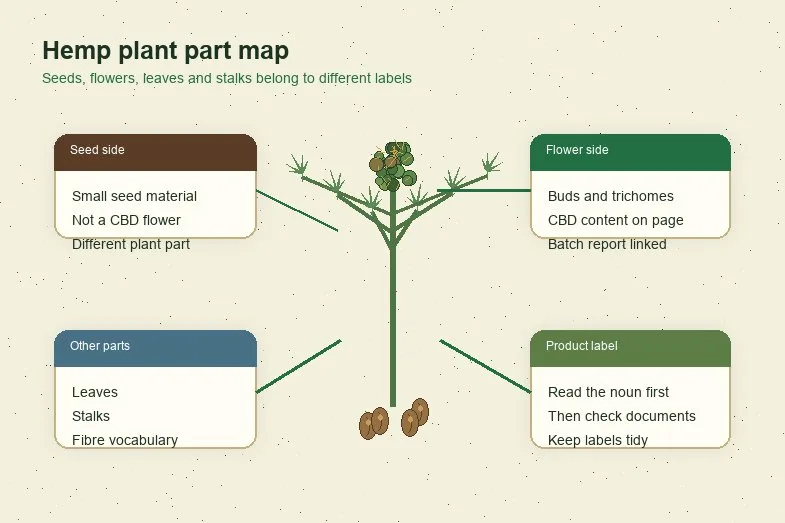
Keeping the plant map clear makes everything easier to understand: seeds belong to one category, flowers and buds to another, while leaves and stalks are separate plant parts with their own characteristics. Once these distinctions are clear, the confusion between hemp seeds and hemp flowers quickly disappears.
Leaves, resin and visible plant parts
Leaves are another part of the hemp plant that is often confused with flowers. While they may surround or accompany the flowering tops, they are not the same as hemp flowers. Likewise, stalks and fibre belong to entirely different parts of the plant and serve different purposes. Keeping these plant parts separate helps avoid unnecessary confusion.
Resin, on the other hand, is closely associated with hemp flowers. CBD flowers are valued for their trichomes, aromatic compounds, and naturally occurring cannabinoids, which is why product photos typically highlight bud structure, surface detail, and colour. These are the characteristics of a flower product, not a packet of seeds.
Terpenes and flavonoids are also commonly mentioned in CBD flower descriptions because they help explain a flower’s aroma profile and overall character. However, these terms should remain descriptive rather than promotional. A well-written product page uses them to describe observable or laboratory-documented characteristics, without making unsupported claims.
Read also: Hemp Buds, Stems And Leaves: Plant Parts
What Justbob means by CBD flower
When Justbob refers to CBD flower, we mean a specific product category: EU-produced hemp flowers presented with clear product descriptions, reported CBD content, THC compliance information, and batch-specific laboratory analysis. This is a much more precise definition than the broad and often ambiguous term hemp.
For this reason, hemp seeds should never be considered another name for CBD flowers. They are not an alternative format, a smaller version, or a variation of the same product. They are simply a different part of the hemp plant, with a different structure and a different purpose. The same principle applies to the expression hemp-derived. While it indicates that a product originates from the hemp plant, it does not identify which part of the plant it comes from. A hemp-derived product could be a flower, oil, extract, seed, fibre, or another hemp material. The product description should always make that distinction clear.
At Justbob, we believe that clear product information is essential. Good e-commerce content should identify the product accurately, provide transparent documentation, and avoid ambiguous terminology. That helps customers understand exactly what they are viewing and compare products with confidence.
For readers interested in the wider regulatory context, the European Commission page on hemp provides an overview of the EU regulatory framework for industrial hemp and the use of certified hemp varieties across the European Union.
How to read product descriptions without mixing plant parts
The easiest way to avoid confusion is to start with the product name. Is the page referring to hemp seeds, hemp flowers, CBD flower, CBD hemp flower, trim, extract, or CBD oil? The product category is your first clue. If the page says flower, expect information about the flower. If it says seed, don’t assume the characteristics of a CBD flower apply.
Next, look at the supporting details. A CBD flower product page will typically describe bud structure, trichomes, aroma, cannabinoid content, THC compliance, strain name, and batch-specific laboratory analysis. Hemp seeds, on the other hand, require a completely different type of description. The same is true for trim, leaves, stalks, extracts, and oils, each of which belongs to its own product category.
Finally, check the documentation. A reliable CBD flower page should make it easy to verify the product’s laboratory analysis. At Justbob, every CBD flower product includes batch-specific lab reports, allowing customers to compare the product description with the corresponding analytical data.
The process is straightforward:
- Identify the plant part.
- Understand the product category.
- Review the supporting documentation.
Keeping these three steps in mind makes it much easier to understand exactly what you’re buying.
Final comparison
- Hemp seeds are the reproductive seeds of the hemp plant.
- Hemp flowers are the flowering tops, while CBD hemp flower refers to a specific category of CBD products made from those flowers.
- Hemp buds belong to the flower category, whereas leaves, stalks, and fibre are separate plant parts with different characteristics and uses.
Understanding these distinctions helps avoid incorrect assumptions. A seed does not explain a flower product, and a flower product does not describe seeds. Although they all come from the same plant, they represent different parts of it and should not be used interchangeably.
The takeaway is simple: hemp seeds and hemp flowers are not the same thing. Once you understand which part of the plant you’re looking at, reading a CBD product page becomes much clearer.
🌿 If you’d like to learn more about premium hemp products, explore the Justbob catalogue. You’ll find a wide selection of CBD flowers, carefully selected and supported by transparent laboratory documentation, alongside CBD oils, CBD hash and other hemp-derived products designed to help you make informed purchasing decisions.
Frequently asked questions about hemp seeds and hemp flowers
Are hemp seeds the same as hemp flowers?
No. Hemp seeds are the seed part of hemp plants, while hemp flowers are the flowering tops discussed in CBD flower product descriptions. They are different plant parts with different meanings.
Do hemp seeds contain CBD like flowers?
Hemp seeds are not the same CBD flower material. CBD flower descriptions focus on the flower structure, cannabinoids, THC information and batch analysis, while seed language belongs to a different plant-part category.
Why are hemp flowers used in CBD product descriptions?
Hemp flowers are used in CBD product descriptions because the flower side of the plant is where buds, trichomes, aroma notes and cannabinoid documentation are normally discussed.