
Modified on: 17/09/2026
CBD Hash Characteristics: Texture, Aroma, Appearance and Label Reading
CBD hash characteristics are best understood by combining what can be observed with what can be verified through product documentation. Texture, colour and aroma provide useful descriptive information, while the label, batch reference and analytical documentation add the technical context needed to understand a specific product.
This Justbob guide explores the main CBD hash characteristics readers may encounter on a product page, from its physical appearance to the information provided on the label and in the available laboratory documentation.
-
 Max CBDAMNESIA CBD BOOSTStarting from: 0,85€/g
Glasshouse | CBD<40%
Grams5 10 20 50 100 200 400 -
Max CBDAK47 CBD BOOSTStarting from: 1,45€/g
Indoor | CBD<47%
Grams5 10 20 50 100 200 -
Max CBDCHARAS
CBD HASH | CBD<45%
Starting from:FLASH SALE -10%
0,90€0,80€/gGrams5 10 20 50 100 200 -
JB OIL 25%Starting from: 14,90€
CBD Oil 25%
The approach is deliberately observational and factual. A well-structured CBD hash page should provide clear descriptions and relevant product information, allowing readers to understand what they are looking at without relying on exaggerated claims.
What CBD hash characteristics cover on a product page
CBD hash characteristics include the observable and documented features used to describe a pressed hemp-resin product. The main elements include texture, colour, appearance, aroma, product labelling, batch information and cannabinoid data provided in the relevant analytical documentation.
On a CBD hash product page, these elements can work together to provide a more complete description. Product images can illustrate colour and texture, while the written description can provide information about the aroma and general characteristics. The label and accompanying documentation can then provide additional information about the product identity, batch and cannabinoid profile.
The most useful CBD hash descriptions therefore combine sensory characteristics with verifiable product information. The first helps readers understand the physical product, while the second provides the technical context behind the description.
Texture: compact, soft, crumbly, resinous
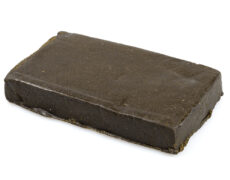
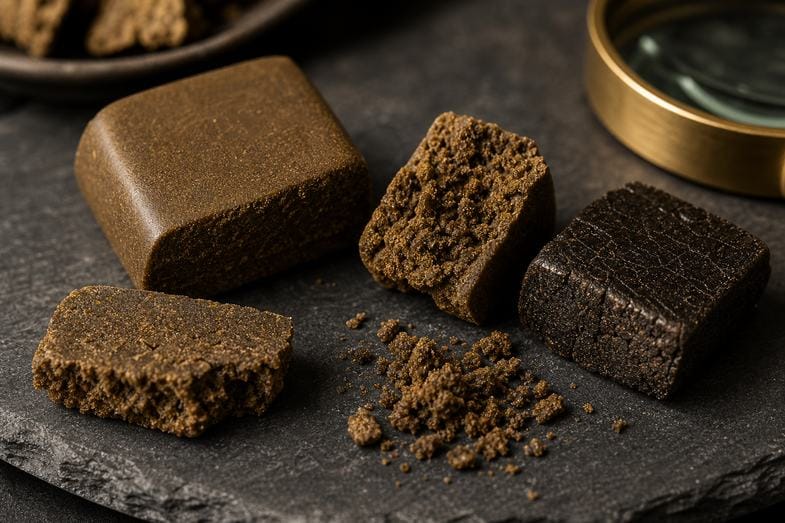
Texture is one of the most immediately noticeable CBD hash characteristics. Depending on how the hemp material has been processed and pressed, a resin product may appear compact and dense, softer and more pliable, or more crumbly and granular.
A compact hash may have a relatively even surface and defined edges. A softer product may appear more pliable, while a crumbly texture can produce visible granules or less-defined edges. These descriptions concern the physical characteristics of the product and should not be interpreted as a direct indication of its cannabinoid concentration.
Texture can be influenced by several factors, including the processing method, pressure applied during pressing, moisture content and storage conditions. Different production methods can therefore result in noticeably different physical textures.
For readers, texture is best treated as an observational characteristic rather than a quality measurement. The appearance of a dense or crumbly block alone cannot establish the CBD content or overall quality of a product.
Colour and appearance: from golden to dark amber
The colour of CBD hash can range from light golden or beige tones to darker brown and amber shades. Its appearance may vary according to factors such as the hemp variety, processing method, storage conditions and the age of the material.
Product photography can provide a useful visual reference, although colour displayed in photographs can vary depending on lighting, camera settings and screen calibration. A close-up image can often provide more information about the surface and internal appearance than a photograph of the sealed packaging.
Colour should therefore be considered alongside the other CBD hash characteristics rather than treated as a standalone indicator of quality or cannabinoid content. Different colours and textures can occur naturally between products and batches.
Aroma: scent families and resin notes
Aroma is another important descriptive characteristic of CBD hash. Depending on the hemp variety and its terpene profile, a product may present notes that can be described as earthy, woody, herbal, floral, citrus or resinous.
The aroma of a hemp-derived resin can reflect compounds present in the underlying plant material, including terpenes, although processing and storage can influence the final aromatic profile. As a result, the description on a product page should be understood as a general sensory reference rather than a precise chemical measurement.
For readers comparing CBD hash products, it can be useful to consider the aroma description alongside the stated hemp variety and available analytical information. When these elements are consistent, they provide a more complete picture of the product being described.
Ultimately, aroma, texture and appearance describe the sensory side of CBD hash, while the label and laboratory documentation provide the product-specific technical context. Reading both layers together is the most reliable way to understand the characteristics presented on a CBD hash product page.
The label: registered variety, CBD percentage, THC threshold
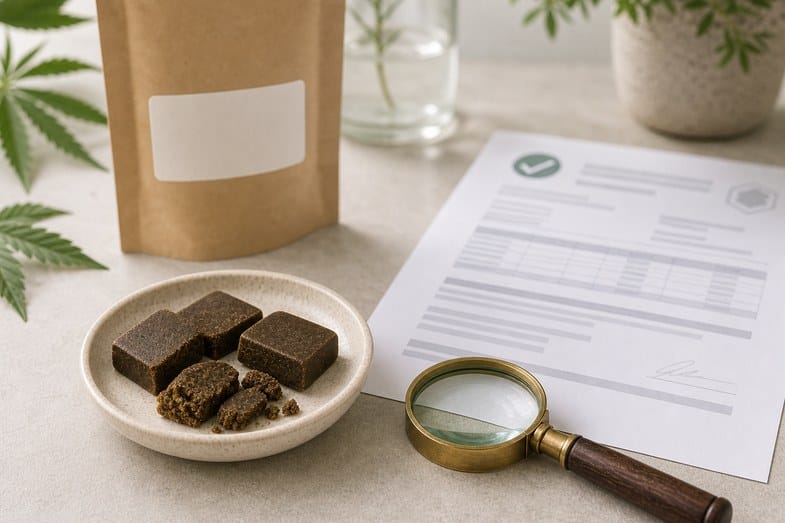
A CBD hash label brings together key information that helps identify and contextualise the product. Depending on the product and applicable requirements, this may include the hemp variety, CBD content, relevant THC information, product positioning, age-related information and batch or lot reference.
The CBD percentage shown on a label or product page may be presented as an indicative value, range or other product-specific figure. Actual cannabinoid concentrations can vary between products and batches, depending on factors such as the hemp variety, processing method and composition of the material. For this reason, the analytical documentation for the specific batch provides more precise information than a general product description.
The label therefore acts as an important link between the physical product and its supporting documentation. Checking the batch reference and comparing it with the available analytical information is a useful step when evaluating a CBD hash product.
For wider regulatory context on CBD products in official UK guidance, the official UK CBD guidance is a useful reference point.
Batch documents and the analytical layer
A certificate of analysis (COA) can provide detailed information about the cannabinoid profile of a specific CBD hash batch, potentially including cannabinoids such as CBD, CBG, CBN, CBC and THC. Depending on the laboratory and the scope of testing, the document may also include information about analytical methods and additional parameters, such as pesticides, heavy metals or microbiological contaminants.
This batch-specific documentation can confirm, refine or provide additional context for the information presented on the product label. While a label provides a practical summary, laboratory analysis offers a more detailed snapshot of the particular lot that was tested.
At Justbob, products are subject to ongoing analysis, including batch-specific testing, and relevant analytical documentation is made available on the corresponding product pages. This allows readers to move from the product description and physical characteristics to the technical information relating to the specific batch.
The analytical document can also provide important information about the THC content of the tested lot. However, readers should distinguish between laboratory results for an individual batch and the broader legal requirements applicable to a product. The COA provides analytical evidence for the tested sample; the applicable legislation determines the relevant legal requirements.
How CBD hash characteristics differ between lots
Two batches of CBD hash made from the same registered hemp variety and processed using a similar method can still show minor differences. Factors such as harvest timing, curing conditions, processing parameters and storage history can influence the final appearance, texture, aroma and cannabinoid profile.
This natural batch-to-batch variation is an important part of agricultural products. A transparent product page should acknowledge that individual lots are not necessarily identical and, where available, provide batch-specific analytical documentation rather than presenting a single figure as though it applied identically to every batch.
For readers, this is one reason why the analytical document is more informative than a general label range. Two lots from the same product line may show slightly different CBD concentrations or cannabinoid profiles. The analysis associated with the relevant batch provides the most precise information about the tested product.
Storage can also influence the physical characteristics of hemp resin. Oxygen, light and temperature can affect the material over time, while appropriate storage conditions can help preserve its original characteristics. Changes in aroma, colour or texture should therefore be considered in the context of the product’s processing and storage history rather than interpreted automatically as a measure of quality.
Reading two CBD hash products side by side
Comparing two CBD hash products is easier when the same categories of information are available for both. Readers can compare texture, colour, aroma, label information and analytical data side by side.
For example, one product might have a compact, darker appearance and a more earthy or woody aroma, while another may have a softer texture, lighter colour and fresher aromatic profile. Differences in CBD concentration may also appear in the respective laboratory analyses.
Neither combination is inherently “better” based on these characteristics alone. The purpose of a comparison is to understand the differences between products, allowing each reader to decide which profile is more relevant to their preferences.
For a meaningful comparison, however, both product pages should provide comparable information in a clear and consistent format. When the same categories are available for each product, readers can make a more informed assessment without having to interpret missing or inconsistent data.
Read also: CBD Hash Texture: What Soft, Firm and Crumbly Can Mean
How Justbob keeps the CBD hash data visible
At Justbob, the approach to CBD hash characteristics is based on providing readers with accessible product information and relevant documentation. Depending on the product, the product page can bring together variety information, CBD data, THC information, product characteristics and available analytical documentation.
This creates a consistent reading method that can be applied across different products. Once readers understand how to evaluate the information on one CBD hash page, they can use the same approach when exploring CBD flowers, CBD oils or other hemp-derived products.
Consistency also makes product comparison easier. When key information is presented in a familiar structure, readers can focus on the actual differences between products rather than searching for missing data.
A simpe reading habit for CBD hash characteristics
The most useful way to read a CBD hash product page is straightforward:
- Look at the product images to understand its general appearance.
- Read the texture description and note the physical characteristics.
- Check the aroma description for the stated scent profile.
- Read the label and product information, including the batch reference where available.
- Consult the analytical documentation for the specific batch.
These five steps bring together the sensory, product and analytical layers without relying on exaggerated claims.
If you want to explore different CBD hash profiles for yourself, you can discover Justbob’s CBD hash range and compare the available product descriptions and documentation.
🌿 Explore Justbob, check the available information and choose the CBD hash product that best matches the characteristics you are looking for.
This article provides general product information and does not constitute medical or legal advice. Product characteristics and applicable regulations may vary over time and by market.
Frequently asked questions about cbd hash characteristics
What are the main CBD hash characteristics to look for?
The main CBD hash characteristics are texture (compact, soft, crumbly, resinous), colour (from golden to dark amber), aroma (scent family and dominant notes), label data (registered hemp variety, CBD percentage, THC threshold) and the analytical document with the lot-specific cannabinoid profile.
Why does CBD hash texture vary between lots?
Texture varies with the registered hemp variety, the pressing method, the curing conditions and the storage history. Lot variation is part of the agricultural nature of the product, and the analytical document is the lot-specific reference.
Where can I check the CBD percentage of a specific CBD hash lot?
On Justbob, the analytical documents are available inside each commercialised product page. The cannabinoid profile in the lab report confirms the CBD percentage for the specific batch and the THC threshold compliance.