Modified on: 03/09/2026
How a hash product card should explain itself
CBD hash product description is where a page should stop performing and start pointing at useful details. The phrase covers the wording on a hash product card: the fields, the visual notes, the label lines and the documents that sit behind them. This guide reads that wording as a structure to get right, not a sales pitch to polish. It looks at which fields belong on the card, how the visual notes should read, and where the documents take over.
-
 Max CBDAMNESIA CBD BOOSTStarting from: 0,85 €/g
Glasshouse | CBD<40%
Grams5 10 20 50 100 200 400 -
Max CBDAK47 CBD BOOST
Indoor | CBD<47%
Starting from:HALLOWEEN SALE -10%
1,45 €1,30 €/gGrams5 10 20 50 100 200 -
Max CBDCHARAS
CBD HASH | CBD<45%
Starting from:HALLOWEEN SALE -10%
0,90 €0,80 €/gGrams5 10 20 50 100 200 -
JB OIL 25%Starting from: 14,90 €
CBD Oil 25%
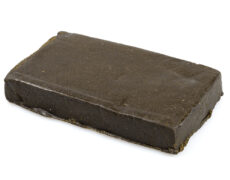
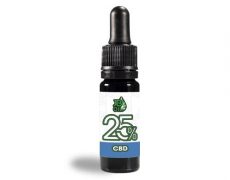
Think of a single product card on a shelf, the kind that has to do all the explaining while the item sits silently beside it. A clear card is organised and plain. The adjectives on it, in a sense, need a supervisor: something to keep them honest, and that supervisor is the document.
What a CBD hash product description is
A CBD hash product description is the block of wording that introduces one hash product on its page. It names the format, sketches the look, gives the figures and points to the paperwork. It is a structured card rather than an essay, built so a reader can take in the product at a glance and then check the details that matter.
Read that way, the description has a clear job. It is not there to convince; it is there to inform, laying out what the product is so the reader can decide for themselves and confirm it against the batch documents.
The fields a product card should carry
A useful hash card carries a predictable set of fields. The format comes first: CBD hash, a pressed hemp resin. Then the visual notes, the colour and the way the piece holds together. Then the figures, a CBD percentage marked as indicative and the THC reading against the 0.3 percent threshold harmonised at European level. Finally the identifiers, a batch code and the link to the certificate of analysis.
Listed like that, the card stops being decorative and becomes a checklist. Each field answers one plain question, and together they describe the product without a single word of persuasion.
Describing the look without overselling
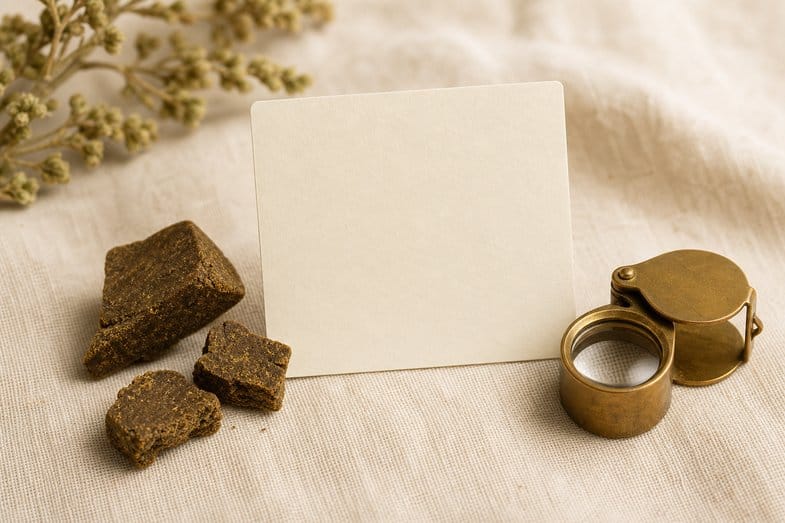
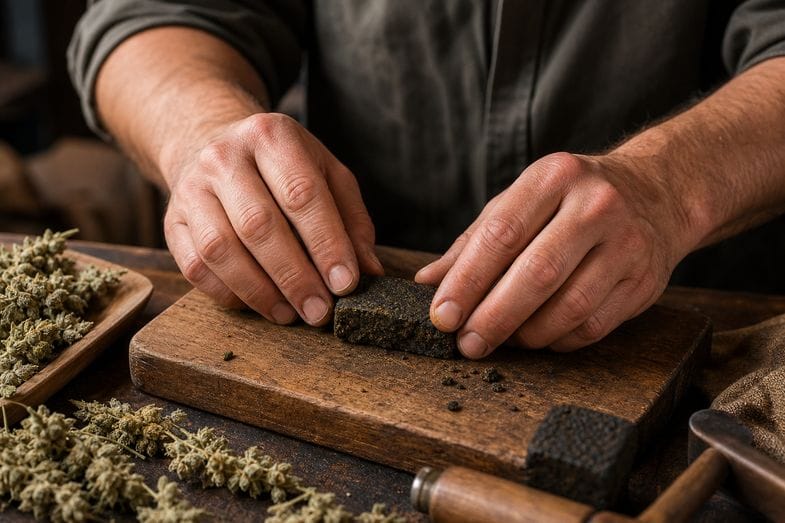
The visual notes are where a card is most tempted to perform. The fix is to keep the words descriptive: a colour, a surface, the way a piece sits in the hand, written plainly rather than dressed up. For the detail behind those words, our guide to CBD hash texture explains what soft, firm and crumbly each describe.
A product description should borrow from that vocabulary, not compete with it. The card names the look in a line or two; the dedicated guides carry the longer explanation, and the division keeps each page doing one thing well.
A page that points, not performs
This is the heart of the product-card idea. A description performs when it leans on adjectives to do the convincing; it points when it uses those adjectives to lead the reader to a field they can check. The same word, rich resin, reads very differently depending on whether a batch document stands behind it.
So the test for any line on the card is simple. Does it point at something verifiable, or is it just performing? Keep the pointing, retire the performing, and the description does its real work.
From description to document
Every honest card ends at the same place: the paperwork. The visual notes and the figures lead the eye, but the certificate of analysis is what confirms them, recording the cannabinoid figures and the THC reading against the 0.3 percent threshold harmonised at European level for that batch. The description introduces; the document settles.
That hand-off is the whole point of a well-built card. It is generous with plain information and quick to send the reader to the record, so nothing on the page has to be taken purely on trust. A card built like that asks for no faith it has not already earned.
Read also: CBD Hash Aroma: How To Read Resin Notes
An old idea: describing goods sold unseen
Writing a product so a reader can judge it from words alone is an old craft. In 1872, Aaron Montgomery Ward sent out what is often called the first mail-order catalogue, at first a single price sheet, describing goods that customers would buy without ever handling them first. The whole business rested on the description being accurate.
A product card carries that same responsibility. When a reader cannot pick up the piece and turn it over, the wording has to be honest enough to stand in for the inspection, which is exactly why a card should point at documents rather than lean on flourishes.
What a product description should avoid
A hash card is also defined by what it keeps out. It makes no claims beyond describing the item and does not borrow the language of food or cooking, none of which belongs on a product card. The description stays on the product as an object, and stops there.
So the card is left clean: format, look, figures, batch and document, in plain order. For an official overview of hemp as an agricultural crop, the European Commission page on hemp sets out the wider framework the products sit within.
A hash product card on a Justbob page
On a CBD hash page, the description follows that structure: the format, the visual notes, the indicative figures and the batch identifiers, with the certificate of analysis a click away. Every commercialised product is analysed and each batch is checked, so the card and the document are built to be read together.
Every hash on a Justbob page sits inside the EU industrial hemp framework, with THC kept at or below the 0.3 percent threshold harmonised at European level. The products are offered for technical, scientific and ornamental purposes only, and a clear product description is simply how the page makes all of that easy to read.
Frequently asked questions about cbd hash product description
What should a CBD hash product description include?
It should carry a predictable set of fields. The format comes first, named as CBD hash, a pressed hemp resin. Then the visual notes, such as colour and how the piece holds together. Then the figures: an indicative CBD percentage and the THC reading against the 0.3 percent threshold harmonised at European level. Finally the identifiers, a batch code and a link to the certificate of analysis. Together those fields describe the product plainly and lead the reader to the documents.
Is this a texture guide?
No. A product description is the product-card wording as a whole, while texture is one detail within it. This page covers how the card should be structured and where the documents take over; the longer explanation of how a piece looks and holds together lives in the dedicated texture and density guides. The card names the look briefly and links out for the full account.
Why check batch documents?
Because the description introduces the product and the document confirms it. The certificate of analysis records the cannabinoid figures and the THC reading against the 0.3 percent threshold harmonised at European level for that specific batch. Reading the card to understand the product and the certificate to verify it is how a hash page is used well.