
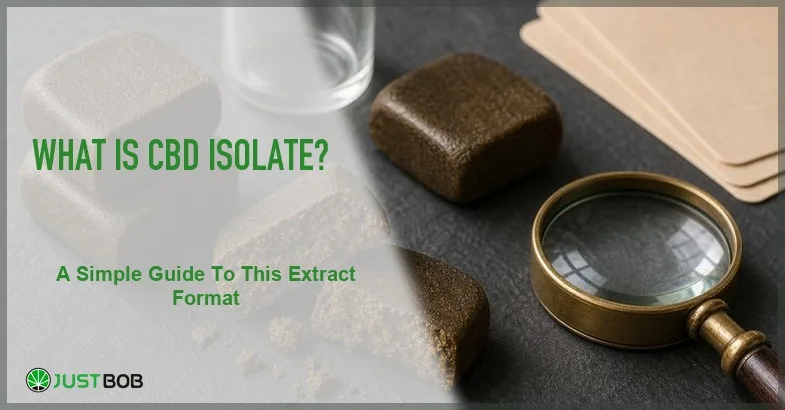
Modified on: 21/07/2026
CBD isolate, explained without the mystery
The word isolate sounds technical, but its meaning is quite straightforward. It refers to a process of separation and refinement, making it easier to understand where CBD isolate fits within the broader family of hemp extracts.
A simple comparison can help. Imagine a box of coloured pencils: a full set offers many colours, while a single pencil represents just one. In the same way, CBD isolate is an extract format focused primarily on cannabidiol (CBD), with most of the other naturally occurring hemp compounds removed during refinement, according to the product specification.
-
 Max CBDAMNESIA CBD BOOST
Glasshouse | CBD<40%
Starting from:FLASH SALE -10%
0,85 €0,75 €/gGrams5 10 20 50 100 200 400 -
Max CBDAK47 CBD BOOSTStarting from: 1,45 €/g
Indoor | CBD<47%
Grams5 10 20 50 100 200 -
Max CBDCHARASStarting from: 0,90 €/g
CBD HASH | CBD<45%
Grams5 10 20 50 100 200 -
JB OIL 25%Starting from: 14,90 €
CBD Oil 25%
At Justbob, all products are manufactured in the European Union, and every commercialised product and production batch undergoes continuous laboratory testing. The corresponding lab reports are available on each product page, allowing customers to verify the CBD content, THC information, batch identity, and other analytical data.
What is CBD isolate?
In simple terms, CBD isolate is a highly refined hemp extract that focuses on cannabidiol (CBD). The term isolate indicates that CBD has been separated from much of the wider chemical profile naturally found in the hemp plant.
However, the name alone should never be the only source of information. A reliable CBD isolate product page should always include batch-specific laboratory analysis, reported CBD values, THC information, and a clear product identity. These documents provide objective confirmation that the product description matches the contents of the batch.
CBD isolate is commonly described as a crystalline or powder-like extract. You may also encounter terms such as CBD crystals, CBD isolate powder, or refined CBD extract. These expressions simply describe the product’s appearance and composition—they are not quality claims or usage instructions. A practical definition is this: CBD isolate is a refined extract in which cannabidiol is the primary component, supported by transparent laboratory documentation rather than marketing claims.
When describing CBD isolate, it’s also useful to distinguish between composition and appearance. Composition refers to the analytical profile reported by the laboratory, including CBD concentration, THC information, and any other listed compounds. Appearance, by contrast, refers to characteristics such as a crystalline, powdery, pale, or granular texture. Keeping these two aspects separate makes the product much easier to understand.
Read also: CBD crystals: what are they and how do they work?
How CBD isolate fits inside the extract family
Extracts are a broader product family that can include different formats, textures, compositions, and visual characteristics. Within this family, CBD isolate represents one of the most refined formats, with the product specification focused primarily on cannabidiol and with many other hemp compounds reduced.
Other extract formats may maintain a wider plant profile. Broad spectrum CBD is generally described as a format containing CBD together with additional hemp compounds, while full spectrum CBD refers to an even broader range of naturally occurring components. These terms should always be read carefully, because the exact composition is defined by the product description and laboratory analysis.
This is why the extract family is better understood as a collection of different formats rather than a ranking system. CBD isolate is not automatically “better” than other extracts. Shatter is not automatically more advanced. Crumble is not automatically more complete. Each format has its own characteristics, terminology, and product identity.
When exploring CBD extracts, the best approach is to consider three elements together: the format, the physical appearance, and the laboratory report. The category explains where the product belongs; the product page explains what makes that specific item unique.
CBD isolate products and product labels
Clear labelling is essential for CBD isolate products. A well-designed product page should help customers understand whether they are looking at isolate, shatter, crumble, crystals, or another extract format. It should also keep two types of information separate: visual description and composition data.
This distinction matters because extract names can sound highly technical. Terms such as shatter, crumble, crystals, and isolate are memorable, but they do not explain everything on their own. Without a clear product description and batch analysis, terminology can create more confusion than clarity.
CBD isolate should therefore be described accurately and without unnecessary exaggeration. A product page can explain that the format is CBD-focused and that other hemp compounds are reduced according to the extraction process. It should not transform those characteristics into promises or universal recommendations.
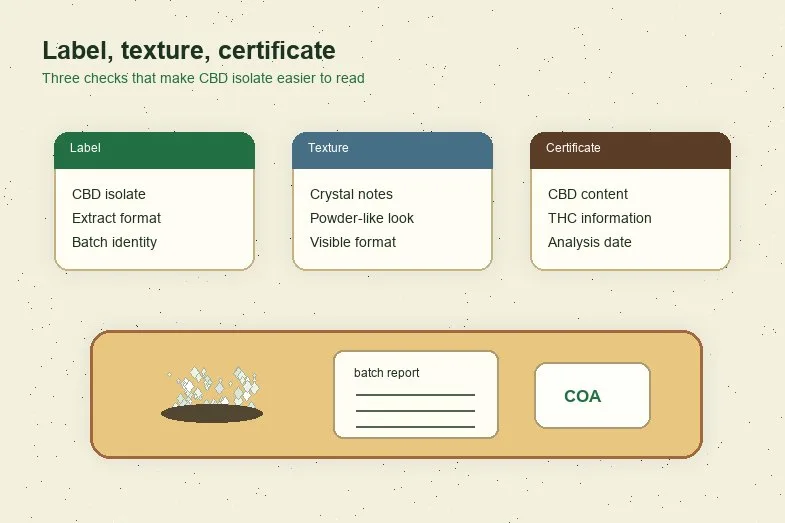
In simple editorial terms: the label identifies the product, the image shows its appearance, and the laboratory report provides the measurable data. Each element has a specific role. Confusion begins when one element is expected to explain everything.
Isolate vs Shatter and Crumble
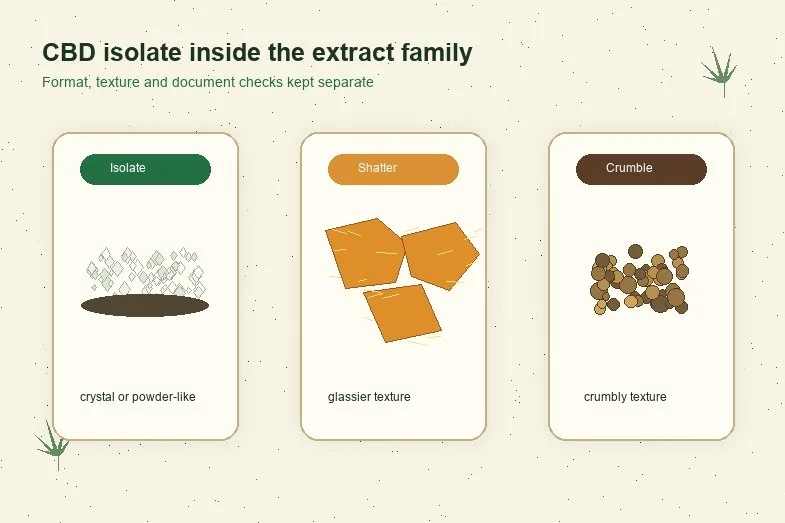
CBD shatter, CBD crumble, and CBD isolate describe different extract formats, each with its own appearance and terminology. Shatter is generally associated with a glassy and brittle texture, while crumble is usually described as having a softer, drier, or more fragmented consistency. CBD isolate, on the other hand, is commonly presented as a crystalline or powder-like format with a composition focused on cannabidiol.
This comparison is useful because it highlights an important distinction: appearance and composition are not the same thing. A glossy extract is not automatically more advanced. A crumbly texture does not necessarily indicate lower refinement. A pale isolate does not automatically answer every question about a product.
A common misunderstanding is to treat extract formats like a ranking system, as if they were medals to win. Extracts are not a hierarchy—they are different formats with different characteristics. Think of them more like a tool drawer: each item has a specific purpose, and a good product page explains what each label describes and what it does not.
For a more detailed comparison of texture and format terminology, a dedicated CBD crumble guide can provide a deeper look at that specific extract type. Here, the key point is understanding CBD isolate: a refined format focused on cannabidiol, where clear product information and laboratory documentation remain essential.
Broad spectrum CBD and CBD oil are different lanes
Broad spectrum CBD and CBD oil often appear alongside CBD isolate in online searches, but they describe different concepts. Broad spectrum refers mainly to composition, while CBD oil usually describes a product format made of an extract combined with a carrier oil. CBD isolate, by contrast, refers to a refined extract format focused on cannabidiol.
The distinction may seem subtle, but it becomes clearer with a simple comparison. Imagine a kitchen shelf: flour, olive oil, and sugar may sit next to each other, but they are not interchangeable ingredients. In the same way, CBD oil, broad spectrum CBD, and CBD isolate can all belong to the wider CBD category while requiring completely different explanations.
A CBD oil product page should typically explain the ingredients, carrier oil, spectrum description, and laboratory analysis. A CBD isolate page should focus on what isolate means, its extract format, physical characteristics, and supporting documentation. Keeping these elements separate helps readers understand the product instead of navigating through one large, unclear block of CBD terminology. Extract terminology becomes much easier to understand when texture and composition are kept separate. Texture describes how a product looks or feels. Composition describes what the laboratory analysis reports. A clear CBD product page should present both pieces of information without confusing one for the other.
For broader cannabinoid context, scientific literature on cannabinoids and terpenes explores CBD as part of the wider range of compounds found in Cannabis sativa.
Why labels and lab reports matter
A product label provides information, but the laboratory report provides verification. A certificate of analysis should identify the batch and show the measured values, allowing customers to compare the product name, description, and analytical profile.
This is particularly important when product pages use terms such as refined, selected, or CBD-focused. These descriptions can help explain a format, but they should always be supported by objective information. Without documentation, terminology alone can create expectations that the data may not confirm.
At Justbob, relevant laboratory analysis is available directly on product pages, allowing customers to connect the product description with the corresponding batch information. This transforms the term CBD isolate from a simple label into a clearly documented product identity. The same principle applies across extracts, CBD oils, and CBD products in general. A well-structured product page should explain what the format is, what the analysis confirms, and what the wording does not claim.
Read also: CBD Flower Lab Report: How to Read a COA – Justbob
What CBD isolate is not
Understanding CBD isolate also means understanding what it does not represent. CBD isolate is not an outcome claim, a shortcut around proper documentation, or a guarantee that one extract format is suitable for everyone. It is simply a specific product format that should always be evaluated through clear information and supporting data.
CBD isolate terminology should also be handled carefully from a legal perspective. A product name or extract definition should not automatically be interpreted as a universal legal statement. Regulations can vary depending on product category, cannabinoid profile, national rules, and current regulatory guidance.
CBD isolate should also not be confused with unrelated cannabinoid trends or speculative terminology. This guide focuses specifically on the meaning of CBD isolate, its format, and how it is documented, because accurate product information starts with clear definitions.
The most useful approach is simple: definition, format, and documentation. It may sound less dramatic, but clarity is exactly what makes extract descriptions useful.
Final thoughts on CBD isolate
CBD isolate is a specific CBD-focused extract format, generally described through a refined composition and a crystal or powder-like appearance. Like any other CBD product, its identity should always be supported by clear product information and laboratory documentation.
Although it belongs to the wider extract family, CBD isolate is not interchangeable with other formats. CBD shatter, CBD crumble, broad spectrum CBD, and CBD oil each have their own characteristics, terminology, and product identity. Understanding the difference simply comes down to three elements: format first, texture second, certificate third.
When these elements are clearly presented, CBD products become much easier to understand. The confusion rarely comes from the extracts themselves—it comes from unclear descriptions or mixed terminology. A transparent product page should help customers know exactly what they are looking at and what information supports it.
🌿 If you want to explore different CBD formats, discover the Justbob collection of CBD flowers, CBD extracts, hash products, CBD oils, and other hemp-derived products. Each product category is presented with detailed information and laboratory documentation to help you better understand the characteristics of the product you choose.
Frequently asked questions about CBD isolate
What is CBD isolate?
CBD isolate is a refined CBD extract format focused on cannabidiol. Product pages should support the label with batch identity, CBD content, THC information and lab documentation.
Is CBD isolate an extract format?
CBD isolate is one type within the wider CBD extracts family. The family can include different formats such as isolate, shatter, crumble and other texture or composition profiles.
How is CBD isolate different from CBD shatter?
CBD isolate is usually described as a crystal or powder-like CBD-focused format, while CBD shatter is usually described through a glassier, more brittle texture. The product label and batch report should clarify the difference.