Modified on: 23/07/2026
The little checklist that makes product pages less noisy
A good hemp product page checklist should feel like having a neat friend beside the screen. It is a short list of what to read on a hemp product page so the important parts stand out from the noise: the label, the category cues, the lot document and the few fields worth a second look. This guide sets out that checklist plainly, as a reading tool, and keeps it on what a page actually shows rather than on anything beyond the product.
-
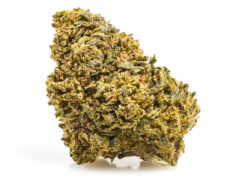
 Max CBDAMNESIA CBD BOOST
Glasshouse | CBD<40%
Starting from:FLASH SALE -10%
0,85 €0,75 €/gGrams5 10 20 50 100 200 400 -
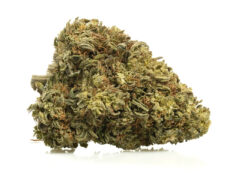
Max CBDAK47 CBD BOOSTStarting from: 1,45 €/g
Indoor | CBD<47%
Grams5 10 20 50 100 200 -
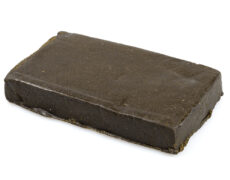
Max CBDCHARASStarting from: 0,90 €/g
CBD HASH | CBD<45%
Grams5 10 20 50 100 200 -
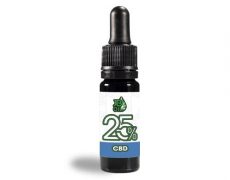
JB OIL 25%Starting from: 14,90 €
CBD Oil 25%
Picture a product page on a desk, scrolled slowly, with a reader checking the plain fields before the pretty ones. That is the honest setting for a checklist. The boring lines, the figures, the lot number, the certificate, are often the most useful, and a checklist simply makes sure they get read rather than skipped.
What a hemp product page checklist covers
A hemp product page checklist covers the fields a reader should look at before anything else: the product name and category, the named figures, the lot number and the certificate of analysis. It is a reading routine, not a ranking, drawn across hemp products from CBD flower to extracts. Read plainly, the checklist is a tool for reading a page clearly, offered for technical, scientific and ornamental products.
Kept at that level, the topic stays steady. A checklist does not judge a product; it makes sure the checkable parts of a page are actually checked. The job of this page is to name those parts and to show how they fit together, so a reader can move through any hemp product page with the same short routine.
Labels and category cues
The label is the first stop. A clear product page names the item, places it in a category, and states the figures: the indicative CBD figure and the THC checked against the threshold. Reading the label and the category together tells a reader what kind of product they are looking at before any other detail.
Category cues matter because they set expectations. A flower, an extract and an oil each read differently, and a page that names its category plainly is easier to trust than one that blurs it. The checklist is most useful when the label and the category agree with the photograph and the description on the page.
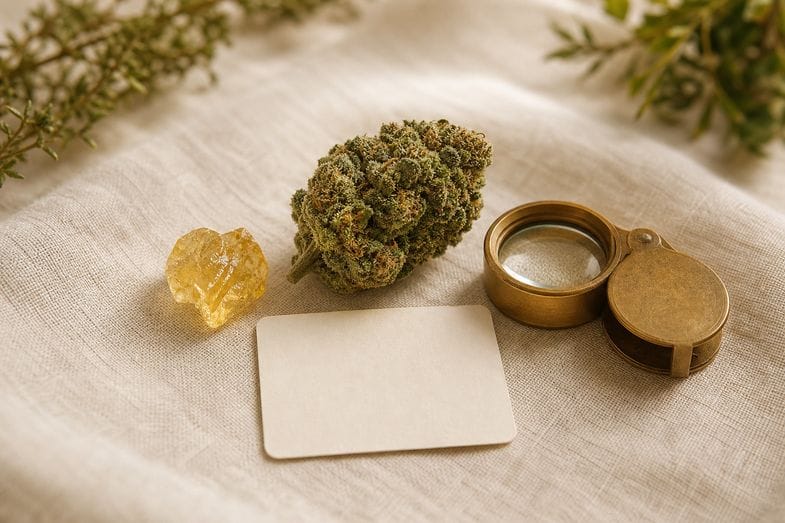
Read also: CBD Flower Product Labels: How To Read Them
Lot documents
The lot document is the heart of the checklist. A certificate of analysis records the measured figures for the batch: the CBD stated as indicative, the THC checked against the 0.3 percent threshold harmonised at European level, and the other compounds tested for the lot. A page that links its certificate lets a reader confirm the label rather than trust it.
This is the field worth slowing down for. A lot number on the label that matches a certificate is the difference between a description and a record. The checklist uses the document as the anchor: every figure on the page should be traceable to the rows that measure it.
A list for what to check before accepting
The habit of checking against a list before accepting something is an old, practical one. In building, a buyer walks a finished property with a snagging list, a plain inventory of things to check and confirm before handover, so nothing is simply assumed. The list turns a vague once-over into a set of definite questions, each with a yes or no.
A product page works on the same plain principle. A hemp product page checklist is the reader’s snagging list: name, category, figures, lot number, certificate, each one checked rather than skimmed. The builder’s list stopped a handover resting on hope; a product checklist stops a reading resting on the prettiest part of the page, which is exactly the point.

Read also: CBD Flower Certificates: What To Read First
Fields worth a second look
A few fields reward a second look. A page that makes a strong claim but links no certificate, or names no lot, leaves a gap a reader should notice; a page that keeps the figures, the lot number and the document together fills it. The point is not suspicion but completeness: a clear page simply has its checkable parts in place.
This is where the framework sits behind the checklist. Our legal hemp note covers the rules these products sit within, and for an official overview of hemp as an EU crop, the European Commission page on hemp is a useful public reference. Both sit outside any single page and help a reader read one in context.
A hemp product page checklist on a Justbob page
On a Justbob product page, the checklist has an easy time: a clear name and category, the named figures stated as indicative, a lot number and the certificate that confirms them. Every commercialised product is analysed and each batch is checked, with the document available on the product page, so each field a reader checks can be traced to the row that records it.
Every product is grown by selected EU hemp partners and sits inside the EU industrial hemp framework, with THC kept at or below the 0.3 percent threshold harmonised at European level. Each one is offered for technical, scientific and ornamental purposes only. Read this way, on a Justbob page a hemp product page checklist is simply a short reading routine, anchored by a document.
Frequently asked questions about a hemp product page checklist
What should a hemp product page checklist include?
A hemp product page checklist should cover the product name and category, the named figures, the lot number and the certificate of analysis for the batch. It is a reading routine that makes the checkable parts of a page stand out: the indicative CBD figure, the THC checked against the 0.3 percent threshold, and the document that records them. Read this way, the checklist is a tool for reading any hemp product page clearly, from flower to extracts, rather than a judgement on any single product.
Why do lot documents matter?
Because the lot document is what turns a description into a record. A certificate of analysis measures the figures for the batch, including the THC reading checked against the 0.3 percent threshold and the CBD stated as indicative. A lot number on the label that matches that certificate lets a reader confirm the page rather than trust it, which is why the document is the anchor of the whole checklist.
Which page fields are useful?
The plain ones. The product name and category place the item; the named figures and lot number record it; the certificate confirms it. A page that keeps these together is easy to read, while one that makes a claim but links no document leaves a gap worth noticing. The checklist simply makes sure the useful, checkable fields are read before the decorative ones.