Modified on: 17/09/2026
CBD Flower Product Labels: How to Read Them in a Minute
A CBD flower label is a small piece of printed text doing a lot of work. Product name, percentage context, batch code, regulatory language, age limit, registered hemp variety: all in the space of a few square centimetres.
This Justbob guide walks through how to read a CBD flower product label in under a minute, line by line and without over-complicating things.
-
 Max CBDAMNESIA CBD BOOSTStarting from: 0,85€/g
Glasshouse | CBD<40%
Grams5 10 20 50 100 200 400 -
Max CBDAK47 CBD BOOSTStarting from: 1,45€/g
Indoor | CBD<47%
Grams5 10 20 50 100 200 -
Max CBDCHARAS
CBD HASH | CBD<45%
Starting from:FLASH SALE -10%
0,90€0,80€/gGrams5 10 20 50 100 200 -
JB OIL 25%Starting from: 14,90€
CBD Oil 25%
The aim is simple: after reading this guide, picking up a hemp flower bag—or checking the same information on the product page—should feel like skimming a familiar form rather than decoding a puzzle.
What CBD flower product labels are built to communicate
A CBD flower label has one main job: connect the physical product with the information provided on the product page and the analytical documentation.
To do that, it typically includes:
- Product name
- Registered hemp variety
- CBD percentage or range
- Batch reference
- Regulatory information
- Intended-use information
- Age restrictions, where applicable
The label is small, so every line has a purpose. It is designed to keep the key information associated with the product as it moves through the supply chain.
For the reader, the label is the bridge between the product shown in the catalogue and the physical product in the package. Learning to read it takes less than a minute and makes it much easier to understand what you are looking at.
Product name and registered variety
The product name on a CBD flower label generally combines the commercial name used to identify the product with the registered hemp variety from which the plant originates. For example, a label might indicate a commercial name followed by a variety such as Finola or Carmagnola CS.
These two pieces of information serve different purposes. The commercial name makes the product easier to recognise and navigate in a catalogue, while the registered variety provides a specific reference to the hemp genetics associated with the product.
For the reader, the variety name is particularly useful because it helps distinguish one product from another and provides context for the plant’s typical cannabinoid and terpene profile.
CBD percentage range and what it represents
The CBD percentage shown on a CBD flower label may be presented as a range or an indicative maximum value. For example, a label could indicate “CBD up to 12%” or “CBD 8–12%”.
This figure should be read as an indication of the product’s expected cannabinoid profile, rather than as a guarantee that every individual flower will contain exactly the same concentration. Hemp is a natural agricultural product, so minor variations between flowers within the same batch are normal. The analytical documentation provides more precise, lot-specific information based on the sample tested.
For the reader, the label percentage is therefore best understood as an at-a-glance reference point. A product labelled “CBD 12–14%” and one labelled “CBD 5–7%” clearly belong to different concentration ranges, while the corresponding laboratory analysis provides the detailed information for the specific batch.
THC threshold language: below 0.3 percent
One of the key pieces of information to look for on a CBD flower label is the THC threshold reference.
You may see wording such as “THC below 0.3%”, “complies with the EU industrial hemp framework”, or a reference to a Cannabis sativa L. variety registered in the European Catalogue. The exact wording can vary depending on the product and market.
The 0.3% threshold is linked to the EU framework for industrial hemp cultivation under Regulation (EU) 2021/2115. The label provides a quick indication, while the analytical document gives the lot-specific laboratory result. For the reader, this is an important line to check when assessing the information provided with a product.
Batch code: the lot identifier
The batch code is one of the most important details on the label and also one of the easiest to overlook.
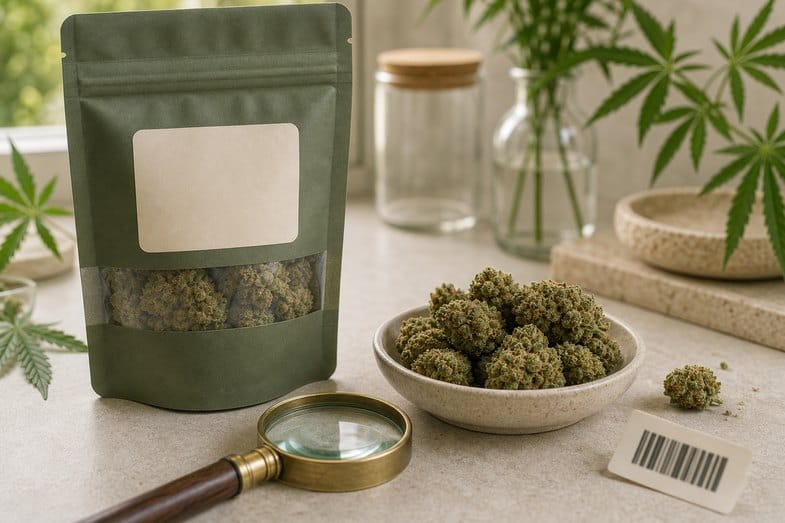
It is usually a short combination of letters and numbers, sometimes printed in a smaller font. Its purpose is straightforward: it links the physical product to a specific production lot and its corresponding analytical documentation. This makes the batch code particularly useful when you want to verify the information on the package against the laboratory report.
A simple rule is worth remembering: if you want to check the analysis, start with the batch number.
Intended use and age limit
CBD flower labels may also include information about the intended use of the product, with wording such as “for technical, scientific or ornamental use”, depending on the applicable market and product positioning.
You may also find an age indication, such as “for adults”, “18+” or “not for sale to minors”. These details form part of the broader information provided alongside the product and should be clearly visible and easy to identify.
When comparing products, these are therefore useful lines to scan alongside the product name, variety, cannabinoid information and batch code. For wider regulatory context on CBD products in official UK guidance, the official UK CBD guidance is a useful reference point.
Storage information and shelf-life
Some CBD flower labels also include practical storage recommendations, such as keeping the product away from direct light and storing it in a cool, dry place.
These instructions are intended to help preserve the product’s characteristics over time. Light, heat and oxygen can affect cannabinoids, terpenes and the overall condition of hemp flowers, so appropriate storage matters.
For the reader, storage instructions are simple but useful: follow the recommendations on the packaging to help maintain the product’s quality throughout its shelf life.
How the label connects to the analytical document
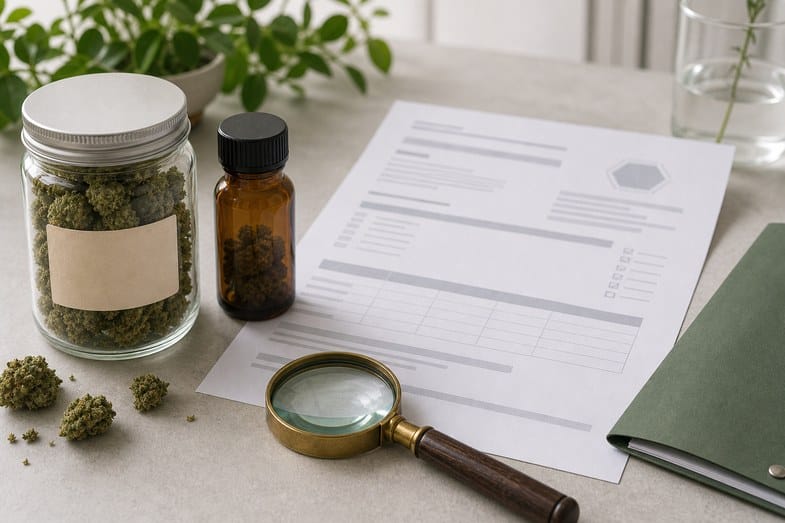
The label and the analytical document should be read together. The label identifies the product, variety and batch, while the corresponding analytical documentation provides more detailed information about the tested cannabinoid profile and other parameters covered by the analysis.
At Justbob, products are subject to laboratory analysis before being commercialised, and the relevant documentation is made available on the corresponding product pages.
The routine is simple:
- Identify the product and variety.
- Check the CBD and THC information.
- Find the batch code.
- Match the batch with the analytical document.
- Check the storage and other product information.
Once you know what each line means, reading a CBD flower label really can take less than a minute. The same approach can then be applied when comparing different products and their accompanying documentation.
Reading a CBD flower label in under a minute
The label-reading routine is short. Scan the product name and registered variety; check the CBD percentage; read the THC information; find the batch code; confirm the intended-use positioning and age limit; note the storage instructions if present.
That is it: five or six key points in less than a minute. After a few times, the routine becomes automatic, making it easier to compare two CBD flower products using the information on the packaging before moving on to the laboratory documentation.
In our view, this is one of the simplest and most useful habits a CBD flower customer can develop. You do not need advanced chemistry knowledge or specialist regulatory expertise. You simply need to know what to look for and, most importantly, where to find it.
Read also: CBD Flower Lab Report: What It Shows and Why It Matters
Compliance-safe wording on labels and pages
Compliance-safe wording on a CBD flower label focuses on describing the product and providing relevant product information, rather than making promises about personal outcomes.
Product name, registered variety, CBD percentage, THC information, intended-use positioning, age limit and batch code are all examples of information that help the reader understand what the product is and how it can be identified.
What should be avoided is language that promises specific effects, suggests personal outcomes or presents the product as an alternative to regulated categories. A good product page should inform the customer without turning descriptive information into unsupported claims.
For the reader, this is a useful distinction. A clear label prioritises identification and transparency over marketing language. When the important information is easy to find, the customer can make a more informed comparison between products.
A closing reading habit for CBD flower product labels
CBD flower labels are among the most compact forms of product information a customer encounters. In just a few lines, they can provide the essential details needed to identify the product, understand its cannabinoid information, trace its batch and connect the physical packaging with the available analytical documentation.
The key is not to memorise every technical term. It is simply to develop a consistent reading order: product name, variety, CBD information, THC information, batch code, intended use, age indication and storage instructions. Once this becomes familiar, checking a label takes only a few seconds and gives you a useful first overview before you explore the product page or laboratory analysis in greater detail.
This habit is particularly useful when browsing different CBD flowers, where product names, varieties and cannabinoid profiles can vary considerably. Taking a moment to check the label helps you move beyond the photograph and the commercial name and focus on the information that actually identifies the product.
If you are ready to put this routine into practice, explore Justbob’s CBD flower collection and take a closer look at the information provided for each product. From the product description to the available batch and analytical details, the aim is to make comparing CBD flowers clear, straightforward and transparent.
🌿 Discover the Justbob CBD flowers collection and find the product that best matches what you are looking for.
Frequently asked questions about CBD flower product labels
What information should a CBD flower product label include?
A CBD flower product label usually includes the product name and registered hemp variety, the CBD percentage range, the THC threshold language (below 0.3 percent in the EU industrial hemp framework), the batch code, the intended-use positioning, the age limit and sometimes storage cues.
Why does the batch code matter on a CBD flower label?
The batch code is the unique identifier that links the physical product to a specific analytical document. Without a batch code, the label cannot be cross-checked against the lab report that confirms the lot-specific values.
How long does it take to read a CBD flower label?
Once the routine is familiar, reading a CBD flower label takes less than a minute. The five or six key lines (product name, variety, CBD range, THC threshold, batch code, intended-use positioning) can be scanned in sequence and compared across products before opening the lab reports.