Modified on: 17/09/2026
Making Sense of Hemp Vocabulary
Cannabis vocabulary can feel like a drawer where botanical names, product labels, old slang and laboratory terms have all been thrown together. CBD flower terminology is simply the process of putting that drawer back in order: flower with flower, cannabinoid with cannabinoid, certificate with certificate.
That matters because the right word prevents the wrong expectation. On JustBob, CBD terminology should stay connected to details that readers can actually verify: hemp flowers, aroma descriptions, cannabinoid profiles, batch numbers and certificates of analysis associated with each product.
-
 Max CBDAMNESIA CBD BOOSTStarting from: 0,85€/g
Glasshouse | CBD<40%
Grams5 10 20 50 100 200 400 -
Max CBDAK47 CBD BOOSTStarting from: 1,45€/g
Indoor | CBD<47%
Grams5 10 20 50 100 200 -
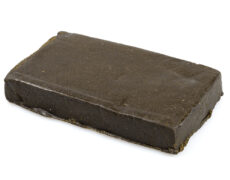
Max CBDCHARAS
CBD HASH | CBD<45%
Starting from:FLASH SALE -10%
0,90€0,80€/gGrams5 10 20 50 100 200 -
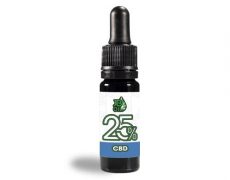
JB OIL 25%Starting from: 14,90€
CBD Oil 25%
This glossary intentionally keeps things simple. No foggy folklore, no exaggerated claims, no mystery fog. Just clear terms for reading a CBD flower page with a sharper eye and a calmer head.
Why CBD flower terminology can be confusing
CBD flower terminology gets confusing because the same plant family appears in many conversations at once. Botanists refers to Cannabis sativa. Retailers describe CBD flowers. Laboratory documents reports focus on cannabinoids, THC levels and batch references. Meanwhile, older slang and informal expressions often adds extra noise and another layer of ambiguity.
In our view, the best glossary does not try to sound impressive or technical for its own sake. Instead, it separates terms according to their purpose. Some describe the plant itself. Others identify the product type. Some refer to aroma and appearance, while others belong exclusively to laboratory testing, quality documentation, and analysis documents.
This distinction is more practical than it may seem. When a product page mentions flower, bud, hemp, CBD, THC, terpenes, trichomes and certificate within a few paragraph, readers benefit from a clear framework that explains how these concepts relate to one another.
Some practical rules helps keeps everything in context:
- Terms describing a product, should lead back to a visible product detail
- Terms describing a measured value, should lead back to a lab report or certificate of analysis
- Terms describing aromas, should remain sensory, descriptive and free from unsupported claims
With that approach, CBD flower terminology becomes less of a puzzle and more like a well-organised label: easy to read, easy to understand and easier to use when comparing products.
Read also: CBD Flower Sensory Profile: Aroma And Look | Justbob
Hemp, cannabis, flower and bud: understanding CBD flower terms
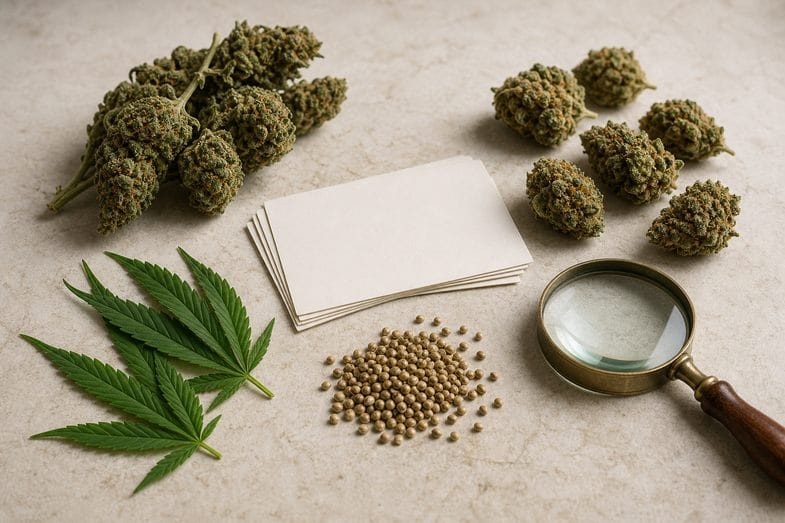
Hemp generally refers to industrial Cannabis sativa L. cultivated and commercialised within regulated hemp contexts. Cannabis, on the other hand, is the broader botanical term used to describe the plant as a whole. Although these words are often used interchangeably in everyday conversations, they do have different meanings when discussing CBD products.
A Flower is the dried flowering part of the hemp plant and is the main product category commonly referred to as CBD flower. Bud is a familiar retail term used to describe an individual flower or a compact portion of it. In simple terms: the product is flower, the individual pieces are often called buds, and the plant being them belongs to the cannabis family.
Small buds are not a different plant material. They are simply smaller flowers. Trim, however, refers to the material removed during flower preparation and should not be confused with whole flowers. Leaves and seeds are separate parts of the plant and should not be described as equivalent to CBD.
The term strain also requires some attention. In everyday cannabis language, strain often refers to a named variety or commercial profile. In botanical contexts, however, terms such as variety, cultivar and genetics have more specific meanings. For consumers, the most useful information is not only the name itself, but the characteristics connected to it: appearance, aroma, cannabinoid profile, and laboratory documentation.
CBD, THC and cannabinoids: key terms explained
CBD (cannabidiol) and THC (tetrahydrocannabinol) are both cannabinoids, meaning naturally occurring compounds found in the cannabis plant. Although these terms are widely known, they are most useful when treated as measurable product information rather than as marketing language. A clear CBD product, should connect cannabinoid terms to verifiable details such as analysis results and product documentation.
CBD is the term that identifies a broad family of products, including CBD flowers, CBD oil, CBD hash, CBD extracts, and other hemp-related products. THC, meanwhile, is mainly discussed in relation to laboratory testing, measured values and regulatory requirements.
The expression cannabinoid profile normally points to a table of measured cannabinoids. It refers to the analytical overview of the cannabinoids detected in a product. Depending on the product and the laboratory analysis, it may include values for CBD, THC, CBG, CBN or other known cannabinoids. A profile is not a mood board, instead it is a document line-up.
A cannabinoid profile is not a description based on impressions or expectations. It is a set of measured values connected to a specific product and batch. This is why a clear cannabinoid table should always include identifiable information, such as the product reference, batch details and corresponding analysis documentation.
Batch numbers, lab reports and certificate of analysis
Among the most important terms in CBD flower terminology are batch, laboratory report and certificate of analysis (COA). These terms describe how a product is identified, tested and documented before reaching costumers.
- A batch, or lot, is a specific group of product.
- A certificate of analysis is a laboratory document that reports the results obtained from testing that material.
- The cannabinoid table included summarises measured values, such as CBD and THC concentrations.
Together, these terms turn a nice-looking product page into something easier to verify. The fields listed in a CBD flower COA give readers a clearer view of how the laboratory information is organised and how it connects to the specific batch being tested. They provide a clearer way to verify product information. A product page becomes more transparent when descriptions are supported by documentation connected to the specific batch being sold.
At Justbob, all commercialised products undergo regular laboratory analyses before being made available to customers. The related analysis documents are available on each commercialised product page, allowing readers to consult the specific information of the interested product. That is our favourite kind of product confidence: not loud, not theatrical, just there. A lot number and a certificate may never win a beauty contest, but they are often the most reassuring details on the page.
Aroma, terpenes and appearance words
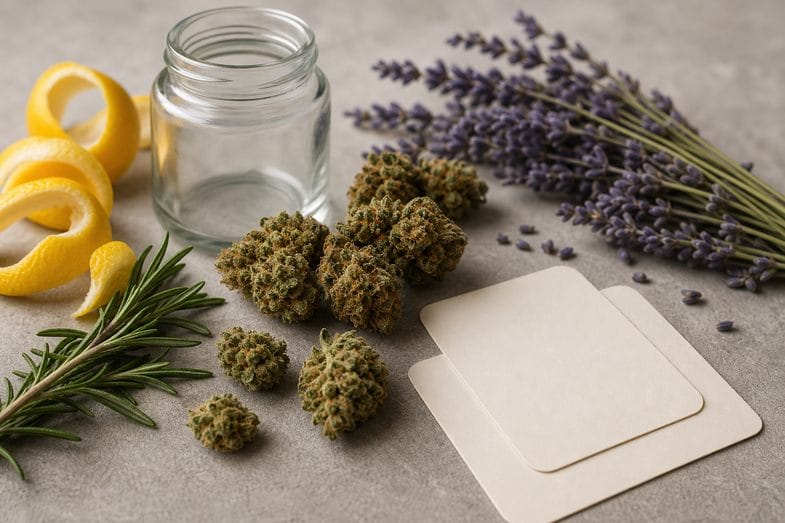
Aroma words are some of the most pleasant parts of a CBD flower page, but they require careful use too. Citrus, earthy, woody, resinous, floral and herbal notes can describe what the nose may recognise in the product profile. They should remain descriptive and should not drift into promises.
Terpenes are aromatic compounds associated with plant scent. Trichomes are tiny resinous structures found on the surface of the flower, where many natural compounds are concentrated. Resin is the sticky botanical material often mentioned when discussing aroma, texture and visual characteristics.
For additional plant-chemistry background, a PubMed Central review on cannabinoids and terpenes provides useful context on why terms such as cannabinoids, terpenes and trichomes frequently appear in Cannabis sativa descriptions.
Appearance terms should remain visual. Compact, airy, resinous, frosty, green, amber and leafy describe characteristics that can be observed. They are useful when combined with clear images and product information. They become less helpful and meaningful when thrown around like trophies and used simply as attractive labels.
Nearby terms: oil, extract, hash and isolate
CBD flower is part of a wider family of hemp.derived products, each with its own terminology and characteristics. Knowing how these terms relate to one another helps create clearer expectations and makes product information easier to navigate.
- CBD flower terminology also overlaps with other CBD product categories. This term refer specifically to the dried flowering parts of hemp plants and are usually describe through terms relayed to appearance, aroma, cannabinoid profile and laboratory documentation.
- CBD oil is a different format from flower and usually includes specific ingredient, a carrier oil and bottle details. The phrase cannabis oil is broader and less precise, so a clear product page should specify exactly what kind of oil is being described. For this product family, the relevant destination is the CBD oil category.
- Carrier oils are the base oils used to dilute and carry cannabinoids in many CBD oil products. Common examples include oils such as hemp seed oil or other plant-based oils, depending on the formulation.
- CBD hash is another related product type. It is built around resin, pressure, density, texture and appearance. It should not be described as if it were simply loose flower presented in a different form. For this product group, the specific reference at Justbob is the CBD hash category.
- CBD extracts, CBD isolate and broad spectrum are terms that naturally belong to conversations about extracts and oils. CBD isolate refers to a format based on a single isolated compound. Broad spectrum generally describes a profile containing multiple hemp compounds without intentionally added THC.
This concepts can be included in a glossary, but they should not shift the focus away from a cannabinoid flower article. Related terms can help readers navigate between different product categories, but every page still needs its own focus.
Words to avoid in CBD flower product descriptions
Not every word belongs in a CBD flower product description. Some expressions come from outdated slang, informal cannabis culture or marketing language, and can create confusion instead of helping readers understand a product. A responsible CBD flower glossary should not build product descriptions around those words. They can attract clicks, but they do not help the reader understand a compliant hemp product. Instead, it should focus on terminology that can be verified: product format, botanical information, aroma descriptions, cannabinoid profiles, batch references and laboratory documents. The goal is not to make descriptions sound more impressive, but to make them more accurate and transparent.
The same principle applies to words that promise and suggest personal effects or individual experiences. A product page should not turn CBD flower terminology into claims about the person reading it. A CBD product description should provide factual information about the product itself, rather than making claims.
The better route is simpler, the most useful product descriptions focus on four simple elements:
- Describe the product: general characteristics.
- Describe the document: the cannabinoid profile and measured values
- Describe the aroma and the appearance: each products has its own characteristics
- Provide the specific laboratory documentation connected to the batch
Understanding Quality in CBD flower terminology
The word quality also deserves a calmer definition, it should be supported by clear information. Quality is not just a marketing adjective: it comes from factors such as reliable EU producers, consistent product details, correct storage information, batch traceability and laboratory analysis documents. It is less glamorous than a slogan, which is exactly why it is more useful.
For CBD products, transparency is more useful than exaggerated descriptions. A product with clear information, a documented cannabinoid profile and available analysis reports gives readers something concrete to evaluate.
A simple rule helps keep CBD flower terminology useful: if a word cannot be connected to something visible, measured or clearly explained, it probably does not belong in the main product description. Some terms may be suitable for educational articles about hemp and CBD culture, but product pages should remain focused on information that customers can verify.
Read also: MCT Carrier Oil In CBD: Label Reading Guide – Justbob
Final CBD flower glossary
Understanding CBD flower terminology becomes easier when every word has a clear role.
- Hemp refers to industrial hemp varieties and the context in which CBD flower products are commonly produced.
- Cannabis identifies the wider plant family.
- CBD flower refers to the dried flowering part of hemp.
- Bud is a common term used to describe an individual flower portion.
- Cannabinoids are natural compounds found in hemp, including CBD and THC.
- A cannabinoid profile shows the measured levels of these compounds in a product.
- Terpenes describe aromatic compounds associated with plant scent.
- Trichomes are resinous structures found on the surface of hemp flowers.
- Resin refers to the botanical material connected with the texture, appearance and aromatic characteristics of the flower.
- A certificate of analysis (COA) is a laboratory document containing measured values.
- A batch or lot number connects those results to a specific product group.
🌿Want to know more about the CBD cannabis products available in our catalog? Visit the Justbob online store.
Frequently asked questions about CBD flower terminology
What does CBD flower terminology include?
CBD flower terminology includes words for the plant, the flower format, cannabinoids, aroma notes, appearance, batch references and certificates of analysis.
Are hemp flower and CBD flower the same term?
They are closely related terms, but not always identical. Hemp flower points to industrial hemp context, while CBD flower usually highlights the CBD-focused product family.
Why should CBD product terms be precise?
Precise terms help readers separate product format, aroma, cannabinoid values and laboratory documentation. That makes a CBD flower page easier to read and easier to verify.