Modified on: 23/07/2026
What MCT Carrier Oil Means On A CBD Oil Label
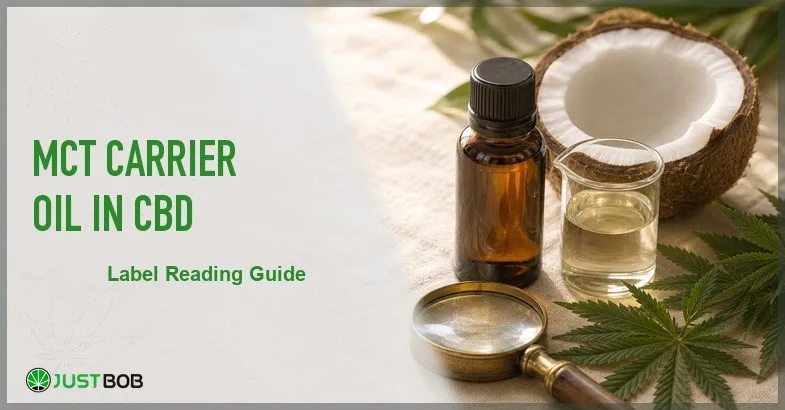
MCT carrier oil is one of the most common components found on a CBD oil bottle, yet the acronym itself rarely gets a full sentence on the front of the label. A reader examining the label panel of a hemp-derived CBD oil will typically find”MCT oil” or “fractionated coconut oil (MCT)” next to the cannabinoid declaration, and the rest of the label assumes the abbreviation is already familiar. This Justbob guide unpacks the MCT acronym and shows what it actually carries onto a CBD oil page.
-
 Max CBDAMNESIA CBD BOOSTStarting from: 0,85€/g
Glasshouse | CBD<40%
Grams5 10 20 50 100 200 400 -
Max CBDAK47 CBD BOOSTStarting from: 1,45€/g
Indoor | CBD<47%
Grams5 10 20 50 100 200 -
Max CBDCHARAS
CBD HASH | CBD<45%
Starting from:FLASH SALE -10%
0,90€0,80€/gGrams5 10 20 50 100 200 -
JB OIL 25%Starting from: 14,90€
CBD Oil 25%
The goal is straightforward label literacy. After a quick read, an MCT mention in a CBD oil label panel should be legible at a glance, and the relationship between the carrier oil and the CBD percentage on the bottle should make sense without needing a chemistry refresher.
MCT: an acronym that points to a fatty acid family
MCT stands for Medium Chain Triglycerides, a family of fats whose fatty acid chains contain between six and twelve carbon atoms. The most well-known members of the family are caprylic acid (C8) and capric acid (C10). Most commercial MCT oils used in CBD formulations are blends that are either enriched in one of these two fatty acids or combine both.
MCT belongs to a broader group of triglycerides that also includes two related categories: SCT (Short Chain Triglycerides), which contain fewer than six carbon atoms and LCT (Long Chain Triglycerides), which contain thirteen or more. Many common plant-based oils fall into the LCT category,while MCT oils represent a more specialised group of fats that has historically been used for technical, industrial and now cannabinoid-carrier purposes.
Read also: CBD Flower Legal Framework: The Rules Behind The Label
The two main MCT carrier oils on a CBD bottle
When a CBD label simply lists “MCT oil” as the carrier, the oil usually comes from one of two main sources. The most common is fractionated coconut oil, which is produced by removing the long-chain acid fraction from regular coconut oil. This process creates a clear, odourless liquid that is naturally rich in C8 and C10 fatty acids.
The second major source is palm kernel oil, which can undergo a similar fractionation process to produce an MCT oil with a comparable fatty acid profile.
Product labels often specify the exact source and composition. Terms such as “fractionated coconut oil (MCT)” and “coconut derived C8 MCT oil” describe a coconut-based carrier, while “C8/C10 MCT” refers to a blend containing both of the main medium-chain fatty acids. By checking the ingredient panel, consumers can usually identify the type of MCT oil used in a CBD product within a few seconds.
What MCT brings to a CBD oil formula
MCT acts as a carrier oil for the cannabinoid fraction in CBD products. Cannabinoids extracted from industrial hemp are lipophilic compounds, meaning they dissolve readily in fats. By blending the cannabinoid extract with MCT oil, manufacturers obtain a uniform liquid that can be accurately measured for cannabinoid concentration per millilitre, filled into small amber bottles, and stored under standard conditions.
The MCT character also affects how the bottle reads visually. A clean MCT carrier is essentially colourless and odourless, which lets the cannabinoid concentration register cleanly on the label without an underlying tone or colour signal from the carrier itself. Some MCT-based CBD oils therefore appear clear or very pale amber; others appear deeper amber, depending on the cannabinoid extract loaded into the carrier.
A note on consistency: MCT oil stays liquid at room temperature, which gives the bottle predictable handling characteristics. Standard coconut oil (which is mostly LCT plus some MCT) tends to solidify below around 24 Celsius. A fractionated MCT oil avoids that behaviour, which is one of the reasons it became a standard carrier for hemp-derived liquid products.
For a broader look at how the carrier oil, bottle format, label information and supporting documentation come together in a CBD product, see our guide to CBD oil packaging notes and label checks.
How MCT appears in the formula declaration
In a CBD oil formula declaration, MCT may appear under different names. Some labels list it simply as “MCT oil“; others use “fractionated coconut oil“; others use the chemical name “caprylic/capric triglyceride“; while some combine these terms, for example “fractionated coconut oil (MCT, C8/C10)“.
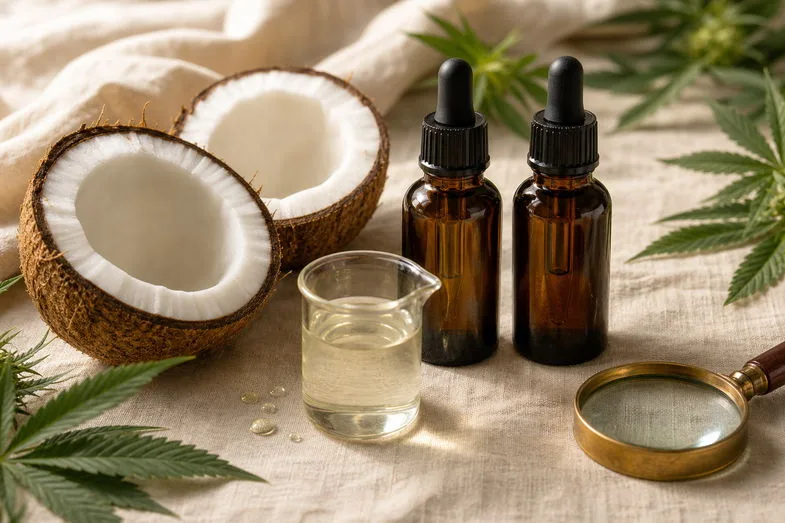
All of these wordings all refer to the same fatty acid family. Readers do not need to memorise every variation. Recognising any of these terms as an indication of the MCT carrier is sufficient.
The cannabinoid declaration on the bottle appears alongside whichever wording is used on the label, and the stated percentage generally refers to the cannabinoid concentration in the MCT-cannabinoid blend.
Looking at the lot certificate alongside the label
The carrier oil is part of the lot record that accompanies a CBD oil bottle. A lot certificate of analysis usually breaks down the cannabinoid panel (CBD, THC, CBG, CBN, and often several acids) while listing the carrier composition separately. For an MCT-based CBD oil, the carrier line will usually read “MCT oil” or “fractionated coconut oil” alongside the rest of the panel.
Where the certificate provides additional carrier oil details, it may also include list the C8 and C10 percentages within the MCT composition. A 60/40 C8/C10 split and an 80/20 split appear differently on the document, even though both refer to an MCT carrier. Readers interested in the carrier composition can usually find this information in the certificate, where the laboratory has reported the specific breakdown.
Our interpretation is that the carrier oil panel serves as a supporting line alongside the cannabinoid panel. The cannabinoid line tells the reader how much CBD or CBG is present in the bottle; the MCT line tells the reader what the cannabinoid is contained in. Together, these two lines provide a complete picture of the formula.
A useful companion article focusing on the lot-document side is CBD Oil Lab Testing: What a Certificate Can Tell You, which complements this one for readers interested in the analytical document behind the carrier-and-cannabinoid interpretation.
A short history of fatty acid chemistry
The MCT acronym is part of a much older scientific tradition. Michel Eugène Chevreul, the French chemist who lived from 1786 to 1889, published foundational research on fats in his volumes Recherches chimiques sur les corps gras d’origine animale between 1813 and 1823. His work identified the major fatty acids and how they connect with glycerol to form the triglyceride structures that the MCT acronym now referes to.
Chevreul’s research established the foundation for nearly two centuries of lipid chemistry that followed, including the distinction between short, medium and long fatty acid chains that the MCT acronym condenses into three letters. A 2026 CBD oil bottle listing “fractionated coconut oil (MCT, C8/C10)” in the formula declaration is connected to this nineteenth-century scientific foundation.
For a label reader, this historical context gives the MCT mention a much longer background than the acronym itself might suggest. The three letters may appear small on the bottle, but they represent more than two hundred years of fatty acid chemistry.
Reading the carrier oil percentage on a CBD bottle
A standard CBD oil bottle lists a cannabinoid percentage (for example “5 percent CBD” or “10 percent CBD”) alongside the carrier oil declaration. That percentage describes the CBD content relative to the total volume of the bottle, which means the remaining volume is primarily the MCT carrier, along with small amounts of other minor components if they are included in the fomula.
For a 10-millilitre bottle containing 10 percent CBD, approximately 9 millilitres of the volume would be MCT carrier, while 1 millilitre is cannabinoid concentrate. The exact ration depends on the formula, but the overall proportion gives the reader a clear indication of how much of the bottle consists of the carrier oil. A reader comparing two bottles with the same cannabinoid percentage and similar volumes is essentially comparing two MCT-based formulas with the same stated cannabinoid load.
The carrier oil percentage also plays a role in shelf-life and storage. A clean MCT carrier maintains its properties well over time, which is why CBD oil bottles commonly display a long shelf life and simple storage instructions (such as keeping the bottle in a cool, dark cupboard) on the label.
How Justbob handles MCT and other carrier oils
Justbob carries out constant analyses on all commercialised products and on every batch. The relevant documents are available inside each commercialised product page, allowing readers who want to verify the cannabinoid breakdown, THC threshold compliance, or carrier oil composition for a specific lot to access the certificate of analysis directly from the catalog.
The carrier oil declaration on a Justbob CBD oil bottle appears alongside the cannabinoid panel in the certificate. Together, these two elements describe the same lot from two different perspectives: the bottle provides the visible product information, while the document provides the laboratory analysis. Readers can cross-check both before making a decision, with the complete information available within the catalog.
The wider framework behind this process is the EU industrial hemp catalogue, with THC maintained below the 0.3% threshold harmonised at European level. The MCT carrier is the vehicle; the registered hemp variety is the source of the cannabinoid load; and the certificate of analysis is the document that completes the chain of verification.
Read also: CBD Oil Ingredients: What Is Usually Inside the Bottle
Compliance-safe wording on MCT-based CBD oil pages
Compliance-safe wording for an MCT-based CBD oil page remains purely descriptive. “10 percent CBD oil in fractionated coconut MCT carrier (C8/C10), 10 ml bottle, certified by lot” describes the product. “Premium MCT-CBD formula with lifestyle promise” describes the marketing language behind it. The first helps the reader understand the product; the second introduces the type of wording that can bring a page under regulatory review.
Hemp-derived CBD oils sold within the EU industrial hemp framework are presented for technical, scientific, and ornamental purposes only.
The MCT carrier declaration, the cannabinoid percentage, and the lot certificate are part of the catalog vocabulary. They are not instructions, not claims of benefits, and not substitutes for other regulated product categories.
The principle is straightforward. If the MCT mention helps a reader understand what the bottle contains, the acronym is being used as label vocabulary. If the wording encourages the reader to take action with the product, the page has moved beyond a descriptive framework.
A short label-reading routine for an MCT-based CBD oil
Reading an MCT-based CBD oil label is a simple verification process. First, identify the cannabinoid percentage on the front label (5 percent, 10 percent, 15 percent); then locate the carrier oil declaration on the label panel (MCT, fractionated coconut oil, caprylic/capric triglyceride). Check the bottle volume (10 ml, 30 ml), locate the lot number and certificate reference, and open the certificate of analysis to confirm the cannabinoid breakdown and THC threshold compliance. Once the carrier oil terminology is familiar, the entire process can be completed in under a minute.
🌿 If you are looking for MCT-based CBD oils with clear product information, batch documentation, and accessible certificate of analysis details, visit Justbob to explore the available formulations and review the relevant product documentation directly from the catalog.
Frequently asked questions about mct carrier oil in cbd
What does MCT stand for on a CBD oil label?
MCT stands for Medium Chain Triglycerides, a family of fats whose molecules carry between six and twelve carbon atoms on the fatty acid backbone. On a CBD oil bottle, the MCT carrier is usually fractionated coconut oil or a coconut-derived C8/C10 blend that holds the cannabinoid concentrate.
Why is MCT used as a carrier oil for CBD?
MCT acts as a vehicle for the cannabinoid fraction extracted from industrial hemp. The cannabinoids are lipophilic molecules that dissolve well in fats, and dissolving them in MCT gives a homogeneous, colourless and largely odourless liquid that holds a stable cannabinoid content over a long shelf life.
What is the difference between fractionated coconut oil and standard coconut oil?
Fractionated coconut oil is produced by separating out the long-chain fraction of standard coconut oil, leaving mostly the C8 and C10 fatty acid chains. The result stays liquid at room temperature and reads as colourless on the bottle, while standard coconut oil contains a larger long-chain fraction and tends to solidify below around 24 Celsius.