Modified on: 25/07/2026
Is CBD Flower Legal? Understanding the Regulatory Framework
Legal pages often begin with bold claims or oversimplified answers. This one starts smaller, and honestly better: CBD flower regulations are best understood as a legal framework rather than a simple yes-or-no question. A framework tells you which pieces matter, where to look, and why a one-line answer can quickly become outdated.
That is the whole point of understanding the legal framework surrounding CBD flowers. It is not a shortcut for every country, every product or future regulatory change. It is a way to approach the topic without getting lost in outdated online information, forum discussions or confident statements that no longer reflect the current legal landscape.
-
 Max CBDAMNESIA CBD BOOST
Glasshouse | CBD<40%
Starting from:FLASH SALE -10%
0,85 €0,75 €/gGrams5 10 20 50 100 200 400 -
Max CBDAK47 CBD BOOSTStarting from: 1,45 €/g
Indoor | CBD<47%
Grams5 10 20 50 100 200 -
Max CBDCHARASStarting from: 0,90 €/g
CBD HASH | CBD<45%
Grams5 10 20 50 100 200 -
JB OIL 25%Starting from: 14,90 €
CBD Oil 25%
At Justbob, all CBD flower products are produced within the European Union. All commercialised products and every production batch are analysed on an ongoing basis, with the relevant laboratory documentation available on each product page. These analyses allow customers to verify the product’s identity, batch information, cannabinoid profile and THC compliance, providing transparent and objective information. They are not a guarantee of compliance with every national regulation, but they are an essential part of a transparent and well-documented product page.
Why CBD flower legality is not a one-line answer
The question Is CBD flower legal? sounds simple. In practice, it hides several smaller questions. Which country are we talking about? Is the page referring to cultivation, import, commercialisation, lab analysis, THC threshold, plant variety, flowers, extracts or finished products? Is the rule national, EU-wide, or only related to agriculture?
This is why a careful article should avoid the oversimplified version of legality. You know the kind: bold statements, absolute certainty and no indication of the source date. It may look clear, but it is rarely useful for understanding compliance. CBD flower sits at the meeting point of hemp farming rules, cannabinoid controls, product documentation and national interpretations.
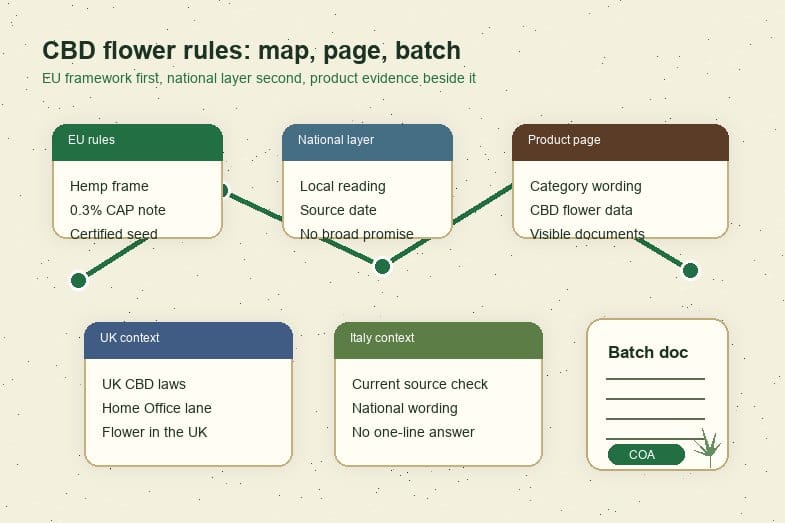
A better approach is to think of the topic as a regulatory map. The EU provides part of the framework for industrial hemp. National authorities then add their own conditions, limits and enforcement practices. Product pages add batch data and composition information. Each layer provides an answer to a different regulatory question. That distinction helps readers interpret information more accurately. It also protects the page from suggesting that a lab result, a variety name or a THC number alone can answer every legal question.
Read also: Is CBD flower legal in the UK? Here’s the answer – Justbob
EU hemp rules and certified varieties
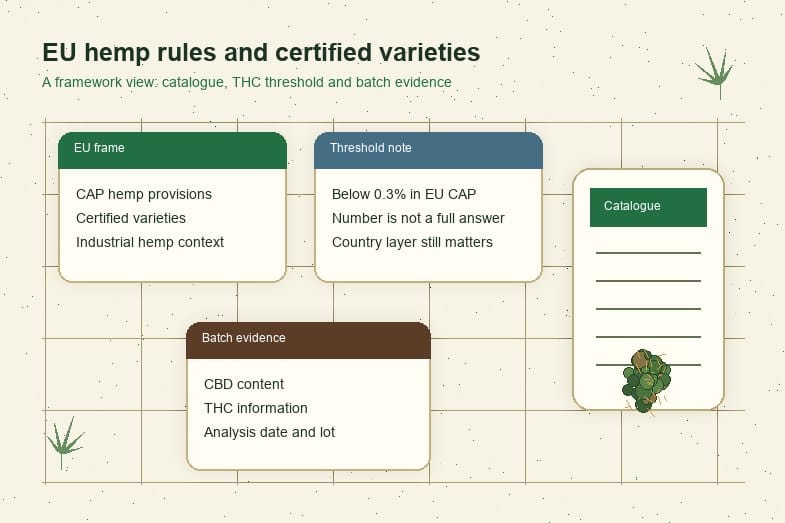
The EU hemp rules begin with agriculture, not with a commercial claim. The European Commission hemp page explains hemp through the Common Agricultural Policy, low THC levels and industrial applications. Under that framework, hemp farmers must work with certified seed varieties listed in the EU common catalogue, and the relevant THC threshold for CAP support is currently set at 0.3% or below.
The EU plant variety catalogue is the administrative foundation behind many references to hemp varieties. It is not glamorous. It is closer to a library catalogue for plant varieties. However, this official classification system plays an important role in organising the agricultural framework for industrial hemp. Still, certified variety does not mean that everything is automatically permitted everywhere. It means the plant variety belongs to a recognised agricultural framework. A careful legal analysis has to keep these two concepts separate: agricultural eligibility is one thing, national product rules are another.
In other words, a variety can belong to an EU hemp framework and still require a country-by-country assessment before anyone makes a public claim about a flower product. The legal status of CBD flower depends not only on the plant itself, but also on how the product is classified and regulated in each specific market.
THC threshold and laboratory documentation
THC threshold language is useful, but it is often interpreted too broadly. In the EU hemp farming context, the Commission page points to the 0.3% THC threshold for relevant agricultural provisions. Some national systems or older documents may still refer to different thresholds, and the UK industrial hemp policy has historically used 0.2% THC terminology in relation to cultivation rules. That is why a product page should not simply display a THC figure and present it as the complete legal answer. A legal threshold is not always the same thing as a regulatory classification or product compliance assessment. A laboratory report can show measured values for a specific batch. However, it does not replace the legal framework applicable in a specific country and at a specific moment.
For CBD flower, laboratory documentation should help establish product identity and composition. Batch number, test date, cannabinoid profile and THC information all matter. When a product page shows these details clearly, the reader can evaluate the product based on documented information rather than relying only on appearance or marketing descriptions.
That is also why Justbob keeps laboratory analysis documentation available inside each product page. The point is not presentation alone. The point is traceability, repeated checks and a clear connection between the product description and the corresponding batch information.
National rules and evolving interpretations
he EUDA cannabis laws FAQ, updated on 21 April 2026, is useful because it shows how quickly national cannabis-related policies can become complex. Even when the discussion starts from hemp, individual country regulations and interpretations remain important.
This is the part many older online articles get wrong. They find one threshold, one court decision or one general statement, then present it as a universal solution. But law rarely behaves like a single key. It is closer to a framework made of several layers, each requiring its own interpretation. For CBD flowers, national differences may involve classification, THC limits, import rules, retail interpretation, enforcement priorities, permitted plant parts or the way authorities assess cannabinoid content. A short article cannot replace a current review of the applicable national rules. It can, however, teach the reader which elements need checking.
That is the purpose of this guide: to explain the different factors involved, without suggesting that one single rule can automatically answer every legal question.
Where UK CBD laws fit in
Many people’s searches ask whether CBD flower is legal in the UK. That does not mean this article should become a duplicate of the dedicated UK legal guide. The more useful approach is to explain how UK rules fit within the broader regulatory picture.
In the UK, the Home Office language around cannabis, CBD and controlled cannabinoids follows a separate national framework. It discusses licensing, controlled cannabinoids, exempt-product criteria and industrial hemp policy. The phrase “legal in the UK” therefore needs careful context. It should never be reduced to the assumption that “CBD exists, therefore all CBD flower products are permitted“.
The same caution applies to flower in the UK. An industrial hemp cultivation licence does not automatically answer questions about retail availability or product classification. A threshold such as 0.2% THC may appear in cultivation policy, but that does not turn every CBD hemp flower listing into a simple legal conclusion. That is why the internal UK article is the better place for detailed country-specific information. This page keeps the map visible: EU frame, national layer, product documentation and the importance of checking current sources.
Novel food status is a separate regulatory area
Another common mix-up is novel food status. The FSA CBD guidance, updated on 1 May 2026, mainly concerns CBD extracts, isolates and products to which CBD is added as an ingredient. That area is particularly relevant for CBD oils and other extract-based product categories, but it should not be used as a general answer for every CBD flower question.
The phrase “novel food status” can be useful when the article explains its specific scope and limitations. It becomes confusing when it is used to avoid the flower-specific questions: plant part, national rules, THC information, cannabinoid profile and product documentation.
A reader should come away with a simple distinction. CBD oil, CBD extracts and CBD isolate-based products may raise novel food questions in certain markets. CBD flower involves a different regulatory discussion, including hemp classification, plant material, THC information, national interpretation and documentation.
Keeping these regulatory areas separate helps readers find clearer answers and avoids applying rules from one product category to another without the necessary context.
What a product page should never over-promise
A CBD flower page should never promise that one label can answer every regulatory question. It should not say “legal everywhere”. It should not turn CBD content into a general statement of legality in every country. It should not make a lab report sound like a complete legal guarantee.
What should it do instead?
- Show the product clearly.
- Name the category carefully.
- Provide relevant batch documentation.
- Keep THC information visible.
- Avoid unsupported quality claims or exaggerated marketing language.
- Link to a current framework guide when the reader needs additional regulatory context.
This is where tone matters. A careful product page does not need to sound uncertain or defensive. It just needs to sound informed and transparent. There is a pleasant confidence in saying, “here are the product details, here is the batch documentation, and here is the wider regulatory context.” No trumpet required. When browsing CBD flower, that is the useful pattern to look for: product description first, documentation alongside it, and legal language kept clear, balanced and accurate.
How to read current CBD flower pages
Start with the product itself. Is it described as CBD flower or another hemp format? Does the page show the strain name, CBD level, THC information and available batch analysis? Are the photos realistic and representative of the product being offered?
Then read the surrounding framework. EU hemp rules can explain the agricultural side. National pages can explain country-specific interpretation. Lab analysis can explain measured composition. Each source provides useful information, but none of them should be expected to replace the others.
For example, a CBD flower page can show that a batch has been analysed. That is important. But the reader still needs the relevant national context, especially when comparing the EU framework with country-specific rules in places such as the UK or Italy. Regulatory understanding comes from combining product information, documentation and the applicable legal framework.
Read also: Marijuana legislation in the UK – Justbob
Final notes on the CBD flower legal framework
The framework is best read as a practical checklist, not a slogan. Certified hemp variety, THC threshold, lab documentation, product category, national regulations and source date all matter. If a page gives only one of those pieces and asks you to trust the rest, be reasonably cautious. If it gives several pieces and explains what each one can and cannot prove, that provides a much clearer basis for understanding the information.
The main takeaway is simple: boring clarity wins. A current source, a visible batch report and a modest sentence beat a dramatic guarantee every time.
At Justbob, we believe transparency starts with clear product information. Our CBD flower pages include detailed descriptions, batch-related documentation and relevant analysis information, helping customers explore products through verified details rather than assumptions.
🌿 Discover the Justbob CBD flower collection and explore our products with a clearer view of their characteristics, documentation and regulatory context.
Frequently asked questions about the CBD flower legal framework
What is the CBD flower legal framework?
The CBD flower legal framework is the set of source categories that shape how CBD flower is discussed: EU hemp rules, certified varieties, THC threshold, lab documentation, product category and national interpretation.
Are EU hemp rules the same in every country?
No. EU hemp rules give an agricultural frame, but EU countries and non-EU countries can have different national rules, interpretations and product conditions. Current local sources still matter.
Why do CBD flower articles need current sources?
CBD flower articles need current sources because hemp, cannabinoid and national product rules can change. A page that was reasonable in one year can be outdated later.