Modified on: 25/07/2026
Why the CBD Question in Italy Needs Careful Wording
Source check: May 11, 2026. This article provides editorial information and should not be considered legal advice.
Italy is the kind of topic where an old CBD article can age quickly. A single legal change can turn a confident paragraph into a museum piece, and Italy has had exactly that kind of fast-moving hemp debate. For that reason, the useful question is not only “Is CBD legal in Italy?”, but also “Which CBD product, under which rule, and according to which current source?”
This guide takes a cautious approach to CBD in Italy for readers who keep finding old cannabis light articles, outdated threshold summaries, and travel-style answers that sound far too neat. The better habit is to slow down: separate the European Union hemp framework from Italian national rules, then check the product category before making assumptions.
-
 Max CBDAMNESIA CBD BOOSTStarting from: 0,85 €/g
Glasshouse | CBD<40%
Grams5 10 20 50 100 200 400 -
Max CBDAK47 CBD BOOST
Indoor | CBD<47%
Starting from:HALLOWEEN SALE -10%
1,45 €1,30 €/gGrams5 10 20 50 100 200 -
Max CBDCHARAS
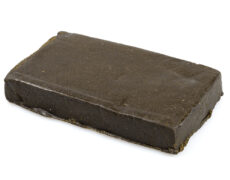
CBD HASH | CBD<45%
Starting from:HALLOWEEN SALE -10%
0,90 €0,80 €/gGrams5 10 20 50 100 200 -
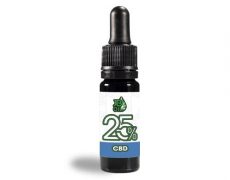
JB OIL 25%Starting from: 14,90 €
CBD Oil 25%
The short version is deliberately careful. CBD in Italy should not be read as a simple green-light issue. Current Italian rules concerning hemp inflorescences and products derived from them became much stricter in 2025, and the situation is still the subject of legal challenges. A lab report can clarify a product’s composition, but it cannot replace country-specific legal checks.
At Justbob, all commercialised products and their batches are analysed regularly, and the relevant lab documentation is available on each product page. That supports transparency regarding product identity, CBD content, and batch details. It does not turn an Italy-specific legal question into a permission slip, which is exactly why this article uses cautious wording.
Short answer: is CBD legal in Italy?
The safest editorial answer is: it depends on the product category, and many broad old answers are now unreliable. Is CBD legal in Italy as a general molecule question? That is too abstract to be useful. Is a specific CBD product allowed for retail sale, transport or delivery under the latest Italian rules? That is the real question, and it needs current sources.
Older CBD in Italy guides often focused on THC thresholds. You may still see phrases such as less than 0.2 THC, low THC, cannabis light or legal cannabis used as if they solve everything. They do not. A threshold can be relevant to cultivation or to the European Union hemp framework, but it is not the whole answer for commercial products. The current risk is that search results mix different topics together: industrial hemp cultivation, CBD oil, hemp flowers, cannabis light, cosmetics, food-related rules and country-specific enforcement. They may all contain the word CBD, but they do not live in the same legal drawer.
In our view, the cleanest reading is the least dramatic one. Read CBD in Italy as a source-check topic, not as a slogan. If a page promises a one-line answer without dates, product categories or official references, the page is probably doing more confidence than research.
Read also: THC and CBD: all the differences – Justbob
European Union hemp rules in brief
The European Union hemp framework provides important context, but it is not the whole story. The European Commission hemp page explains that hemp grown for Common Agricultural Policy (CAP) support must come from certified seed varieties listed in the EU Common Catalogue and must have a THC content below 0.3%.
That 0.3% threshold is useful because it explains the agricultural framework for hemp. It also explains why older articles can be confusing: some Italy-focused pages repeated the less than 0.2% THC threshold from older national cultivation discussions, while newer EU agricultural references use the 0.3% limit in the CAP context. But EU law and national law are not the same thing. The European Union can define an agricultural framework for hemp and establish market principles, while each country may still have its own rules, interpretations, and enforcement priorities. That is why the statement CBD is legal in Europe is not enough to answer whether it is legal in Italy.
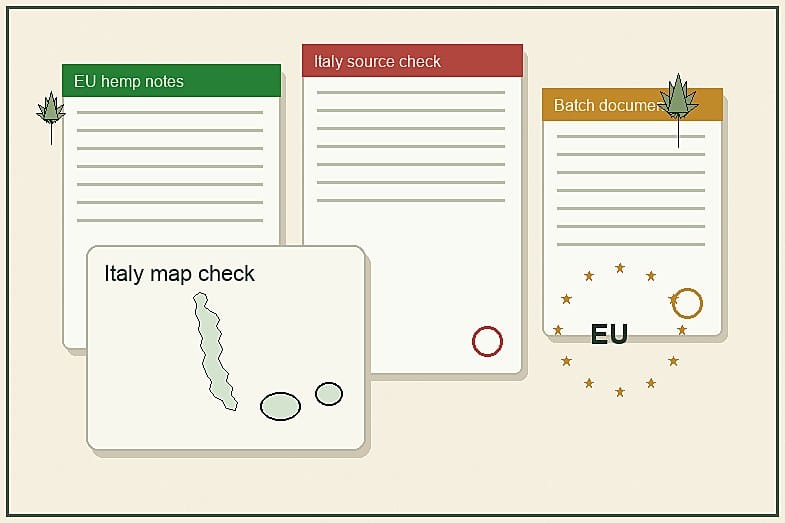
Think of it like a map legend. The European Union gives you the symbols and boundaries. Italy still provides the street signs, and sometimes those street signs change before the old tourist map is updated.
The Italy CBD ban and Article 18
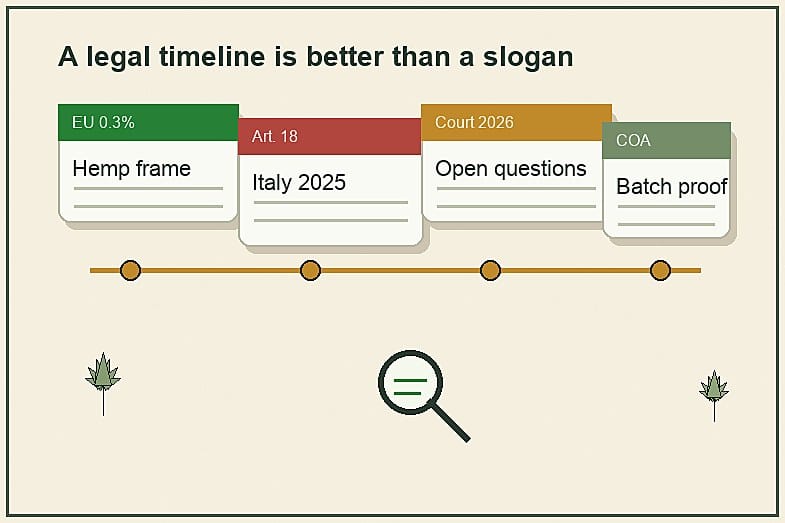
The major recent change is Article 18 of Decree-Law No. 48 of April 11, 2025, later converted into Law No. 80 of June 9, 2025. The official text published in the Gazzetta Ufficiale shows that Article 18 amended Law No. 242 of 2016 on industrial hemp.
The practical point for readers is this: Article 18 moved the Italian debate away from a discussion focused solely on THC thresholds and toward a stricter regulatory approach covering prohibited commercial activities involving hemp inflorescences and products containing or derived from them, including extracts, resins, and oils. That is why a recent article about the Italian CBD ban can sound more restrictive than an older cannabis light article. The focus is no longer just on whether a plant variety is certified or whether its THC content is low.
The wording of the 2025 change matters because it addresses the commercial distribution and sale of hemp inflorescences and products linked to them. Official updates issued after the 2025 change continue to emphasise caution. For general readers, the safest approach is to assume Article 18 remains relevant unless a later official source clearly indicates otherwise. That does not make the topic simple. It makes it even more important to avoid casual advice. CBD products, CBD oil, and cannabis light labels may look familiar from older retail pages, but familiar vocabulary is not the same as the current legal framework.
Legal challenges: Why the story is still evolving?
Italy’s CBD law is not only stricter than many older articles suggest. It is also the subject of ongoing legal challenges. In 2026, the Italian Constitutional Court included a constitutional question concerning Article 18 on its docket, raising issues related to urgency, proportionality, and the European Union’s free movement principles.
That means the story has two layers. One layer is the rule currently in force. The other is the ongoing legal challenge to that rule. A careful article should not pretend that the challenge has already erased the rule, nor should it pretend that the rule is free from legal dispute. This is also why old cannabis light guides can be misleading. For several years, “cannabis light” became a common phrase in Italy, almost like its own retail category. People got used to seeing it in headlines, storefronts, and quick guides. Then the legal framework changed, and the phrase continued to circulate online like a label from the previous season.
The EUDA FAQ on cannabis laws in Europe, last revised on April 21, 2026, is useful for one simple reason: it reminds readers that cannabis-related rules in Europe are changing rapidly. That warning is especially relevant to Italy.
CBD oil, hemp flowers, hashish: Why product categories do matter?
Product category matters because different CBD-related topics do not follow the same rules. A question about hemp cultivation is not the same as one about CBD oil. A question about hemp flowers is not the same as one about cosmetics. Likewise, a question about an old cannabis light shop is not the same as a question about a batch certificate.
For readers comparing hemp flowers as a product category, the Italian context requires particular attention, because the 2025 rules focus specifically on inflorescences and products containing or derived from them. A product page can explain a product’s appearance, CBD content, THC levels, batch identity, and supporting documentation. It can provide transparency about the product, but it cannot override national restrictions.
CBD oil creates another common source of confusion. The fact that a product contains CBD does not automatically mean that every CBD product has the same legal status. The wording of Article 18 also covers oils derived from hemp inflorescences, which means that composition, source material, and the current legal framework all matter. A label can provide useful product information, but it cannot be considered a legal conclusion.
This is where documentation still plays an important role. A certificate of analysis (COA) shows what was tested, when it was tested, and which batch the results refer to. It can report CBD content, THC levels, batch references, and laboratory identity. However, laboratory documentation does not determine whether a product is permitted in every country or how authorities may interpret the rules.
In the JustBob catalogue, that distinction is important. Product documentation helps readers understand what a product contains and how it was analysed, while national rules determine what can be marketed, shipped, or handled in a specific jurisdiction. Confusing these two roles is one of the main reasons many older articles about CBD in Italy have become outdated.
How to read CBD in Italy critically
Start with the date. If a CBD in Italy article was written before April 2025 and has not been updated, read it carefully. It may still provide useful background, but it could miss the most significant legal developments.
Then check the product category. Does the page discuss hemp cultivation, inflorescences, CBD oil, extracts, cosmetics, food-related products, or general cannabis legislation? If it treats all of them as though they belonged to the same category, the article is probably oversimplifying the legal framework.
Next, look for official sources. A reliable legal information guide should refer to the Gazzetta Ufficiale, European Union sources, or other official institutional documents. A paragraph that simply states “CBD is legal in Italy” without identifying the relevant legislation is not a source. It is merely an unsupported claim.
Finally, pay attention to the verbs. Terms such as import, transport, trade, market, deliver, sell, and possess carry specific legal meanings. They are not interchangeable. If legislation distinguishes between different types of conduct, a good article should reflect those distinctions instead of reducing them to a simple shopping message.
Read also: New Regulations on the Sale of CBD Flowers in Austria
Final practical reading notes
Is CBD legal in Italy? The most reliable answer is a cautious one: do not rely on a generic “yes.” Italy currently has restrictive rules governing hemp inflorescences and products containing or derived from them, while EU hemp rules and ongoing legal challenges provide important context that many older guides do not reflect.
CBD in Italy therefore requires a careful reading habit. Check the date, check the official source, check the product category, and check whether the article is trying to sell certainty where the law is still evolving.
The little editorial rule is simple: do not let a familiar phrase like “cannabis light” do too much work. It may have been a common Italian expression, but today it has to be considered alongside Article 18, Law No. 80/2025, the EU framework, and ongoing court challenges. That is a crowded table, and every document needs its own chair.
For readers, the best approach is to treat legal articles as maps, not tickets. A good map helps you understand the terrain. It does not give permission to cross every border it shows.
🌿 If you want to explore CBD products supported by transparent product information, visit the Justbob catalogue. Each product page includes batch-specific documentation to help you understand its composition and laboratory analysis. You can also discover the CBD hash collection, where detailed product information and testing documentation are available to support informed comparisons.
Frequently asked questions about CBD in Italy
Is CBD legal in Italy?
There is no safe one-word answer. As of the 11 May 2026 source check, Italy has strict rules affecting hemp inflorescences and products containing or derived from them. Always check current official sources and product category details.
Is cannabis light still allowed in Italy?
Older cannabis light articles can be misleading. Article 18 of Decree-Law No. 48/2025, converted by Law No. 80/2025, introduced strict restrictions around hemp inflorescences and related products. The rule is also being challenged, so current sources matter.
Why do EU hemp rules and Italian rules differ?
EU hemp rules set an agricultural framework, including certified seed varieties and a 0.3% THC threshold for CAP support. Italian national rules can add country-specific restrictions, so EU context alone does not answer every Italy CBD question.