
Modified on: 17/09/2026
Reading CBD Extract Texture on a Product Page
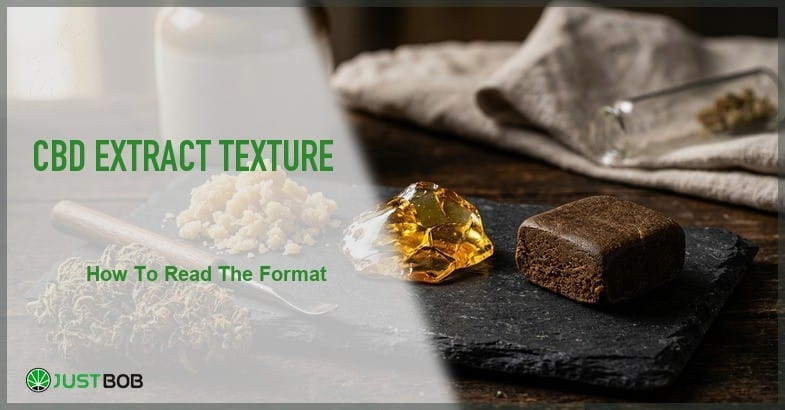
A CBD extract is where hemp plant material is presented in a more concentrated format, and texture is one of the first things a reader can observe on a product page. Shatter, crumble, wax and crystals each have different visual characteristics, while composite formats such as Moonrock and Icerock add an extra layer to the appearance.
This Justbob guide explains how to read CBD extract texture format by format, and how to compare what you see in the product photo with the label and the available analytical documentation.
-
 Max CBDAMNESIA CBD BOOSTStarting from: 0,85€/g
Glasshouse | CBD<40%
Grams5 10 20 50 100 200 400 -
Max CBDAK47 CBD BOOSTStarting from: 1,45€/g
Indoor | CBD<47%
Grams5 10 20 50 100 200 -
Max CBDCHARAS
CBD HASH | CBD<45%
Starting from:FLASH SALE -10%
0,90€0,80€/gGrams5 10 20 50 100 200 -
JB OIL 25%Starting from: 14,90€
CBD Oil 25%
The aim is practical: after browsing a few product pages, the difference between shatter, crumble, wax and crystals should become easy to recognise at a glance, while the label and analytical document provide the additional information needed to verify the specific product and batch.
What “CBD extract texture” describes on a product page
When a product page describes CBD extract texture, it is generally referring to four simple characteristics:
- Format: shatter, crumble, wax, crystals or a composite format
- Surface: glossy, matte, granular or slightly sticky
- Consistency: brittle, firm, soft or pliable
- Colour: golden, amber, pale yellow, off-white or translucent
This vocabulary gives the reader a practical way to compare products before opening the analytical documentation.
In our view, the most useful product descriptions focus on characteristics that can actually be observed. A description such as “translucent amber shatter with a brittle appearance” tells the reader something about the product. Generic expressions such as “premium-grade flagship extract” provide much less useful information.
Read also: CBD Hash Texture: What Soft, Firm and Crumbly Can Mean
The main CBD extract formats and their typical textures
CBD extracts can appear in several recognisable formats. Among the most commonly encountered are crystals, shatter, crumble and wax, while products such as Moonrock and Icerock combine a CBD flower base with an extract or crystalline coating.
Each format has its own visual signature:
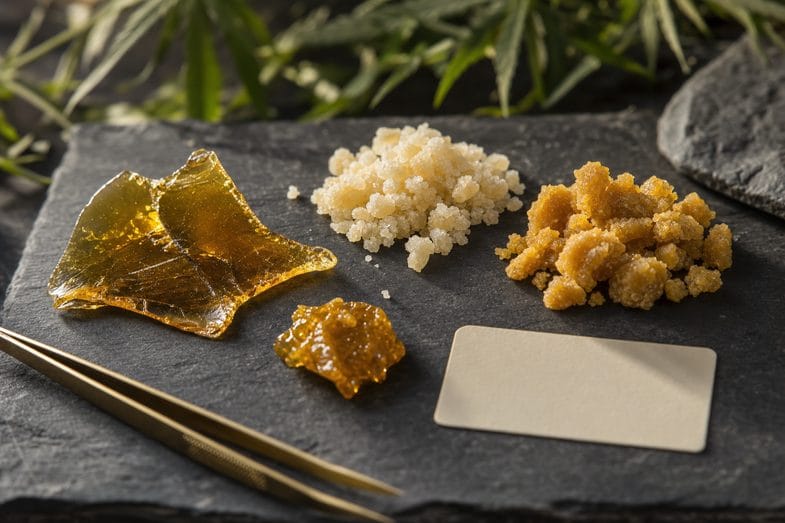
- Crystals: fine, granular or powder-like, usually pale or off-white
- Shatter: thin, translucent and glossy, with a brittle appearance
- Crumble: dry, matte and friable, with an irregular texture
- Wax: softer and more cohesive, generally with a pale yellow or amber appearance
- Moonrock: a dense flower covered with a visible extract layer
- Icerock: a flower covered with a more crystalline, frost-like layer
For the reader, the basic rule is simple: the product name, description and photograph should tell a consistent story.
Crystals: a granular, isolated format
CBD crystals, also known as isolate in some product contexts, typically have a fine granular or powder-like appearance. They can range from bright white to slightly off-white or translucent depending on the product and processing.
Their most obvious characteristic is the dry, crystalline texture. Unlike an extract such as shatter, crystals do not normally present as a continuous sheet or cohesive block.
For the reader, the photograph provides the first clue: a clearly granular, pale product is visually consistent with a crystalline format. The analytical document then provides the more precise cannabinoid information for the specific batch.
Shatter: thin, glossy, and brittle
Shatter is named for its characteristic brittle appearance and consistency. On a product page, it is typically shown as a thin sheet or fragment with a smooth, glass-like surface.
The colour can range from pale golden tones to deeper amber, depending on the product. The surface is generally glossy rather than matte, making shatter relatively easy to distinguish from crumble or wax.
For the reader, the key visual cues are translucency, a smooth surface and a thin, brittle-looking structure. If the photograph shows a completely different texture, it is worth checking the product description and label before drawing conclusions.
Crumble and Wax: matte and softer formats
Crumble and wax can look similar at first glance, but their textures are usually different. Crumble tends to appear dry, irregular and friable, often breaking into smaller pieces or grains. Wax is generally softer and more cohesive, with a consistency that can resemble a soft paste or compact block.
Both can appear in shades ranging from pale yellow to amber, depending on the product.
For the reader, the most useful check is straightforward: does the photograph match the format named on the page? A dry, broken-looking product fits the visual language of crumble, while a softer and more cohesive appearance is more consistent with wax.
Moonrock and Icerock: layered composite formats
Moonrock and Icerock are different from a conventional extract because they are composite products built around a CBD flower base.
A moonrock generally has a visibly denser appearance than standard flower because of the extract layer surrounding the bud. Icerock can have a particularly distinctive crystalline or frost-like outer appearance when CBD crystals form the visible coating.
The important point for the reader is to recognise the product as a combination of a flower component and an extract component, rather than interpreting the entire appearance as the texture of a single extract. Where the product documentation provides separate information for the components, the reader can use that information to understand the composition more precisely.

How texture connects to the production method
Texture does not appear by accident. The final appearance of an extract is influenced by the production and processing methods used to obtain it.
Different processes and finishing techniques can result in different physical formats, from granular crystals to thin shatter or softer crumble and wax. Composite products such as moonrock and icerock involve an additional step in which an extract or crystalline material is applied to a flower base.
The starting hemp variety also provides part of the plant’s underlying cannabinoid and terpene profile, while subsequent processing influences the final format.
For the reader, however, it is important not to over-interpret the format name. Texture can tell you what the product looks like and provide clues about its format, but the analytical document remains the appropriate reference for the specific cannabinoid composition of a batch.
Reading the surface cues alongside the label
A CBD extract product page is easiest to understand when the photograph, format name, texture description and product information all correspond.
A quick cross-check can therefore look like this:
- Read the format name.
- Look at the product photograph.
- Compare the visible texture with the description.
- Check the label and CBD information.
- Open the analytical document for the lot-specific data.
This takes only a few seconds and can help identify obvious inconsistencies before you look more closely at the technical documentation.
The photograph is useful for understanding appearance. The label helps identify the product and batch. The analytical document provides the laboratory data.
A short history of laboratory extraction methods
The science behind modern hemp extraction and analysis has developed over decades. High-performance liquid chromatography (HPLC) became an important analytical technique during the second half of the 20th century and is now widely used to determine cannabinoid profiles.
Extraction technologies have also evolved significantly, including the development and industrial use of supercritical CO₂ extraction, which became an important technique for extracting compounds from plant material. These technologies represent two different sides of the process: extraction produces a concentrated material, while laboratory analysis measures and characterises its composition.
For the reader, this history provides useful context. The small product page you see today is supported by analytical and processing technologies that have developed through decades of scientific research and refinement.
Read also: CBD crystals: what are they and how do they work? – Justbob
How Justbob documents extract texture and quality
At Justbob, commercialised products and batches are subject to laboratory analysis, with the relevant documentation made available through the corresponding product pages.
This allows the reader to move from the visual information to the technical information: first identifying the format and appearance, then checking the product details and finally consulting the documentation associated with the relevant batch.
The same reading method can be applied across different formats. The texture helps identify what you are looking at; the label identifies the product and batch; the analytical document provides the detailed laboratory information.
In our view, this consistency is what makes a product page genuinely useful. A photograph can attract attention, but clear product information and supporting documentation give the reader something concrete to check. For wider regulatory context, the European Commission page on hemp is a useful entry point. It links to the EU industrial hemp catalogue and the Regulation (EU) 2021/2115 framework, which sit behind every registered variety that enters the CBD extract supply chain.
A closing reading habit for CBD extract texture
Reading CBD extract texture is a quick and practical habit. Start with the format name, look at the photograph, identify the main surface and consistency cues, and then check that the description matches what you can actually see. From there, use the label to confirm the product information and batch, and consult the analytical document when you want the lot-specific laboratory data.
Once this routine becomes familiar, it works across crystals, shatter, crumble, wax, moonrock and icerock without requiring specialist knowledge. More importantly, it helps separate three different types of information: what the product looks like, what the label identifies, and what the laboratory documentation confirms.
If you want to put this approach into practice, explore Justbob’s CBD extract collection and compare the different formats, textures and product information available. Take a closer look at the photographs, read the descriptions and check the supporting documentation for the products that interest you.
🌿Discover Justbob CBD products and explore the different varieties available in our shop.
Frequently asked questions about CBD extract texture
What does CBD extract texture refer to?
CBD extract texture refers to the visible and tactile character of the concentrated hemp product. It usually combines the format name (shatter, crumble, wax, crystals, moonrock), the surface impression (matte, glossy, granular, sticky), the consistency and the colour profile.
How does the format relate to the production method?
The format is largely shaped by the production method. Crystals come from longer post-processing; shatter from controlled solvent extraction with precise purging; crumble and wax from similar paths with different agitation; moonrock and icerock from flower-and-extract assembly.
Why does the texture vary between lots of the same format?
Texture varies with the starting variety, the extraction parameters and the storage conditions. The format name names the family; the lot-specific texture and cannabinoid profile come from the registered variety, the production setup and the analytical document for that batch.