Modified on: 27/08/2026
Reading Sweet Berry CBD flower through aroma and labels
Sweet Berry is is a familiar aroma reference in CBD flower catalogs. The phrase describe a fruity, slightly sweet scent profile that is more pronounced in some registered hemp varieties than others.
This Justbob guide explore Sweet Berry CBD flower as an aroma descriptor, looking at the label cues, terpene chemistry, and analytical data associated with the individual lot.
-
 Max CBDAMNESIA CBD BOOST
Glasshouse | CBD<40%
Starting from:FLASH SALE -10%
0,85€0,75€/gGrams5 10 20 50 100 200 400 -
Max CBDAK47 CBD BOOSTStarting from: 1,45€/g
Indoor | CBD<47%
Grams5 10 20 50 100 200 -
Max CBDCHARASStarting from: 0,90€/g
CBD HASH | CBD<45%
Grams5 10 20 50 100 200 -
JB OIL 25%Starting from: 14,90€
CBD Oil 25%
The goal is to make the “berry” shorthand easier to understand. By the end, it should be easier to tell the difference between a berry-forward hemp flower and one with more citrusy or herbal notes simply by reading the product page.
What “sweet berry CBD flower” describes on a product page
Sweet Berry CBD flower is a catalog term used to describe hemp flower with a fruity, slightly sweet aroma reminiscent of red berries, blueberries, or blackcurrants. The description belongs to the aroma profile of the product: it tells you what the flower smells like, rather than what effects it may have.
For a CBD flower reader, the Sweet Berry label provides a quick way to identify a specific aroma family. These fruity notes comes from a distinctive combination of terpenes produced by the plant in measurable amounts. When a lab report includes a terpene profile, it can provide a more detailed picture of the compounds behind the aroma.
In our view, the most useful Sweet Berry product pages keep the description specific and grounded in observation. A phrase such as “fruity aroma with red-berry and blueberry notes, supported by a myrcene-led terpene profile” tells the reader something concrete about the product. An overly sweet berry slogan, by contrast, is more marketing language than aroma description.
Read also: CBD Flower Aroma Profile: How to Read Scent Notes
The berry aroma family: myrcene, linalool, caryophyllene
The berry aroma family in hemp is shaped from a small set of monoterpenes and sesquiterpenes. Myrcene contributes a soft, ripe-fruit character. It is also found in mangoes, where it contributes to their aroma, and in hops, where it plays a role in their resinous scent. Linalool adds a floral, slightly sweet note that sits somewhere between berry and lavender, while caryophyllene brings a peppery, mildly spicy undertone that helps balance the sweeter notes.
In berry-leaning hemp varieties, myrcene is often one of the dominant terpenes and can exceed one percent of the total terpene content when this value is reported in the lab analysis. Linalool and caryophyllene generally appear as secondary components, while smaller amounts of pinene, limonene and humulene can add further layers to the overall aroma profile.
A useful way to read a product page is to combine the descriptive name with the terpene profile. “Sweet Berry, myrcene-dominant with a secondary linalool note” gives the reader a much clearer picture than “Sweet Berry” on its own, because it connects the aroma description to the underlying chemistry.
The visible signature of a berry-leaning bud
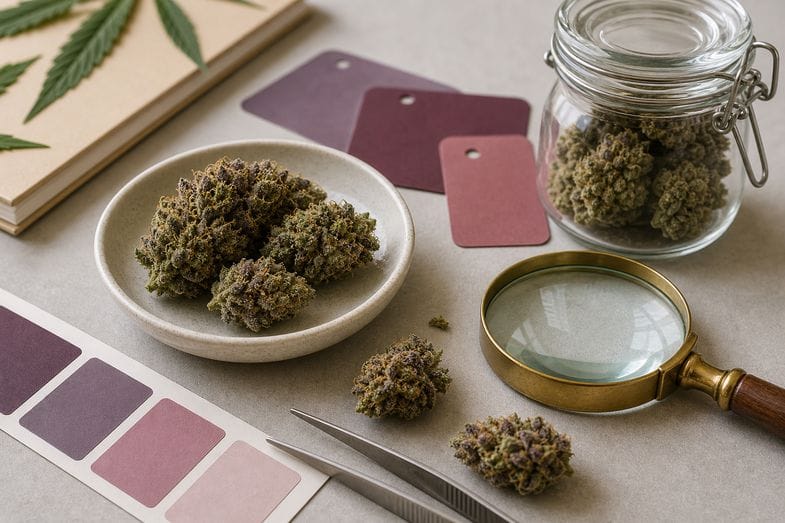
The visible signature of a Sweet Berry hemp flower comes from a combination of bud structure, colour and trichome development. The colour often leans toward a deeper green, with amber and, in some varieties, subtle purple hues. Dense trichome coverage can give the surface a frosted, glossy appearance, with the resin glands catching the light across the bud.
Colour is another useful part of the visual profile. Some berry-leaning varieties develop purple tones during the final stages of flowering, particularly when temperatures drop during the last weeks before harvest. The genetics determine whether the plant has the potential to develop these colours, while growing conditions influence how strongly that potential is expressed.
In catalog photographs, a well-developed Sweet Berry bud will often show a compact structure, visible amber pistils, frosted sugar leaves around the inflorescence, and a layered colour pattern that distinguishes it from a uniformly green hemp flower.
If you want to explore how berry, citrus, floral and other aroma profiles fit into the wider hemp vocabulary, our article about CBD flower aroma families offers a broader overview of the main scent categories and the terpene profiles behind them.
How berry aroma varies across registered hemp varieties
The berry aroma profile is not exclusive to a single hemp variety. Several registered varieties listed in the EU Common Catalogue of Varieties of Agricultural Plant Species can show fruity or berry-leaning aroma profiles, often with myrcene playing a prominent role in the terpene composition. The genetic potential for a berry-like aroma is therefore spread across different varieties rather than concentrated in a single entry.
A registered variety with a berry-leaning baseline can produce a more pronounced Sweet Berry profile in one harvest and a subtler expression in another. Factors such as growing conditions, curing, humidity and storage can all influence how the aroma develops and is ultimately perceived. The variety provides the genetic framework, while the individual lot determines its specific expression.
For this reason, product pages that pair the Sweet Berry label with the registered variety name provide a more informative picture. A description such as “Sweet Berry CBD flower based on Carmagnola CS, with a myrcene-led terpene profile and purple-leaning colour” connects the sensory description and catalog photograph with the underlying variety.
Reading the terpene profile on the lab report
When a lot’s analytical report includes a terpene profile, the Sweet Berry reference can be assessed against measurable data. A relatively high myrcene content can support a fruity, ripe character, while the presence of linalool may add floral and sweet nuances. By contrast, a strongly limonene-dominant profile is more likely to point toward a citrusy aroma direction.
The cross-check is straightforward: open the lab report, find the terpene table, and look at the main compounds and their reported percentages. A berry-leaning profile may feature myrcene prominently, with linalool or caryophyllene among the secondary terpenes, while smaller amounts of pinene or humulene can contribute additional nuances. The exact balance, however, can vary from lot to lot.
When a Sweet Berry product page does not provide a terpene profile, the descriptive name remains useful as a sensory reference, but it cannot be independently checked against the analytical data. In that case, the aroma description provides the shortcut; the laboratory report would provide the supporting layer.

Sweet Berry on the label: what the line conveys
A Sweet Berry CBD flower label typically includes several key pieces of information: the commercial name, the registered hemp variety, the CBD content or range, and the applicable THC threshold.
The commercial name, “Sweet Berry,” works as a quick aroma cue, while the variety name connects the product to the relevant EU catalogue. The CBD content and THC threshold, meanwhile, provide the regulatory and analytical context.
The four elements tell a more complete story when they are consistent with one another. For example, a label reading “Sweet Berry CBD Flower, Carmagnola CS, CBD 12–14%, THC below 0.3%” gives the reader a clear overview of the product, its variety and its declared cannabinoid profile. If the variety name, CBD content or applicable THC threshold is missing, the information is less complete and harder to cross-check.
The label is also where the production batch or lot reference usually appears. This batch code is particularly useful because it links the product on the shelf or catalog page to the analytical report for that specific lot, allowing the information on the label to be checked against the corresponding laboratory data.
Cross-checking berry aroma against the analytical document
The analytical document for a Sweet Berry lot is where the description can be checked against measurable data. The cannabinoid profile provides the reported CBD content and THC level, while the terpene profile, when available, can help support the myrcene-led character associated with the berry reference. The variety name should also be consistent across the analytical document and the product label.
Once you know what to look for, this cross-check only takes a few minutes. A Sweet Berry lot with myrcene reported above 0.8 to 1.0% of dry plant material and CBD in the 10 to 14 % range is a standard, well-documented expression of the variety. Differences in either direction do not necessarily indicate a problem; they can simply reflect the natural variation between individual batches.
A useful way to read the product page is to consider the label, photograph and analytical document together. The label provides the commercial name and variety, the photograph gives visual clues about the flower, and the analytical document adds the measurable chemical data. Taken together, these three layers give the reader a more complete and verifiable picture of a Sweet Berry product.
A short history of terpene chemistry in hemp
The chemistry behind hemp aroma sits within a much longer history of cannabinoid and plant research. Roger Adams isolated cannabidiol from hemp extract in 1940 and carried out some of the earliest detailed structural work on the compound, helping lay the foundations for modern cannabinoid chemistry. In 1963, Raphael Mechoulam and his team at the Hebrew University of Jerusalem clarified the structure of CBD, while subsequent research helped establish the chemical basis for the cannabinoids studied today.
The study of terpenes in hemp and other aromatic plants developed alongside advances in analytical chemistry throughout the twentieth century. Techniques such as gas chromatography made it increasingly possible to separate and identify the volatile compounds responsible for plant aromas. Today, these analytical methods are used to profile compounds such as myrcene, linalool, caryophyllene, pinene and limonene in hemp and CBD flower samples.
A Sweet Berry lot in 2026 therefore sits within a much longer analytical tradition. The cannabinoid and terpene data found on modern laboratory reports are the result of decades of progress in chemical analysis and chromatographic techniques, providing a measurable layer behind the sensory descriptions used on today’s CBD flower catalogs.
For a closer look at how terpenes shape the aroma language used to describe CBD flowers, see our guide to CBD flower terpenes, which explores the main compounds and the scent profiles they help create.
Sweet Berry vs other aroma families: citrus, herbal, woody
Sweet Berry is just one of several recognisable aroma families used to describe hemp flowers in product catalogs. Citrus-leaning varieties are often associated with limonene, while herbal profiles may feature pinene alongside compounds such as cineole. Woody or earthy profiles can show more prominent humulene and caryophyllene, whereas berry-leaning flowers often have myrcene among their main terpenes, sometimes accompanied by linalool.
Knowing these broad aroma families gives readers a useful mental map for navigating CBD flower descriptions. The name used on the product page suggests the general aroma direction, the terpene profile in the lab report provides the chemical context, and the variety name connects the product back to the relevant EU Common Catalogue.
This aroma map can also help when comparing different lots of the same variety. Two Sweet Berry batches may share the same overall profile while differing slightly in intensity or character. One might come across as fresher and more berry-like, while another may have a deeper, jammy or candied quality, with factors such as curing and storage influencing how the aroma develops over time.
How Justbob documents berry aroma profiles
Justbob carries out constant analyses on all commercialised products and on every batch, with the relevant documentation available directly on each product page. This means that readers who want to check the cannabinoid profile or, where available, the terpene composition of a Sweet Berry lot can consult the certificate of analysis without leaving the catalog.
The same approach can then be applied across different products. Once a reader has learned how to cross-check a Sweet Berry lot against its analytical document, the process can be repeated for other lots, varieties and aroma families. The catalog follows a consistent structure, while the analytical documentation provides the data needed to look beyond the descriptive language used on the product page.
In our view, it is the combination of these three layers that makes Sweet Berry a useful aroma reference rather than simply a marketing label. The product page introduces the sensory profile, the analytical document provides the supporting chemical data, and the variety name connects the product to the broader EU industrial hemp framework.
Compliance-safe wording on berry aroma references
When describing Sweet Berry CBD flower, compliance-friendly language should remain factual, descriptive and grounded in the available product data. A phrase such as “Sweet Berry CBD flower based on a myrcene-led variety, with linalool as a secondary terpene and a documented fruity aroma profile” describes the product and its characteristics. By contrast, wording such as “irresistibly delicious berry CBD flower” is promotional and adds a subjective marketing claim.
CBD flower products are presented for technical, scientific and ornamental purposes, in accordance with the applicable regulatory framework for industrial hemp. Within that context, references to the berry aroma, terpene composition and reported cannabinoid percentages describe the product and its analytical profile. They should not be presented as instructions, claimed benefits or suggestions for use.
A simple test can help keep the wording on the right side of the line: if the berry reference describes the aroma and connects it to the available analytical data, it is serving an informational purpose. If the wording encourages the reader to use the product or suggests a particular outcome, it moves beyond a purely descriptive approach and requires greater care from a compliance perspective.
A closing reading habit for Sweet Berry CBD flower
Once you know what to look for, reading a Sweet Berry CBD flower page takes less than a minute. Start with the descriptive name, then check the registered variety and look at the main terpene profile, paying particular attention to myrcene and linalool. Next, review the declared CBD content and applicable THC threshold, and finally open the analytical document for the specific lot to compare the product description with the reported values.
This simple routine makes it easier to move from the sensory description to the underlying product data without overcomplicating the reading.
🌿And if you want to explore the profile for yourself, you can take a closer look at Justbob’s Sweet Berry CBD flower and review the available product and analytical information.
Frequently asked questions about sweet berry cbd flower
What does Sweet Berry CBD flower refer to?
Sweet Berry CBD flower refers to a hemp flower with a fruity, slightly sweet aroma profile that recalls red berries, blueberries or blackcurrants. The reference describes the scent family, not a use; the underlying chemistry usually shows myrcene as the dominant terpene with linalool as a secondary note.
Which terpenes drive the berry aroma in hemp?
The berry aroma family in hemp draws mainly on myrcene (the ripe-fruit base, shared with mangoes and hops), linalool (the floral-sweet edge, shared with lavender) and caryophyllene (a peppery undertone). Pinene, limonene and humulene appear as smaller secondary notes that complete the profile.
How can a reader verify the Sweet Berry reference on the page?
The verification routine pairs the catalog photo, the variety name on the label and the analytical document for the lot. A myrcene fraction above one percent on the terpene profile, paired with a registered hemp variety from the EU Common Catalogue, supports the Sweet Berry reference with documented chemistry.