Modified on: 23/07/2026
What Hemp Flower Moisture Means On A Product Page
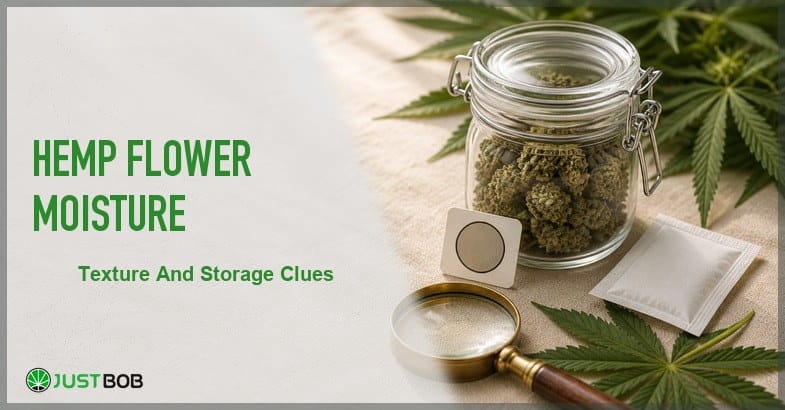
Hemp flower moisture is the small amount of water that stays inside a bud after the post-harvest drying and finishing steps. This moisture level influences how a bud appears in catalog photos, how its texture feels in the hand, how its aroma is released when the jar is opened, and how well the lot maintains its character over time on the shelf. This Justbob guide walks through the moisture signals a reader can pick up on a hemp bud listing, with the storage cues that travel with the lot.
-
 Max CBDAMNESIA CBD BOOSTStarting from: 0,85€/g
Glasshouse | CBD<40%
Grams5 10 20 50 100 200 400 -
Max CBDAK47 CBD BOOSTStarting from: 1,45€/g
Indoor | CBD<47%
Grams5 10 20 50 100 200 -
Max CBDCHARAS
CBD HASH | CBD<45%
Starting from:FLASH SALE -10%
0,90€0,80€/gGrams5 10 20 50 100 200 -
JB OIL 25%Starting from: 14,90€
CBD Oil 25%
The goal is texture literacy. After a quick read, a hemp bud listing should provide enough information for readers to picture the moisture level before opening the package, , while the packaging should consistently reflect the description presented on the page.
Moisture as one of the freshness markers on a hemp bud
Moisture is one of the key freshness markers readers can look for in a hemp bud, alongside colour, aroma, and trichome density. A bud with the right moisture level feels supple and slightly springy. One that has lost too much moisture feels brittle and dusty, while a bud with excessive moisture feels damp and may become susceptible to mould over time. The narrow range between these three conditions is what a CBD flower page refers to when describing freshness.
Moisture is often left unmentioned on the front label because most product pages assume a properly finished bud. When a label does refer to texture or moisture explicitly, that wording becomes part of the freshness vocabulary that reinforces the rest of the product description.
Read also: How to store marijuana optimally
The moisture range a hemp bud usually carries
A well-finished hemp bud usually carries a moisture content between 8 and 12% by weight, with most operators targeting a level of around 10 to 11% across the lot. Below 8 percent, the bud starts to feel brittle, the calyces snap rather than fold, and noticeable fragmentation collects at the bottom of the jar. Above 13 percent, the bud may feel damp, the air inside the package approaches saturation, and the risk of mould growth on the trichome layer increases.
The range is intentionally narrow. A bud that falls near the middle retains its aroma, preserves the trichome structure, and maintains a stable weight that matches the figure on the label. When moisture levels drift outside this range in either direction, the changes become apparent in the texture, the aroma, and the bud’s overall appearance in photographs.
How moisture changes the visible texture of a bud
The moisture content of a hemp bud can be recognised through a small set of visible and tactile cues. A well-hydrated bud has calyces that fold under gentle pressure and spring back to shape, a flexible stem that bends slightly before breaking, and a surface that catches the light in soft highlights. A dry bud has calyces that fracture under pressure, a stem that snaps cleanly, and a surface that appears matte or chalky.
A damp bud sits at the opposite end of the spectrum. Its surface looks glossy in a way that goes beyond the natural shine of the trichomes, the calyces feel heavy and slow to spring back, and the stem bends without producing a clean snap. This level of moisture is often accompanied by a slightly off aroma, tending toward wet hay or compost, providing an additional cue alongside the visual appearance.
For someone viewing a catalog photo, moisture is naturally more difficult to judge than when handling the bud in person. Even so, a detailed image can still reveal useful clues. A well-hydrated bud displays a rich matte surface with subtle highlights, a brittle bud appears flatter and chalkier, while a damp bud shows an unnatural sheen across the calyces. These visual cues work alongside other sensory indicators, such as aroma and texture, which help readers build a clearer picture of the flower’s overall quality before opening the package.
The snap test: a three-second tactile check
The snap test is the simplest moisture check a reader can run on a hemp bud after opening the package. The process involves taking a small side stem from the bud and gently bending it.
A well-finished bud gives a clean, audible snap, with a slight amount of resistance before the break. A bud that bends without breaking suggests excessive moisture, while one that crumbles under minimal pressure indicates that it has lost too much moisture
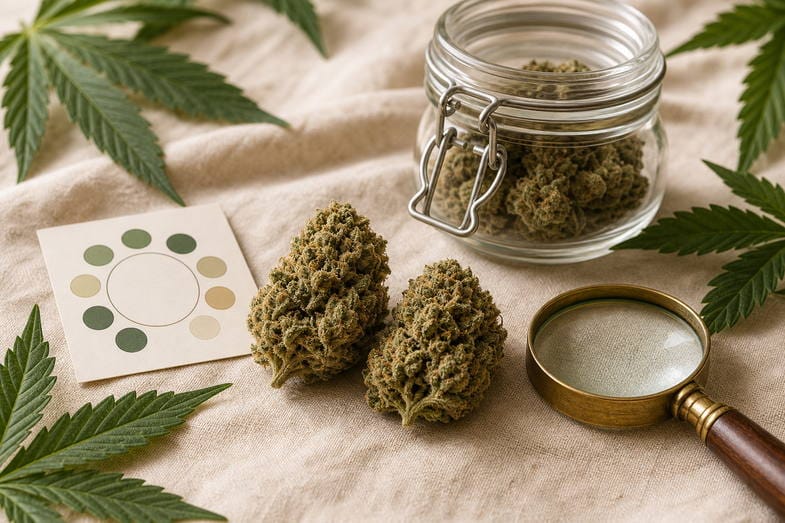
The entire check takes only a few seconds, and requires no equipment beyond the bud itself and a clean hand. The snap test is one of the long-standing texture checks used in plant-material work, and the same principle applies to hemp flowers. When comparing two lots of the same registered variety, a reader can often identify within seconds which one sits closer to the target moisture band.
Storage signals on packaging and how they read
The packaging provides a second layer of moisture-related information alongside the bud itself. A sealed jar with a tight gasket helps maintain stable lot moisture over time; a heat-sealed pouch preserves moisture in the short-term but allows changes once opened; a thin paper pouch loses moisture more quickly and can shift the lot toward the drier end of the range within days.
Most modern hemp bud packages also include a small humidity-control sachet, designed to maintain the relative humidity inside the jar around 58 to 62%. The sachet helps keep the bud within the target moisture range throughout a longer shelf life, and it works in both directions: it release moisture when the air inside the jar becomes too dry and absorbs excess moisture when humidity levels rise.
A product page that mentions a humidity-control sachet on the packaging indicates a moisture-aware storage approach. By contrast, a page that lists a generic jar without a sachet leaves the moisture profile more dependent on how frequently the container is opened throughout the product’s shelf life.
A short history of moisture measurement
Measuring moisture in plant material has a long and established laboratory history. In 1935, the German chemist Karl Fischer published the titration method that now bears his name in Angewandte Chemie.
The Karl Fischer titration uses a reagent that reacts selectively with water in a sample, providing a precise measurement of moisture content that remains the gold standard in analytical laboratories today.
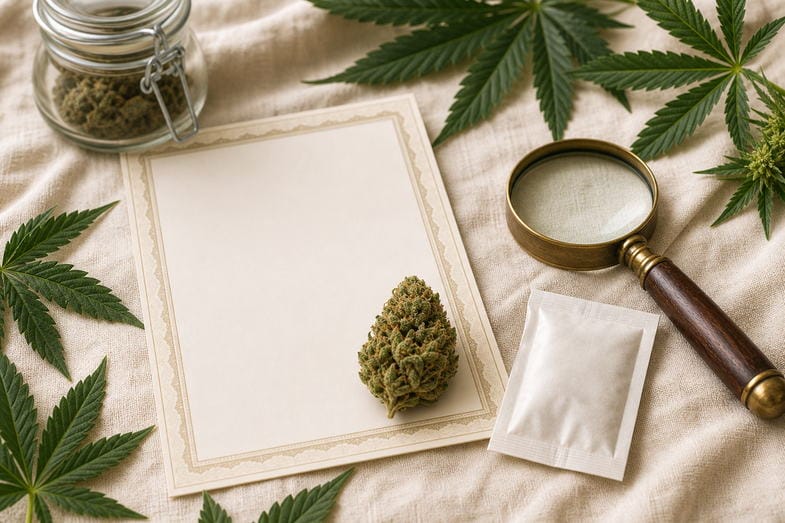
Hemp lots that undergo formal moisture analysis as part of a certificate of analysis usually rely on a Karl Fischer titration or on a loss-on-drying gravimetric method.
Both approaches are rooted in the same lipid-and-water chemistry tradition that emerged in the 1930s. A 2026 hemp bud lot reporting a moisture values on its documentation therefore reflects nearly a century of scientific and laboratory development.
For the reader, the date is mainly relevant as historical context. The moisture reading reported on a hemp bud document is not an arbitrary figure; it is the result of a well-defined analytical method that has been continuously refined over decades.
How moisture sits next to the lab document
A lot certificate of analysis can include a moisture reading alongside the cannabinoid breakdown. The value usually appears under terms such as “loss on drying“, “water content” or “Karl Fischer titration“, followed by a percentage figure. Lots reporting 9% moisture on the certificate are considered drier than lots reporting 11%, with both values falling within the typical well-finished range for hemp buds listed in the European catalog.
When a certificate does not report a moisture reading, the bud texture and packaging signals become the main reference points. A reader can usually estimate the moisture range by examining the photo, reviewing the storage indicators on the label, and performing the snap test on the bud after opening the package.
For a related reference on texture, the glossary entry CBD Hash Consistency: Texture And Compactness which sits beside this article for readers focused on how density and moisture interact on a different product format.
How Justbob keeps the moisture reading on the table
Justbob carries out constant analyses on all commercialised products and on every batch. The relevant documents are available on each commercialised product page, allowing readers who want to verify the cannabinoid breakdown, THC threshold compliance, or moisture reading (where reported in the analytical panel) for a specific lot to access the certificate of analysis directly from the catalog.
The packaging aspect works alongside the laboratory documentation. A jar with a humidity-control sachet, a clear label, and a moisture-friendly seal helps maintain the same target range measured by the laboratory in the certificate. These two elements describe the same lot from complementary perspectives, allowing readers to cross-check both sources before making a decision.
The broader framework behind this process is the EU industrial hemp catalogue, with THC maintained below the 0.3% threshold harmonised at European level. The registered variety establishes the cannabinoid baseline; the post-harvest finishing protocol defines the moisture target; and the packaging contributes to storage stability throughout the shelf life.
Read also: Aged cannabis and hashish: the effects of the passage of time on these products
Compliance-safe wording on hemp bud moisture pages
Compliance-safe wording for a hemp bud moisture page should remain strictly descriptive. Descriptions such as a “CBD flower jar with humidity-control sachet, target moisture band 10 to 11%, snap test reading well-finished” focus on observable product characteristics. By contrast, phrases like “premium hand-selected flower with unforgettable freshness” shift the focus toward marketing language and can create the type of signals that may draw additional scrutiny.
Hemp flowers are sold for technical, scientific and ornamental purposes only, in accordance with the EU industrial hemp framework. The moisture range, texture description, and packaging cues are part of how the product is presented in the catalog. They are descriptive elements only: they do not constitute instructions, claims of benefits, or alternatives to other regulated product categories.
The distinction is straightforward. When moisture-related language helps a reader understand the texture and physical characteristics of the product, it functions as descriptive terminology. When the wording encourages a reader to take a particular action or suggests a specific use, it moves beyond a compliant descriptive approach.
A short routine for reading hemp bud moisture
Reading hemp bud moisture is a simple and consistent process once the main indicators are familiar. Start by looking at the catalog photo for visible surface texture cues, such as a matte appearance, a slightly chalky finish, or an unusual sheen. Then check the packaging description for storage details, such as a sealed jar, humidity-control sachet, or paper pouch. After opening the package, a quick snap test on a small side stem can provide an additional texture reference. If available, the certificate of analysis can also provide the reported moisture reading for the specific lot.
The entire routine takes less than a minute once the main texture signals become familiar. Proper storage also plays an important role: keeping the package in a cool, dark place and sealing the jar between openings helps preserve the product’s original characteristics over time.
🌿Once these moisture and storage signals become familiar, exploring a hemp flower catalog becomes a clearer and more informed experience. Discover Justbob CBD flower collection with detailed product information, packaging insights, and available documentation for every selection.
Frequently asked questions about hemp flower moisture
What moisture range does a well-finished hemp bud usually carry?
A well-finished hemp bud usually carries a moisture content in the range of 8 to 12 percent by weight, with most operators aiming for a target between 10 and 11 percent on the lot. Below 8 percent the bud starts to feel brittle; above 13 percent the air inside the package gets close to saturation and the risk of mould rises.
What is the snap test on a hemp bud?
The snap test is a simple tactile check. The reader takes a small side stem from the bud and bends it gently. A well-finished bud gives a clean audible snap with slight resistance before the break. A bud that bends without breaking carries too much moisture; a bud that crumbles under the lightest pressure carries too little.
Why do humidity-control sachets appear in some hemp bud jars?
A humidity-control sachet is designed to hold the relative humidity inside the jar around 58 to 62 percent. The sachet keeps the bud near the target moisture range over a longer shelf life, adding moisture if the air dries out and absorbing moisture if the air gets too damp.