Modified on: 24/07/2026
Aroma words that stay close to product pages
Hemp aroma compounds sounds technical, yet a reader really only needs two things: a clear scent vocabulary and a page that keeps things plain. The phrase points to the natural compounds that give hemp flower its smell, and to the words used to describe that smell on a product page. This guide keeps to the words. It frames aroma as a vocabulary for reading and comparing flower, not as a promise about anything else.
-
 Max CBDAMNESIA CBD BOOST
Glasshouse | CBD<40%
Starting from:FLASH SALE -10%
0,85€0,75€/gGrams5 10 20 50 100 200 400 -
Max CBDAK47 CBD BOOSTStarting from: 1,45€/g
Indoor | CBD<47%
Grams5 10 20 50 100 200 -
Max CBDCHARASStarting from: 0,90€/g
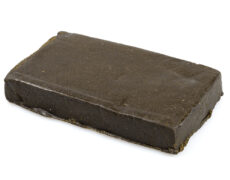
CBD HASH | CBD<45%
Grams5 10 20 50 100 200 -
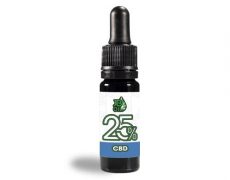
JB OIL 25%Starting from: 14,90€
CBD Oil 25%
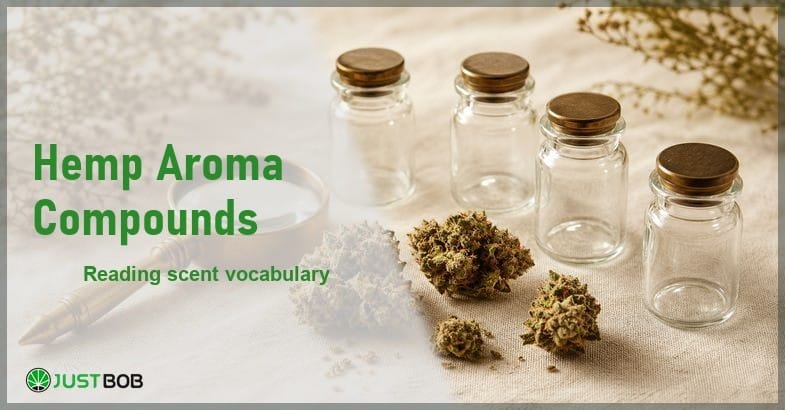
Picture a desk with a row of scent cards, each one carrying a single plain word: citrus, pine, pepper. Aroma words are at their most useful exactly when they stay like that, describing a smell and stopping there, without drifting into claims they were never meant to make.
What hemp aroma compounds means
Hemp aroma compounds are the naturally occurring compounds in the flower that carry its scent, together with the descriptive words a page uses to name that scent. The compounds themselves form in the resin of the flower, on the same tiny glands that hold its other natural compounds, but on a product page that origin stays in the background. What the reader meets is the vocabulary, words like citrus or pine that translate a smell into something readable.
So the practical meaning is narrow and useful. A hemp aroma vocabulary is a set of agreed scent words, there to help you picture how a flower smells before you ever see it in person. It is the part of a page that speaks to the nose, written down so it can be compared from one listing to the next.
The main scent families
Most hemp aroma descriptions group into a handful of families. Citrus covers the bright, zesty notes; pine and wood cover the fresh, forest-like ones; pepper and spice cover the warm, sharp end; floral and sweet cover the softer, rounder smells. A single flower usually sits across two or three of these at once.
These families are descriptive, not technical. They give a page a shared shorthand, so that one variety can be called bright and citrus-led and another earthy and peppery, and a reader can tell the two apart on words alone.
The families also overlap, which is part of their use. A flower described as citrus with a pine edge tells you more than either word alone, because the pairing sketches a fuller picture of the smell. Reading the combination, rather than a single label, is usually the most honest way to use a scent line.
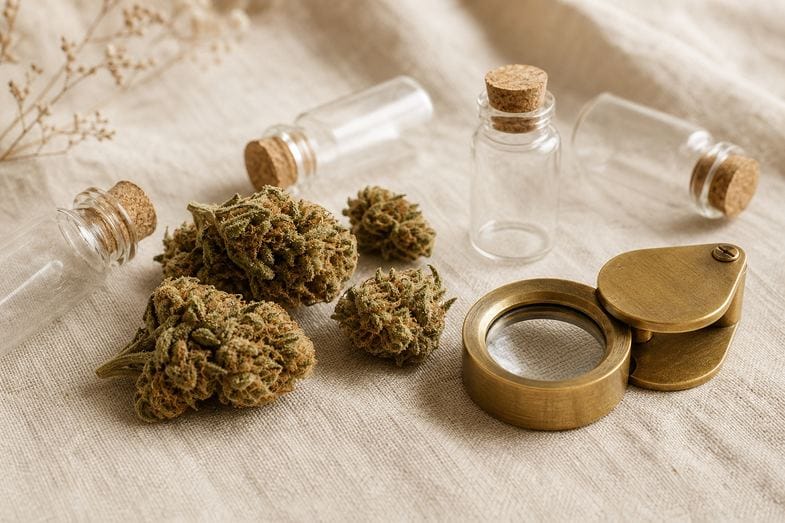
Read also: Hemp Flower Aroma Notes: A Clear Scent Vocabulary
Aroma in a product description
On a flower page, aroma usually appears as a short line of scent words next to the look and the variety name. It is one descriptive field among several, sitting alongside the appearance and the figures rather than standing above them. For a closer look at how those notes are organised, our guide to the CBD flower aroma profile walks through reading them in order.
Read this way, an aroma line is a label, not a verdict. It tells you what the flower smells of, in words you can compare against other pages, and it leaves every other question to the documents. Two listings that use the same scent words can be lined up directly, which is exactly what makes a consistent vocabulary worth the effort.
A shared vocabulary, borrowed from the tasting room
The idea of a fixed scent vocabulary is older than hemp pages. In the 1980s, the University of California, Davis scientist Ann Noble built the Wine Aroma Wheel, a circle of plain smell words arranged from general to specific. Her aim was to give tasters a shared, neutral language, so that one person’s citrus meant the same as another’s, with no judgement attached.
That is exactly the job an aroma vocabulary does on a hemp page. A wheel of agreed words, citrus, pine, pepper, floral, lets two different flowers be described in the same terms, so the descriptions can be compared rather than simply trusted.
Aroma words and the document
A scent line never carries the page on its own. The aroma words describe the smell; the certificate of analysis records the cannabinoid figures and the THC reading against the 0.3 percent threshold harmonised at European level. One is descriptive, the other is measured, and a careful reader uses both: the words to picture the flower, the document to confirm the batch.
This is why aroma stays in its lane. It is a rich, helpful description, but it is not a substitute for the paperwork, and careful pages keep the two clearly apart. Used like that, the scent line adds character to a listing without ever being asked to prove anything, which is the most it should ever do.
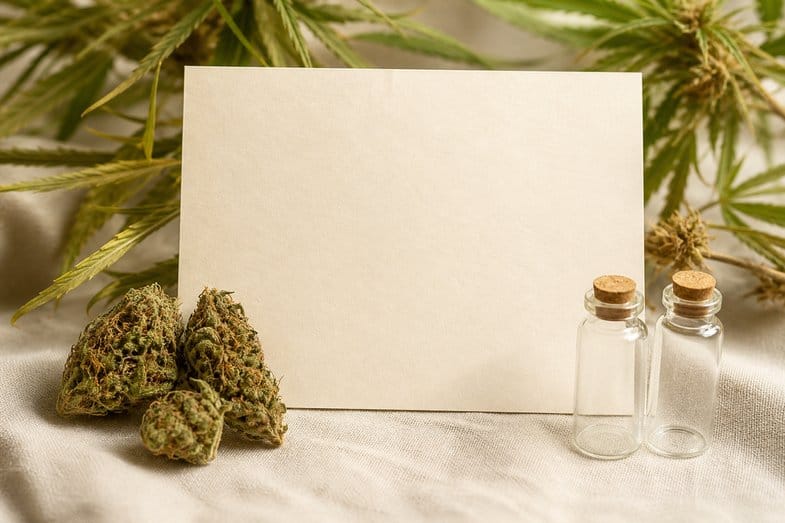
Read also: What Are Terpenes?
What aroma words cannot promise
It is worth being plain about the limits. Aroma words describe a smell and nothing more. They do not promise an experience, they do not stand in for any kind of personal outcome, and they are not a wellness message hiding inside a scent note. A page that respects that keeps aroma where it belongs, in description.
So the smell of a flower is reported, not sold. For an official overview of hemp as an agricultural crop, the European Commission page on hemp sets out the wider framework that the products sit within.
Aroma vocabulary on a Justbob page
On a CBD flower page, the aroma line does its quiet part of the job: a few scent words beside the variety, the appearance and the figures. Every commercialised product is analysed and each batch is checked, with the certificate of analysis kept inside the product page, so the description and the document can be read together.
Every flower on a Justbob page sits inside the EU industrial hemp framework, with THC kept at or below the 0.3 percent threshold harmonised at European level. The products are offered for technical, scientific and ornamental purposes only, and the aroma vocabulary is simply one more way the page is made readable.
Frequently asked questions about hemp aroma compounds
What are hemp aroma compounds?
They are the naturally occurring compounds in hemp flower that carry its scent, together with the descriptive words a product page uses to name that scent. In practice, the reader meets the vocabulary rather than the chemistry: scent words such as citrus, pine, pepper and floral that translate a smell into something readable. The words exist to help compare one flower with another before seeing it in person.
Are aroma words product claims?
No. An aroma word is a description of smell, not a claim about anything else. It tells you what a flower smells of, in shared terms you can compare across pages, and it stops there. Aroma vocabulary sits alongside the appearance and the documents as one descriptive field, and it is never a stand-in for a personal outcome of any kind.
Why compare aroma with documents?
Because the two answer different questions. The aroma line describes how a flower smells, while the certificate of analysis records the cannabinoid figures and the THC reading against the 0.3 percent threshold harmonised at European level for the batch. Reading the scent words to picture the flower and the document to confirm the batch is how a page is used well.