Modified on: 29/07/2026
How to read a small oil label without guessing
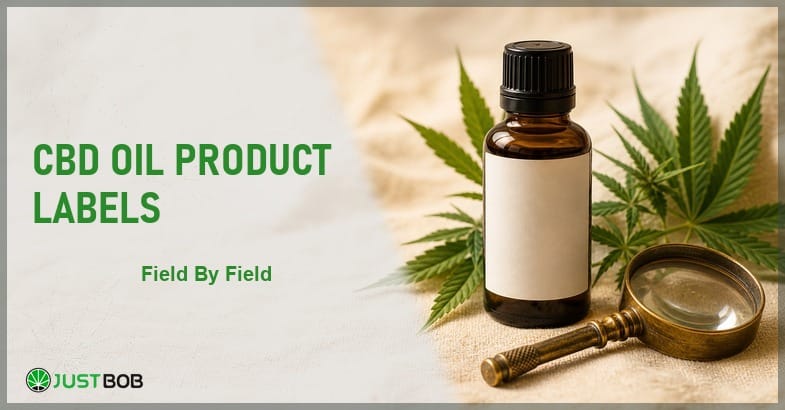
CBD oil product labels are tiny maps. The trick is reading them without inventing extra streets. A small panel on a bottle has to hold the product identity, the cannabinoid figures, a batch code and a short warning, all in a few square centimetres. This Justbob guide walks through those fields one by one, in a sensible order, so the small print becomes information rather than a riddle. It stays on label literacy, not on personal outcomes.
-
 Max CBDAMNESIA CBD BOOSTStarting from: 0,85 €/g
Glasshouse | CBD<40%
Grams5 10 20 50 100 200 400 -
Max CBDAK47 CBD BOOST
Indoor | CBD<47%
Starting from:HALLOWEEN SALE -10%
1,45 €1,30 €/gGrams5 10 20 50 100 200 -
Max CBDCHARAS
CBD HASH | CBD<45%
Starting from:HALLOWEEN SALE -10%
0,90 €0,80 €/gGrams5 10 20 50 100 200 -
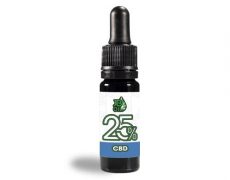
JB OIL 25%Starting from: 14,90 €
CBD Oil 25%
After a quick read, you can pick up a CBD oil bottle, name each field on the label, and know which document confirms it.
What CBD oil product labels include
A CBD oil label usually carries a recognisable set of fields. These include the product identity (what the item is), the CBD figure, the THC compliance reading and a batch or lot code. The carrier oil, a short warning line and a pointer to the document behind it round out the panel. Some labels add a QR code that links to the certificate.
In practice, the useful approach is to read a label as a checklist, not a paragraph. Each field answers one question. Taken together they describe the bottle; taken alone, no single field tells the whole story.
Product identity fields
The identity fields tell you what the product is. That means the product name, the format (an oil rather than another form), the volume in millilitres, and the carrier oil that the CBD sits in. These are the plain facts of the bottle, the ones that place it before any figures are read.
Identity comes first for a reason. Once you know what the product is and how much is in the bottle, the cannabinoid figures and the batch code have something to attach to. A figure without an identity is just a number floating on glass.
Batch number and percentages
The next cluster is the measurable part. It covers the CBD figure (often shown as a percentage or in milligrams), the THC reading against the 0.3 percent threshold harmonised at European level, and the batch code that ties the bottle to its document. Read these three together, because they only make sense as a set.
The label is the front door; the document is the room behind it. For more on how the bottle size and the label space interact, our guide on CBD Oil Bottle Sizes: How To Read Labels covers how much detail a small panel can realistically carry.
Read also: CBD Oil Ingredients: What Is Usually Inside the Bottle
Why labels carry standard fields
The idea that a label must carry honest, standard fields is a buyer-protection habit with a clear origin. In the United Kingdom, the Sale of Food and Drugs Act of 1875 was one of the first laws to require that what a label said matched what the container held. It set a principle that still shapes product panels today: the label is a promise the contents have to keep.
That history gives a modern CBD oil label a longer story than its small print suggests. When a 2026 bottle lists an identity, a figure and a batch code, it is following a labelling logic that took shape across the nineteenth and twentieth centuries. The fields are modern; the duty behind them is old.
Warnings and document checks
Most CBD oil labels carry a short warning line and an age note, kept brief by necessity. The warning is not the interesting part to skip; it is part of the standard panel. Beside it sits the pointer to the document, sometimes a QR code, sometimes simply the batch code that lets you find the certificate of analysis.
The document check closes the loop. Match the batch code on the label to the batch code on the certificate, and the figures on the panel gain a source. A label that points cleanly to its document is doing exactly what a label should.

Read also: CBD Oil Certificate Checklist: What To Read
What labels should not imply
A label has limits, and reading them is part of label literacy. A CBD oil panel describes identity, figures, a batch code and a warning. It does not promise an outcome, and a label that drifts into suggesting one has stepped outside what the panel is for.
So the sensible reading sticks to the fields themselves. The label tells you what the product is and points to the document that backs the figures. Anything beyond that, any hint of a benefit or a result, is wording to read with care rather than a fact the panel can carry.
From label to product page
Justbob carries batch-by-batch analyses across everything it commercialises. The documents stay inside each product page. A reader who wants to confirm the cannabinoid breakdown or the batch identity for a specific bottle can open the certificate of analysis in a click from the listing.
Every CBD oil listing sits inside the EU industrial hemp framework, with THC kept at or below the 0.3 percent threshold harmonised at European level, and the products are offered for technical, scientific and ornamental purposes only. Within that frame, the label is taken as a set of fields to read, each one pointing back to the document that supports it.
A quick pass across the panel
A label rewards a quick, ordered look. Read the product identity and the volume first. Then the CBD figure and the THC reading against the 0.3 percent threshold. Then the batch code. Then glance at the warning line and find the pointer to the document. Five quick fields, in the same order each time, and the label is read in moments.
For official background on how CBD products are framed for the public, the Food Standards Agency CBD guidance is a neutral public reference that sits outside the catalog, so the regulatory context stays its own thing.
Frequently asked questions about cbd oil product labels
What should CBD oil product labels show?
A CBD oil label usually shows the product identity (name, format and volume), the CBD figure as a percentage or in milligrams, and the THC reading against the 0.3 percent threshold harmonised at European level. It also carries the carrier oil, a batch or lot code, a short warning line with an age note, and a pointer to the certificate of analysis. Read as a checklist, each field answers one question and together they describe the bottle.
Why does the batch number matter?
The batch number ties the specific bottle to its own laboratory document. The CBD and THC figures on a label only gain a source when you can match the batch code on the panel to the batch code on the certificate of analysis. Without that match, the figures describe the product in general rather than the bottle in your hand, which is why the code is a small but important field.
Where should documents be checked?
On the Justbob catalog, the certificate of analysis for a specific lot sits inside each commercialised product page, so the document can be opened without leaving the listing. The quickest check is to match the batch code on the label to the batch code on the certificate, then read the cannabinoid figures against the panel.