Modified on: 17/09/2026
Reading a CBD oil certificate checklist on a product page
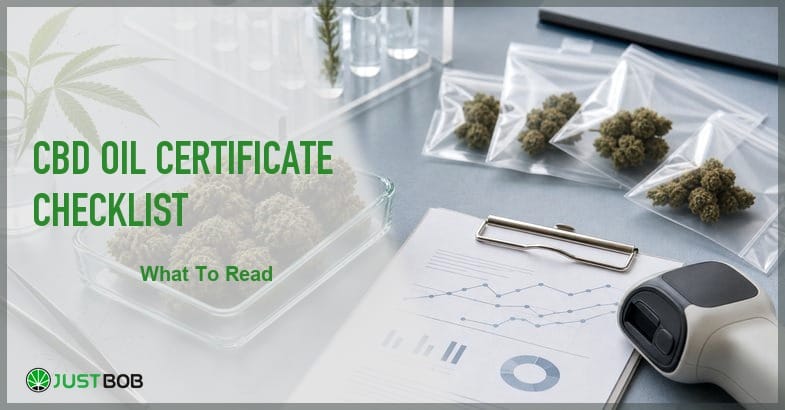
A Certificate of Analysis (COA) is the document that turns a CBD oil bottle into a verifiable product. The COA lists the cannabinoid breakdown, the terpene profile when reported, the contaminants check, the lot reference and the laboratory identification.
Understanding how a CBD oil certificate is laid out makes it easier to locate the key information and cross-check each section against the product label.
This Justbob guide walks through a CBD oil certificate checklist, section by section, so a reader can open any COA and verify the lot in a few minutes.
-
 Max CBDAMNESIA CBD BOOSTStarting from: 0,85€/g
Glasshouse | CBD<40%
Grams5 10 20 50 100 200 400 -
Max CBDAK47 CBD BOOSTStarting from: 1,45€/g
Indoor | CBD<47%
Grams5 10 20 50 100 200 -
Max CBDCHARAS
CBD HASH | CBD<45%
Starting from:FLASH SALE -10%
0,90€0,80€/gGrams5 10 20 50 100 200 -
JB OIL 25%Starting from: 14,90€
CBD Oil 25%
The goal is to make the process second nature. After one or two COA readings, the structure becomes familiar, and cross-checking it against the bottle label becomes a quick and routine step.
What “CBD oil certificate checklist” describes on a product page
A CBD oil certificate checklist is a step-by-step reading routine for the Certificate of Analysis that accompanies a specific lot of CBD oil. The checklist covers the five main sections of a standard COA: cannabinoid breakdown, terpene profile (when included), contaminants check, lot traceability and laboratory identification.
For someone reviewing CBD oil, the checklist provides a practical link between the bottle label and the underlying analytical record. The label appears on the front of the bottle, while the COA is available in the catalog or on the product page. The checklist connects the two, helping the reader verify that the analytical data corresponds to the product on the shelf.
In our view, the most useful CBD oil product pages make the COA available alongside the label information, allowing readers to work through the checklist without leaving the catalog. A COA that is available only upon request, or presented as an unstructured PDF, is more difficult to verify in practice.
Read also: CBD Oil Lab Testing: What a Certificate Can Tell You
The COA anatomy: five sections to read
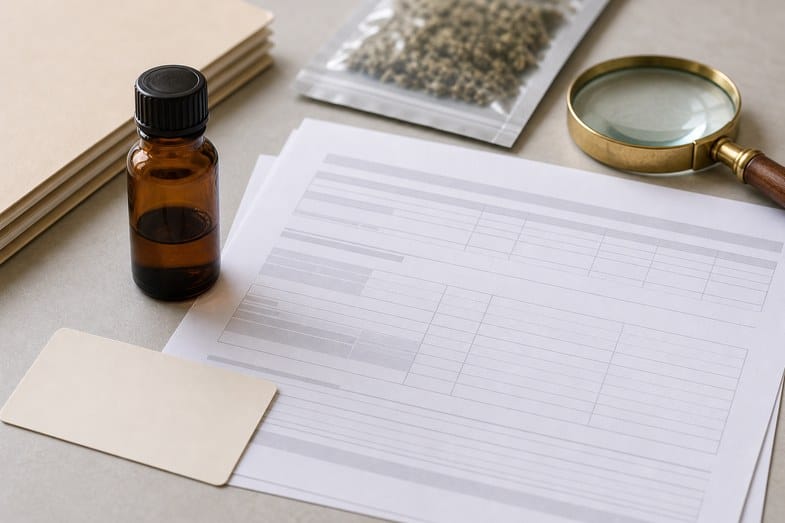
A standard Certificate of Analysis (COA) for CBD oil follows a recognisable structure across European laboratories. The five main sections are: the cannabinoid breakdown (CBD, THC, CBG, CBN, CBC, and sometimes CBDV); the terpene profile (when included in the analysis); contaminant testing (pesticides, heavy metals, and microbiological tests); lot reference information (batch code, sample reference, and test date); and laboratory identification (accreditation, analytical method, and signature).
Each section answers a specific question. The cannabinoid breakdown shows what the lot contains, the terpene profile provides information about its aromatic composition, contaminant testing confirms what has been screened for, the lot reference links the document to the specific bottle or batch, while the laboratory information helps establish the credibility and traceability of the report.
Once the routine is familiar, an initial review of a COA can take less than five minutes. The five sections generally appear in the same order across most documents, although the layout and level of detail may vary from one laboratory to another.
Section 1: cannabinoid breakdown
The cannabinoid breakdown is usually the most closely examined section of a CBD oil COA. The main table lists the principal cannabinoids—CBD, THC, CBG, CBN, CBC, and sometimes CBDV—along with their concentrations, reported by weight or volume depending on the analytical method used. CBD is typically the dominant cannabinoid, while THC is also reported, particularly where compliance with applicable regulatory limits needs to be assessed.
A typical full-spectrum CBD oil lot may report CBD at around 5–10% of the product, along with smaller amounts of CBG, CBN, and CBC. A broad-spectrum oil may contain similar minor cannabinoids but show no detectable THC. A CBD isolate by contrast, is expected to show CBD as the principal measurable cannabinoid, with other cannabinoids absent or below the laboratory’s detection limits.
The cross-check against the bottle label is straightforward: the CBD concentration reported on the COA should correspond to the concentration declared on the label, allowing for the normal lot-to-lot variation associated with plant-derived products.
Section 2: terpene profile (when included)
The terpene profile is an optional section of a CBD oil COA. Laboratories that test for terpenes typically report the main aromatic compounds—such as myrcene, limonene, pinene, caryophyllene, linalool, and humulene—along with their percentage or concentration, usually expressed in milligrams per millilitre. Not every laboratory tests for terpenes as part of its standard analysis; this section is generally included when the producer specifically requests terpene testing.
For someone reviewing CBD oil, the terpene profile provides analytical support for the aroma and flavour characteristics described on the bottle label. A full-spectrum oil with a myrcene-dominant profile and smaller amounts of limonene, for example, has a different analytical profile from one in which limonene is the predominant terpene.
When a COA does not include a terpene profile, the cannabinoid breakdown remains the primary analytical reference. The aroma description on the bottle can still provide a useful sensory indication, but the analytical picture is less complete.
Section 3: contaminants check
The contaminants section of a CBD oil COA establishes the product’s basic screening profile. Standard tests may include pesticides (residual agricultural chemicals), heavy metals such as lead, cadmium, arsenic, and mercury, and microbiological parameters such as total yeast and mould count and total aerobic microbial count. Depending on how the extract was produced, the analysis may also include residual solvents.
Each test reports a measured result against a specified reference limit. A “pass” indicates that the reported result meets the applicable limit, while a “fail” indicates that it does not. This section is therefore where a product’s claims about contaminant screening can be checked against actual analytical results rather than simply taken at face value.
The applicable limits depend on the specific substance being tested, the type of product, and the regulatory framework that applies. For products marketed in Europe, the relevant requirements may derive from EU food, agricultural, and product-safety rules, including provisions applicable to industrial hemp under Regulation (EU) 2021/2115 and related legislation.
For wider regulatory context on CBD products, the official UK CBD guidance provides a useful reference point, outlining the broader regulatory framework surrounding CBD products and the role of safety and compliance testing.
Section 4: lot reference and traceability
The lot reference section links the COA to a specific production batch. Typical fields include the batch code (the alphanumeric identifier printed on the bottle label), the sample reference (the laboratory’s internal identifier for the tested sample), the production date, and the test date.
The cross-check is straightforward. The batch code on the bottle label should match the one on the COA. The production date should fall within a reasonable period before the test date, while the test date should be recent enough to support the product’s current catalog listing.
When the batch codes match, the COA can be linked directly to the lot in the bottle. If the codes do not match, the COA refers to a different lot, and the verification chain is broken.

Section 5: laboratory identification and accreditation
The laboratory identification section provides key information for assessing the credibility and traceability of the analytical record. Typical fields include the laboratory name and address, the accreditation reference (often ISO/IEC 17025 for testing laboratories), the analytical method used (such as HPLC, gas chromatography, or ICP-MS), the analyst’s signature or initials, and the test date.
ISO/IEC 17025 is the international standard for the competence of testing and calibration laboratories. A CBD oil COA issued by an ISO/IEC 17025-accredited laboratory provides a stronger basis for evaluating the analytical results than a report from a non-accredited laboratory. The relevant accreditation reference should therefore be clearly visible on the document.
The analytical method is also worth checking. HPLC is commonly used for cannabinoid quantification, while gas chromatography can be used for terpene analysis, and ICP-MS (inductively coupled plasma mass spectrometry) is widely used to test for heavy metals.
Reading the COA alongside the bottle label
The COA and the bottle label form the two layers of CBD oil verification. The label provides the commercial name, CBD percentage, bottle volume, product positioning, and batch code, while the COA provides the analytical data behind each of these details.
A well-structured CBD oil product page presents both layers side by side. The bottle label tells the reader what the product is; the COA provides the analytical evidence needed to verify that the contents correspond to the label. When the two layers are consistent, the product information is easier to verify. If the percentage declared on the label does not match the COA result for the corresponding lot, the verification chain breaks.
The most effective reading routine is therefore to work through the two layers in sequence: start with the label, identify the batch code, open the COA for that specific lot, and cross-check the cannabinoid breakdown and contaminant results.
Knowing how to read a CBD oil product label makes this verification routine easier, as the key details can then be matched directly with the corresponding information in the COA.
For readers who want to take the same approach beyond CBD oil, our guide to CBD Flower Lab Report: What It Shows and Why It Matters, which sits beside this one for readers focused on the wider lab report structure across CBD product formats.
HPLC and the standardised CBD oil lab report
The technology behind a CBD oil COA has a well-established scientific history. HPLC emerged as a powerful analytical tool in the 1960s and 1970s, with early applications to cannabinoid analysis appearing in scientific literature during this period. Today, HPLC is widely used for cannabinoid quantification, providing reproducible analytical results across accredited laboratories in Europe.
The scientific foundation goes back even further. In 1963, Raphael Mechoulam and his team at the Hebrew University of Jerusalem isolated and structurally characterised THC and CBD, laying important groundwork for the analytical study of cannabinoids. Their work established the chemical framework behind the cannabinoid measurements that appear on modern COAs.
A CBD oil COA in 2026 therefore reflects more than six decades of analytical development. The cannabinoid table, contaminant testing, and laboratory identification all form part of a reporting framework that has become increasingly consistent across the European hemp and CBD sector.
How Justbob documents CBD oil quality
Justbob carries out constant analyses on all commercialised products and on every batch. The relevant documents are made available on the individual product pages, so readers who want to apply the checklist to a specific CBD oil lot can access the corresponding COA directly from the catalog.
The reading routine is easy to apply across products.
What drives the price of CBD oil can also be considered alongside the documented product characteristics when comparing different CBD oil products.
Once a reader has cross-checked one CBD oil lot against its COA, the same five-section approach can be used for the next batch, another CBD oil variant, or a different terpene profile. The product pages follow a consistent structure, while the COAs use a familiar reporting format and reference the same broader European testing framework.
This consistency is what makes the COA a practical verification tool rather than simply a laboratory document. The label provides the information to check; the COA provides the analytical data behind it; and the laboratory details provide the final point of reference for assessing the report’s traceability and credibility.
Read also: CBD Oil Ingredients: What Is Usually Inside the Bottle
Compliance-safe wording on CBD oil certificate references
Compliance-safe wording around a CBD oil COA should remain grounded in analytical data and regulatory context. “Full-spectrum CBD oil, lot 2026-XX-NN, with 8.5% CBD, THC below 0.3%, a myrcene-dominant terpene profile, an ISO/IEC 17025-accredited laboratory, and passed contaminant testing” describes documented product characteristics. “Premium-grade CBD oil with the best certificate in the catalog,” by contrast, is a marketing claim rather than an analytical statement.
CBD oil products are sold for technical, scientific and ornamental purposes only, in line with the EU industrial hemp framework. COA references, cannabinoid concentrations, and laboratory identification help document the products presented in the catalog. They should remain descriptive and factual, rather than being framed as instructions, health claims, or suggested uses.
A simple test can help keep the wording on the right side of the line: if the COA reference connects the product to documented analytical data, it is functioning as documentation; if the wording encourages the reader to use the product in a particular way, it moves beyond that documentary role.
A closing reading habit for the CBD oil certificate checklist
Running the five-section CBD oil certificate checklist on a single lot takes less than five minutes once the routine becomes familiar. Cannabinoid breakdown, terpene profile (when included), contaminant testing, lot reference, and laboratory identification: each section has a clear purpose and a corresponding cross-check against the bottle label.
🌿Once the method is familiar, the next step is simply to put it into practice. Browse the CBD oil collection, choose a product, and follow the label-to-COA trail yourself. The next certificate you read can be your quickest one yet.
Frequently asked questions about cbd oil certificate checklist
What are the five sections of a CBD oil Certificate of Analysis?
A standard CBD oil COA has five main sections: cannabinoid breakdown (CBD, THC, CBG, CBN, CBC), terpene profile when included, contaminants check (pesticides, heavy metals, microbiological), lot reference (batch code, sample reference, test date) and laboratory identification (accreditation, method, signature).
Why does ISO 17025 accreditation matter on a CBD oil COA?
ISO/IEC 17025 is the international standard for the technical competence of testing and calibration laboratories. A CBD oil COA from an ISO 17025 accredited laboratory carries stronger verification weight than one from a non-accredited laboratory, because the accreditation confirms that the analytical methods follow standardised protocols.
How does the batch code link the bottle label to the COA?
The batch code on the bottle label and the batch code on the COA should match. When the two codes agree, the COA refers to the specific lot in the bottle, and the cannabinoid breakdown, the terpene profile and the contaminants section apply to that lot. When the codes do not match, the verification chain breaks and the COA becomes a generic reference rather than a lot-specific record.