
Modified on: 29/07/2026
Date first, adjectives later
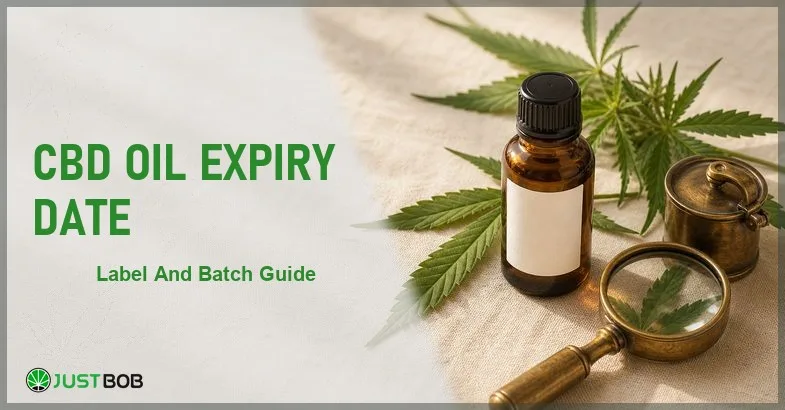
A CBD oil expiry date is one of those label details nobody celebrates, right up until it saves a comparison from being fuzzy. Before any description of a product matters, the date tells you whether you are looking at a current lot or an old one. This Justbob guide explains what the expiry or best-before date means on a CBD oil label, how it sits next to the batch identity, and how it connects to the storage notes and documents. It stays on reading the label, with no guidance on anything beyond it.
-
 Max CBDAMNESIA CBD BOOSTStarting from: 0,85€/g
Glasshouse | CBD<40%
Grams5 10 20 50 100 200 400 -
Max CBDAK47 CBD BOOSTStarting from: 1,45€/g
Indoor | CBD<47%
Grams5 10 20 50 100 200 -
Max CBDCHARAS
CBD HASH | CBD<45%
Starting from:FLASH SALE -10%
0,90€0,80€/gGrams5 10 20 50 100 200 -
JB OIL 25%Starting from: 14,90€
CBD Oil 25%
Simple sequencing is the idea: check the date, then read the rest. Soon enough, you can find the date field, place it against the batch code, and know what it does and does not say.
What a CBD oil expiry date means
An expiry date, often printed as a best-before date, is the manufacturer’s stated window for the product in its sealed state. It is a label field, set by the producer, that marks how long the lot is intended to be at its described condition. It is not a verdict on a single bottle so much as a planning marker for the batch.
To our mind, the date is best read as a coordinate, not a headline. It places the lot in time. A current date and a clear batch code together tell you that the figures and the description belong to a recent run, which is exactly what a careful comparison needs.
Label dates and batch identity
The date and the batch code work as a pair. The batch code identifies which production run a bottle came from; the date tells you the window set for that run. Read together, they locate a bottle precisely: this lot, made for this period.
This is where the catalog connection sits. The CBD oil listings carry both the batch detail and the date field, so a reader can line them up quickly.
For the label layout that holds these fields, our guide on CBD Oil Bottle Sizes: How To Read Labels covers where the date usually sits on the panel.
Storage notes on product pages
Alongside the date, many product pages carry short storage notes. These describe the conditions a sealed product is kept in, typically a cool place away from direct light and heat. The notes are descriptive context for the date, not directions for anything else.
The reason the two travel together is straightforward. A date assumes a product has been kept in reasonable conditions, so the storage note simply states what those conditions are. Date and storage note are two halves of the same label idea.
Read also: CBD Oil Certificate Checklist: What To Read
How dates reached the label
Printing a date on a product is a relatively modern retail habit. Open dating, the practice of putting a readable best-before date on the package, spread through United Kingdom retail during the 1970s, moving date information out of secret manufacturer codes and onto the label where a reader could see it. The point was transparency: the date belongs to the customer, not just the producer.
That history gives the small date field a clear purpose. When a 2026 CBD oil label prints a best-before date, it is following a labelling logic built over half a century: state the window plainly, so the reader can place the product in time without decoding anything.
Documents and traceability
The date also connects to the paperwork. The batch code on the label leads to the certificate of analysis for that lot, and the date sits alongside it as part of the same record. A current date, a matching batch code and an accessible document form a clear chain from bottle to paperwork. The date is simply one entry on a panel that also carries the carrier oil, the cannabinoid figures and the warning line.
Read also: CBD Flower Packaging: Labels And Batch Codes
What dates cannot promise
A date has firm limits. It is a planning marker for a sealed lot, not a guarantee about a single bottle and not a statement about any result. A long window does not prove quality, and the date says nothing beyond the period the producer set for that run.
So the careful reading stays within those limits. The date places the lot in time and points, with the batch code, to the document. Everything that actually describes the product lives in those figures and that paperwork, not in the date alone.
Dates that travel with the batch
Constant analyses run on all of Justbob’s commercialised products and on every batch. The relevant documents are kept inside each product page. A reader who wants to confirm the batch identity or the cannabinoid breakdown for a specific bottle can open the certificate of analysis directly on the listing.
Every CBD oil listing sits inside the EU industrial hemp framework, with THC kept at or below the 0.3 percent threshold harmonised at European level, and the products are offered for technical, scientific and ornamental purposes only. Within that frame, the date is read as a label coordinate that travels with the batch code and the document.
Date, batch, storage, document
Reading the date is quick once the order is set. Find the best-before or expiry date on the label. Read it next to the batch code, so the lot and its window line up. Glance at the storage note for the conditions the date assumes. Then follow the batch code to the certificate of analysis. Date, batch, storage, document, in that order, and the check is done in seconds.
For official background on how CBD products are framed for the public, the Food Standards Agency CBD guidance is a steady neutral reference, set apart from the catalog and from any single listing.
Frequently asked questions about cbd oil expiry date
What does CBD oil expiry date mean?
A CBD oil expiry date, often shown as a best-before date, is the window the producer states for the product in its sealed state. It is a label field that marks how long the lot is intended to be at its described condition, set per production run rather than per individual bottle. Read alongside the batch code, it places the lot in time and points, with the document, to the figures that describe the product.
Is a date the same as a batch number?
No. They are two different fields that work together. The batch number identifies which production run a bottle came from, while the date marks the window set for that run. Reading them as a pair locates a bottle precisely: this lot, made for this period. The batch number then leads to the certificate of analysis for the same run.
Why read storage notes too?
Because the date assumes the product has been kept in reasonable conditions, and the storage note states what those conditions are, usually a cool place away from direct light and heat. The note is descriptive context for the date rather than guidance on anything else, which is why the two fields are read together on a product page.