
Modified on: 17/09/2026
Terpenes: The Small Compounds Behind Big Aroma Words
If a CBD flower page mentions notes such as citrus, pine or herbal, those descriptions usually refer back to terpenes. These small aromatic compounds may be tiny in size, but they create a surprisingly rich vocabulary around hemp products. For Justbob, that vocabulary has one simple purpose: to make product descriptions clearer and easier to understand.
-
 Max CBDAMNESIA CBD BOOSTStarting from: 0,85€/g
Glasshouse | CBD<40%
Grams5 10 20 50 100 200 400 -
Max CBDAK47 CBD BOOSTStarting from: 1,45€/g
Indoor | CBD<47%
Grams5 10 20 50 100 200 -
Max CBDCHARAS
CBD HASH | CBD<45%
Starting from:FLASH SALE -10%
0,90€0,80€/gGrams5 10 20 50 100 200 -
JB OIL 25%Starting from: 14,90€
CBD Oil 25%
CBD flower terpenes are not a magic button. They are part of the plant’s natural profile and help explain the aroma language used to describe different products. Once viewed this way, the topic becomes much more approachable: less chemical confusion, more careful reading of botanical information on the label.
What CBD flower terpenes are
Terpenes are aromatic compounds found in many plants, including hemp. In CBD flower descriptions, they are often linked to scent families such as citrus, herbal, floral, earthy or woody. Cannabis Sativa L., the species behind industrial hemp, produces these compounds in the same trichomes where it produces cannabinoids, which is why aroma and cannabinoid profiles are often discussed together on a CBD flower page.
This matters because CBD flower is usually compared through several elements at once: appearance, aroma, trim, resin characteristics, label details and batch documents. Terpenes contribute mainly to the aroma side of this picture, helping describe the sensory profile of a product in a more precise way.
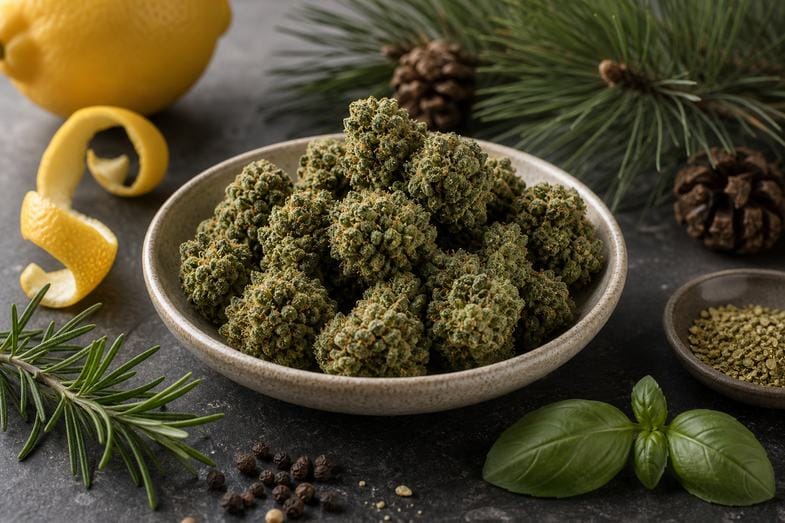
The same terpenes are also found throughout the plant world and are already familiar through everyday aromas: limonene in citrus peel, pinene in pine needles, linalool in lavender and caryophyllene in black pepper. CBD flower terminology is therefore not creating a new language from scratch; it is using a broader botanical vocabulary to describe the aromas and characteristics that readers may recognise.
Read also: CBD Flower Aroma Profile: How to Read Scent Notes
Common scent families in hemp flowers
A flower may be described as earthy, pine-like, fresh, resinous or gently floral. These words are not there simply to sound appealing, even if they sometimes do. Their real purpose is to help readers compare one product page with another. The scent families behind CBD flower terpenes generally fall into a few recognisable groups: citrus (lemon, orange peel, grapefruit), herbal and woody (pine, sage, rosemary), floral (lavender, jasmine and other light floral notes) and earthy or spicy (soil, hops, pepper). A CBD flower description using one of these families is simply borrowing familiar terms from a much broader botanical vocabulary.
A useful description stays specific. A less useful one says that everything smells “amazing” while giving the reader nothing concrete to compare. We prefer the first approach: fewer decorative words and more practical information. The same principle applies to the terpenes listed in batch documents. Compounds such as limonene, pinene, myrcene, linalool, caryophyllene and humulene may be reported with their relative percentages, allowing readers to compare the analytical profile with the aroma family described on the page. When the written description and the laboratory data point in the same direction, the product information becomes easier to understand.
Terpenes, resin and visual cues
Terpene language often appears alongside descriptions of resin and appearance, which is why cannabis resin is a useful related topic. A resin-rich appearance, visible trichome coverage and a clear trim can all contribute to the overall description of a flower, but none of these elements should be turned into a promise.
The best flower page works like a small field notebook: it records what the product looks like, how the aroma is described, what the label states and which batch document supports the information. This image works well because it suggests accuracy rather than spectacle. A page that includes details such as Cannabis Sativa L., the registered hemp variety, the THC threshold below 0.3% applicable to industrial hemp under the EU framework, and the relevant batch reference gives readers a clearer map for understanding the product.
The aroma vocabulary then has a concrete foundation, connecting the named terpenes with the wider plant profile without exaggerated interpretations. The most useful CBD flower terpene guides work almost like a simple inventory: aroma family, terpene name, visible resin, trim, label details and batch document. These small details, read together, help readers compare CBD flowers based on information rather than only on adjectives.
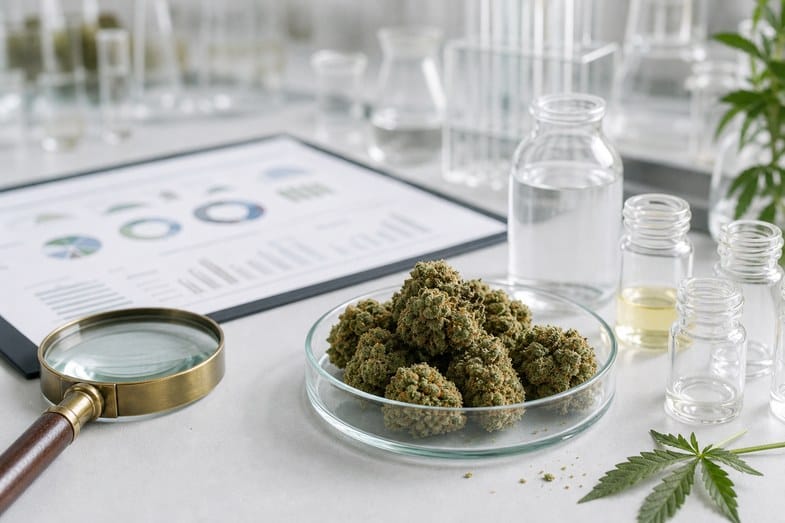
Why terpenes are not claims: reading Justbob product pages
Terpenes should not be used to predict personal outcomes. A citrus note is a citrus note. A woody note is a woody note. Turning these descriptive details into promises does not make a product description stronger; it only makes it less precise. This is why careful wording matters. A product page can describe what is observed, documented and connected to the product profile. It should not ask aroma words to do a job they were never meant to do.
A practical reading approach starts with the product family, then moves through the photo, aroma notes, label details and batch documents. This order keeps terpenes in the right place: useful for understanding scent vocabulary, but never a replacement for product-specific information. For plant-chemistry background, a PubMed Central review on cannabinoids and terpenes explains how Cannabis sativa compounds and aroma-related terpenes are discussed in scientific literature.
Justbob carries out constant analyses on all commercialised products and on every batch. The relevant documents are available on each commercialised product page, helping readers connect terpene descriptions with information linked to the specific lot. Aroma gives the first impression and makes the description more approachable. Documents provide the second layer of detail and make the information more reliable. Together, they work best when each one stays in its proper role.
Why terpene words should stay close to aroma
CBD flower terpenes are easiest to understand when they remain connected to aroma and description. Terms such as citrus, pine, herbal, floral and earthy are useful because they help readers create a clearer picture of a product. They become less useful when they are expected to explain more than they actually can.
This is why terpenes in CBD flower should be treated as aroma context first. Hemp flower terpenes can make a product description easier to follow, but they work best alongside other elements such as photos, labels and batch documents.
A clear product page should not ask a single terpene name to carry the entire explanation. Terpene in cannabis culture language is only one part of the description, working together with visual details, flower structure, label information and product-specific documentation. There is also a certain value in this kind of restraint. A page often feels more reliable when it focuses on describing the product rather than trying to make every detail sound extraordinary.
Reading aroma notes like a product editor
A product editor reads aroma notes with a pencil in hand—at least in spirit. The first question is whether the words are specific. Herbal is useful; nice is not. Fresh can be meaningful if the rest of the description gives it context. Amazing, on the other hand, adds little value.
When reading CBD flower terpene descriptions, compare the aroma notes with the flower’s visual characteristics: colour, trim quality, visible resin, and overall structure. The stronger the connection between the written description and the product itself, the more trustworthy the page feels.
This does not mean every product needs a long aroma paragraph. It simply means that the words used should help the reader notice something concrete and verifiable.
Terpenes and batch documents belong in different lanes
Aroma descriptions and batch documents are both valuable, but they serve different purposes. Aroma language helps readers understand the product’s sensory profile, while batch documents connect a specific lot to its analytical data.
Think of it as a well-organised shelf: aroma notes on the left, the product label in the middle, and the batch document on the right. The system works because each element has a distinct role.
Some pages make terpenes sound like a secret code. That does not help the reader. A better approach is to explain that terpenes are natural aromatic compounds found in plants, then show how their characteristics are reflected in the product descriptions. Another common mistake is listing terpene names without any context. A long list may look scientific, but if it does not help customers compare products or understand what they are reading, it is simply a list dressed up as science.
For Justbob, the better approach is a clear, conversational structure: introduce the main aroma families, explain how they relate to the flower descriptions, and show customers where they can find the corresponding batch documentation. Simple, practical, and genuinely useful.
Examples that make terpene language less abstract
Terpene names can sound technical until they are linked to familiar aroma families. For example, limonene is commonly associated with citrus notes, pinene with fresh pine aromas, and myrcene with earthy or herbal characteristics. Linalool, also found in lavender, is often linked to floral notes, while caryophyllene contributes peppery, slightly spicy aromas and humulene is typically associated with woody, hoppy scents. The goal is to provide descriptive vocabulary, not to suggest specific effects.
On a CBD flower product page, this vocabulary should help customers connect the aroma profile with visible product characteristics such as colour, trim quality, resin coverage, and overall appearance. Terpenes are concentrated in the trichomes—the tiny resin glands that cover the flower—which also contain most of the cannabinoids reported in the batch analysis. As a result, the visible resin, aroma description, and cannabinoid profile should be understood as three complementary aspects of the same product.
Imagine comparing three different CBD flowers: one with a citrus-forward aroma profile, another with a more earthy and herbal character, and a third with fresh pine notes. None is inherently better than the others—they simply offer different aromatic profiles. A well-written product page allows readers to picture those differences before they even open the package.
For JustBob, this is the most effective approach: clear, balanced, and descriptive aroma language that helps customers understand and compare products without unnecessary technical jargon or exaggerated claims.
Terpene notes and CBD flower product photos
Terpene descriptions help customers imagine a flower’s aromatic profile, but product photos provide the visual context that makes those descriptions more meaningful. While aroma cannot be captured in an image, the CBD flower itself can reveal important details that support the written description.
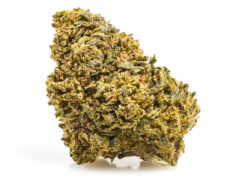
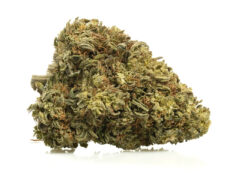
A page describing fresh, citrus, earthy, or resinous aromas should be accompanied by clear, high-quality images that show the flower’s colour, trim quality, trichome coverage, and overall structure. These visual elements help customers connect the terpene vocabulary with the appearance of the product, making the information easier to understand and more credible.
This creates a practical bridge between CBD flower terpenes and the online shopping experience. The product description explains the aromatic profile, while the images provide tangible evidence of the flower’s quality and presentation.
Read also: Hemp Flower Aroma And Texture: What To Notice – Justbob
How batch documents support terpene descriptions
Terpene terminology is most useful when it is supported by clear product information. On its own, aroma language can become purely descriptive; combined with product photos, labels, and batch documents, it gives customers a more complete understanding of what they are buying.
A well-structured CBD flower product page allows readers to move naturally from the aroma description to the product images and, where available, the corresponding batch analysis. Each element serves a different purpose: the aroma notes describe the sensory profile, the photographs show the flower’s appearance, and the batch document provides analytical information about that specific lot.
By presenting these elements together, the page becomes clearer, more transparent, and easier to trust, helping customers compare CBD flower varieties with confidence.
Choosing CBD flower with confidence
Understanding CBD flower terpenes is not about memorising scientific names. It is about learning how to read a product page more carefully. Aroma notes, product photos, visible resin, trim quality and batch documents each provide a different piece of the picture. Together, they make it easier to compare CBD flowers based on clear, transparent information rather than vague marketing language.
At JustBob, every product is 100% natural, carefully selected and subjected to regular laboratory analyses on every batch before being offered for sale. Each product page is designed to help you make an informed choice, combining detailed aroma descriptions with clear photographs and the corresponding batch documentation.
🌿Want to know more about CBD flower products available in Justbob? Explore our wide selection of premium CBD products, and find the variety that best matches your preferences with the confidence of knowing exactly what you are buying.
Frequently asked questions about CBD flower terpenes
What are CBD flower terpenes?
CBD flower terpenes are aromatic plant compounds associated with scent notes such as herbal, citrus, earthy or floral. They help describe aroma language on product pages.
Do terpenes define CBD flower aroma?
They are one part of the aroma profile, but not the whole story. Product photos, resin look, trim and batch documents also help readers compare flowers.
Are terpenes the same as personal outcomes?
No. Terpene language should describe aroma and plant profile, not promise personal outcomes.