Modified on: 17/09/2026
How to read CBD Flower Compliance through Labels, Batch Codes and Lab Reports
A CBD flower page is easier to read when the documents and the wording line up. This guide explains what CBD flower compliance means in practical terms: how to read labels, what batch codes are for, why lab reports matter and how the EU industrial hemp framework fits into the wider picture.
-
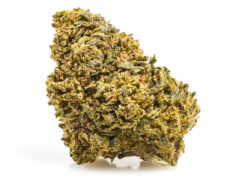
 Max CBDAMNESIA CBD BOOSTStarting from: 0,85 €/g
Glasshouse | CBD<40%
Grams5 10 20 50 100 200 400 -
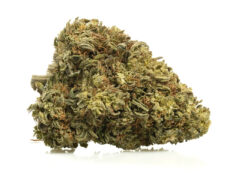
Max CBDAK47 CBD BOOST
Indoor | CBD<47%
Starting from:HALLOWEEN SALE -10%
1,45 €1,30 €/gGrams5 10 20 50 100 200 -
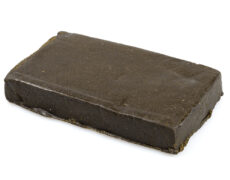
Max CBDCHARAS
CBD HASH | CBD<45%
Starting from:HALLOWEEN SALE -10%
0,90 €0,80 €/gGrams5 10 20 50 100 200 -
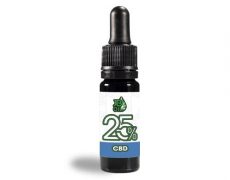
JB OIL 25%Starting from: 14,90 €
CBD Oil 25%
The aim of compliance-focused content is not to scare the reader or make legal promises. It is to make the page transparent enough for a customer to compare two products based on facts rather than adjectives.
Understanding CBD flower compliance in practical terms
CBD flower compliance is the practice of understanding a product through the visible details available to the reader: the product name, the label data, the batch reference, the analytical document and the wording used to describe them. It is a way of reading product information clearly, not a substitute for legal advice.
For CBD flower pages, compliance helps create a consistent way to compare different products. A description that stays connected to available documents is much more useful than one built around exaggerated claims. The label and supporting documents provide the essential information; the page text acts as a guide to help the reader navigate those details.
In our view, the cleanest way to think about CBD flower compliance is to follow a simple reading order: identify the product category first, then check the label, the batch code, the analytical document, and finally the descriptive information. When these elements work together, the page becomes clearer, more structured, and easier to understand.
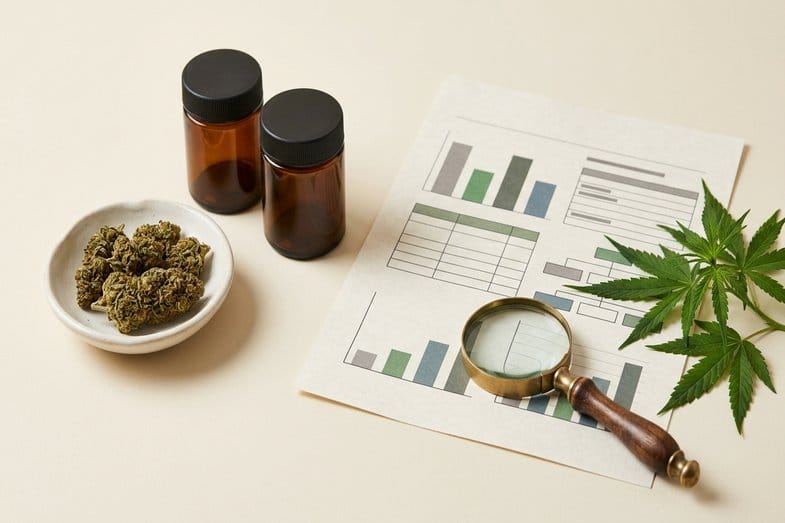
Read also: CBD Flower Lab Report: What It Shows and Why It Matters
What a CBD flower label is designed to show
A CBD flower label, despite its limited surface, is expected to perform several functions at once. Product name, CBD percentage context, batch reference, intended technical, scientific or ornamental positioning, age limit, and the registered Cannabis Sativa L. variety on which the flower was grown all need to fit somewhere on the package. The label is small but the information it carries is layered.
Think of a label as a passport for the flower. It identifies the bearer, names the issuing context (the hemp variety, the producer) and carries a serial number (the batch code) that links back to a more detailed record (the document). A label alone does not tell the whole story; rather, it opens the door to the supporting documentation behind the product.
A well-structured CBD flower page should present the same key details on the product packaging, allowing readers to verify the information without needing to inspect the product directly. The label on the bag and the label data shown on the page should match line by line.
Batch codes: the bridge between the label and the document
Batch codes are the part of the label that often gets ignored. They look like a string of letters and digits, small and unassuming, and yet they carry the whole connection between a specific product lot and the analytical paperwork behind it.
The batch code tells the producer and the careful reader which harvest, which curing run and which laboratory analysis the flower belongs to. Without a batch code, two visually identical products could come from different lots with slightly different cannabinoid percentages, terpene profiles or storage histories, and there would be no way to tell.
For CBD flower compliance, the batch code is the link in the chain between general description and lot-specific evidence. Whenever a label looks generic, look for the batch code as your first verification step. If it is missing, the compliance story is incomplete before you have even read the rest of the page.
Lab reports and what cannabinoid profile listings cover
A CBD flower lab report, also called a certificate of analysis, is a document produced by an analytical laboratory after testing a specific batch. The certificate usually reports the cannabinoid profile (CBD, CBG, CBC, CBN, THC and other cannabinoids when measured), water content, contaminants where tested (heavy metals, pesticides, mycotoxins) and the analytical methods used.
The HPLC method, short for high-performance liquid chromatography, has been widely used for cannabinoid quantification in plant material since the 1970s, when the first stable protocols were validated. Today, a CBD flower analytical document is essentially a small spreadsheet on letterhead, with a structure that looks broadly similar across laboratories: rows for each compound, columns for the value and the analytical method, sometimes a graph of the chromatographic peaks alongside.
For a reader, the lab report turns a label number into a verified picture. The CBD percentage on the label is supported by the analytical reading; the THC sits below the regulatory threshold for industrial hemp; the cannabinoid profile shows what other compounds are present in measurable amounts. This is where compliance language stops being decorative and becomes substantive.
The EU industrial hemp framework as background
European industrial hemp is grown under a shared agricultural framework. Regulation (EU) 2021/2115 within the Common Agricultural Policy sets the rules for cultivation and the registered varieties that qualify for CAP support, with a harmonised THC threshold of less than 0.3 percent at harvest. The list of registered hemp seed varieties is maintained in the European Catalogue of varieties of agricultural plant species, an instrument whose modern form dates back to the 1972 Common Catalogue of varieties of agricultural plant species.
That EU framework is the agricultural baseline behind every CBD flower page that mentions “industrial hemp grown in the EU“. It is not, by itself, a commercial rulebook for the sale of CBD products in each national market, where individual countries may add their own provisions on commerce, labelling and product positioning.
For compliance copy, the takeaway is straightforward: the EU framework sets the cultivation baseline, the national rules add the commercial lens, and the product page sits at the intersection of both. A clear page does not collapse the two layers; it lets the reader see them as connected but distinct.
How Justbob makes batch documents visible
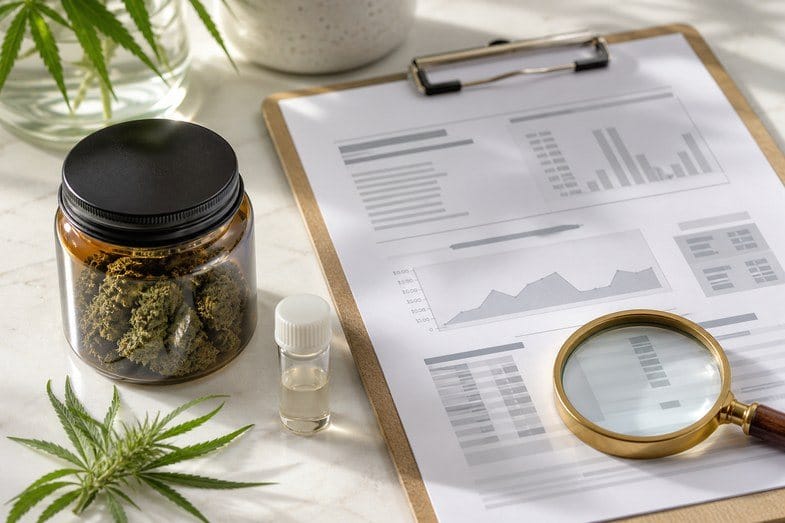
Justbob carries out constant analyses on all commercialised products and on every batch. The relevant documents are available on each commercialised product page, so the reader can move from the label number to the analytical document without leaving the catalog.
That habit changes the way the page reads. The reader is not asked to trust a slogan; they are invited to open the document and read the numbers. The label says what to look for, the batch code provides the address, and the document gives the detail. Three small steps, applied consistently across the catalog.
The same routine applies whether you are reading a CBD flower page, a CBD hash page or a CBD oil page. The format of the document differs, but the reading sequence is identical. A useful companion article on the regulatory side is CBD Flower Legal Framework: The Rules Behind The Label, which sits beside this one as a more detailed legal-context piece.
Reading a CBD flower page: a five-step routine
- The first step is the product family. Identify whether the page is in the CBD flower category, the CBD hash category or somewhere else. This sets expectations for what the rest of the page should describe.
- The second step is the label. Read the product name, the CBD percentage context, the THC threshold language and the intended positioning, with phrases like “for technical, scientific or ornamental use” and “for adults”. Check the registered hemp variety if listed on the page.
- The third step is the batch code. Find it on the label and on the product page. The two should match. If the page does not display a batch code at all, the compliance story is incomplete.
- The fourth step is the analytical document. Open it, scan the cannabinoid profile, confirm that the THC value sits within the regulatory threshold and that the CBD percentage matches the label range. Read the contaminants section if present.
- The fifth step is the descriptive language. Once the documents have been checked, the wording around the photo (aroma family, visual texture, trim notes) becomes safe to read on its own terms.
Common ambiguities to read carefully
The CBD percentage on a CBD flower label is usually a maximum value obtained through laboratory analysis for that genetic line. Batches can vary slightly from one another within the same variety, which is why a small range above the certified value is more honest than a single absolute number. A page that acknowledges this variability reads as more reliable than a page that suggests every flower is identical.
Another common ambiguity is the difference between a registered hemp variety and a CBD-rich variety. The first is a legal classification: the variety is listed in the European Catalogue and respects the THC threshold. The second is a commercial description that may or may not be supported by the analytical document. Compliance reading keeps these two separate, with the legal classification anchored to the catalogue and the commercial wording anchored to the lab report.
A third area is the relationship between the cannabinoid profile and the page wording. If a page describes a flower in poetic language but the analytical document shows a low CBD value, the wording is not necessarily misleading, but it asks the reader to do extra work. A clearer page lets the document speak first and uses descriptive language to add the visual and aroma layer.
Read also: CBD Flower Lab Testing: What the Checks Show
When wording stays compliance-safe
Compliance-safe wording describes the product, the label, the batch and the document. It does not promise personal outcomes, provide usage instructions, or position the product as an alternative to anything else. Those boundaries are not a rhetorical limitation; they are part of what makes a CBD flower page clear and understandable across markets.
For a CBD flower compliance reading, the wording should also remain specific. A description like “aromatic hemp flower with citrus and earthy notes” describes the aroma; a description like “intensely powerful CBD flower for unbeatable relaxation” describes the marketer rather than the product. The first wording earns the reader’s attention; the second risks losing it.
A clearer way to read CBD flower compliance
CBD flower compliance is not defined by a single detail. It is the result of several elements working together: the product category sets the context, the label provides the visible information, the batch code connects the product to its specific record, the laboratory document adds analytical support, and the descriptive language completes the picture.
This reading approach changes the way a customer looks at a CBD flower page. Instead of focusing on isolated claims or decorative wording, the reader can follow a clear path from the product description to the supporting information behind it. Transparency does not mean adding more words; it means making the right details easier to find and easier to understand. A well-structured page allows product information, labels and documents to work together, creating a more complete view of what is being presented.
🌿 Want to compare CBD flower products with this routine in mind? Visit the Justbob online store and discover all our CBD products!
Frequently asked questions about CBD flower compliance
What does CBD flower compliance mean?
CBD flower compliance means reading a product through visible details: the label, the batch code, the analytical document and the wording on the page. It is a practical reading discipline, not legal advice.
Why does the batch code matter?
The batch code is the link between a specific product lot and its analytical document. Without a batch code, a label cannot be checked against the laboratory analysis that supports it.
Where can I find CBD flower lab reports?
On Justbob, analytical documents are available inside each commercialised product page. The reading routine is to identify the product family, read the label, find the batch code and then open the corresponding document.