
Published on: 07/10/2026
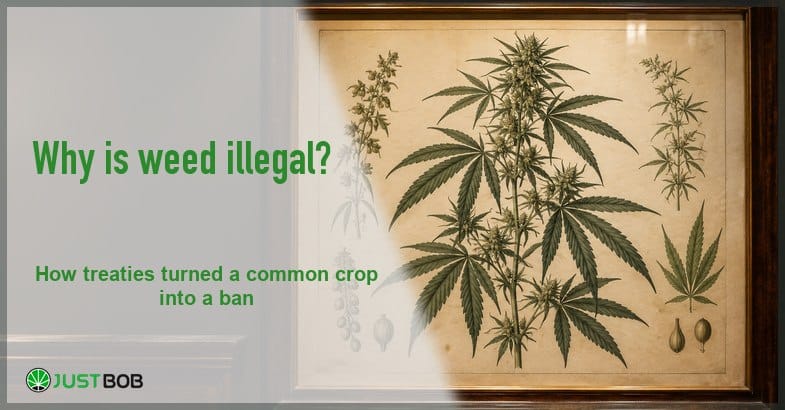
Why is weed illegal, when it was legal for most of human history?
For thousands of years cannabis was simply another useful plant, grown for fibre, seed and medicine across continents without a criminal record to its name. Its prohibition is barely a century old. So the honest question is not why it was banned, but why such an ordinary crop was singled out so late and so suddenly.
-
 Max CBDAMNESIA CBD BOOST
Glasshouse | CBD<40%
Starting from:FLASH SALE -10%
0,85 €0,75 €/gGrams5 10 20 50 100 200 400 -
Max CBDAK47 CBD BOOSTStarting from: 1,45 €/g
Indoor | CBD<47%
Grams5 10 20 50 100 200 -
Max CBDCHARASStarting from: 0,90 €/g
CBD HASH | CBD<45%
Grams5 10 20 50 100 200 -
JB OIL 25%Starting from: 14,90 €
CBD Oil 25%
This is a history piece rather than a legal guide. We will trace how cannabis went from farmyard staple to controlled substance, the treaties and politics that drove it, and why industrial hemp was eventually carved back out. A note first: this explains a story, it does not encourage anything, and current rules vary by country.
A plant that was legal for almost all of its history
Cannabis has travelled with humanity for a very long time. Hemp rope rigged sailing fleets, hemp fibre made paper and cloth, and the plant appears in the pharmacopoeias and farm records of cultures from China to the Islamic world to colonial Europe. For most of that span it was uncontroversial, closer to flax or barley than to anything forbidden.
That long normality is the part modern readers forget. Prohibition is the historical exception, not the rule, and it arrived only when a set of twentieth-century pressures lined up against the plant at once.
Cannabis spent millennia as an ordinary crop and barely a hundred years as a banned one.
Read also: The Origin Of Cannabis: A Long History
The turning point: international treaties
The first real machinery of prohibition was international. Early twentieth-century drug-control diplomacy, built around a series of conventions, gradually pulled cannabis into the same regulatory net as opium and cocaine. The 1925 Geneva convention was a notable step, adding cannabis to the list of internationally controlled substances at the urging of several states.
What matters here is the mechanism. Once cannabis sat inside an international treaty framework, individual countries were expected to legislate against it at home, and a local plant became a global legal category almost overnight. The story of how cannabis was understood historically makes the scale of that shift clearer.
American politics and the 1937 turn
The United States gave prohibition its sharpest push. Through the 1930s a campaign combined lurid public messaging with legislative action, culminating in the 1937 Marihuana Tax Act, which effectively criminalised the plant through punitive taxation. The rhetoric of the era leaned heavily on fear and, uncomfortably, on the racial politics of the time.
Historians still debate how much economic self-interest played a role, with long-running arguments about rival industries wanting hemp out of the way. That thread is genuinely contested rather than settled, so we flag it as a live historical debate rather than a proven cause. What is clear is that the American turn set a template many other countries would follow.

The 1961 convention that globalised the ban
The decisive moment came in 1961, with the Single Convention on Narcotic Drugs. It placed cannabis in the strictest control categories and committed signatory nations, most of the world, to prohibiting its non-medical, non-scientific use. This is the treaty that turned a patchwork of national bans into a near-global standard.
For decades that framework held with little movement. In our view it is the single most important document for understanding the modern legal map: almost every national cannabis law written since is, in some way, a response to the obligations set in 1961.
Why industrial hemp escaped the ban
Here is the twist that brings the story up to date. The plant that was banned is the intoxicating one, and lawmakers eventually recognised that low-resin industrial hemp is a different proposition. Hemp grown for fibre and seed, kept under a strict THC ceiling, does not carry the intoxicating load that prohibition was aimed at.
Europe formalised exactly that distinction. Hemp grown from varieties in the EU Common Catalogue and kept under the harmonised 0.3 percent THC ceiling is treated as an agricultural crop, a threshold set out in Regulation (EU) 2021/2115 and in force since 2023. That carve-out is why compliant hemp and its derivatives sit outside the narcotics framework entirely.
It is also why a modern CBD flower exists as a lawful product at all. The prohibition targeted intoxication; compliant hemp was allowed back precisely because it falls under that line.
Why weed is illegal, in three movements
Three acts tell the story. Cannabis was a normal crop for most of history. A twentieth-century sequence of treaties and national politics, crowned by the 1961 Single Convention, turned it into a globally controlled substance. And a later, narrower correction let low-THC industrial hemp back out, which is where compliant CBD lives today.
The ban was never really about the plant as a whole, but about one property of one version of it.
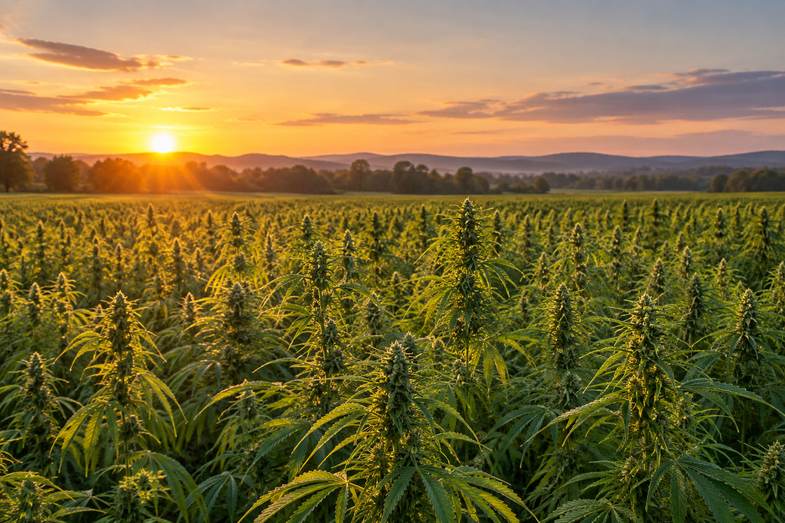
What the Justbob catalogue offers is hemp grown by EU partners from catalogue varieties, analysed batch by batch, and sold for technical and ornamental purposes.
Read also: Cannabis In Art History: Symbols And Botany
Frequently asked questions about why weed is illegal
Why is weed illegal?
Cannabis was legal for most of history and became widely prohibited only in the twentieth century. The ban was driven by international drug-control treaties, notably the 1925 Geneva convention and the 1961 Single Convention on Narcotic Drugs, alongside national politics such as the United States’ 1937 Marihuana Tax Act. Together these turned a common crop into a globally controlled substance in the space of a few decades.
Was cannabis always illegal?
No. For thousands of years cannabis was an ordinary plant grown for fibre, seed and medicine across many cultures, closer in status to flax or barley than to a forbidden substance. Prohibition is a recent historical exception rather than the long-standing rule, arriving only when a set of twentieth-century treaties and political campaigns lined up against it.
What role did the 1961 convention play?
The 1961 Single Convention on Narcotic Drugs was decisive. It placed cannabis in the strictest control categories and committed most of the world’s nations to prohibiting non-medical, non-scientific use. It transformed a patchwork of separate national bans into a near-global standard, and most national cannabis laws written since have been shaped by its obligations.
Why is industrial hemp legal if cannabis was banned?
Because the ban targeted intoxication, and low-resin industrial hemp does not carry it. Lawmakers eventually distinguished hemp grown for fibre and seed, kept under a strict THC ceiling, from the intoxicating plant. In Europe, hemp from EU Common Catalogue varieties under the 0.3 percent THC threshold is treated as an agricultural crop, which is why compliant hemp and CBD sit outside the narcotics framework.