
Modified on: 30/07/2026
What Trichomes Mean on a Hemp Flower Page
Trichomes are the small glandular hairs that cover the surface of a hemp flower and produce most of the cannabinoid and terpene fraction that the catalog page eventually describes. The word appears on product listings, lab certificates, glossaries and visual guides, and a reader who knows what trichomes are can pick up the resin coating on a bud photograph and link it back to the cannabinoid percentage on the document. This Justbob guide walks through the botany of trichomes, the main forms a reader can spot on a hemp flower, and the way the trichome layer connects to the rest of the product page.
-
 Max CBDAMNESIA CBD BOOSTStarting from: 0,85€/g
Glasshouse | CBD<40%
Grams5 10 20 50 100 200 400 -
Max CBDAK47 CBD BOOSTStarting from: 1,45€/g
Indoor | CBD<47%
Grams5 10 20 50 100 200 -
Max CBDCHARAS
CBD HASH | CBD<45%
Starting from:FLASH SALE -10%
0,90€0,80€/gGrams5 10 20 50 100 200 -
JB OIL 25%Starting from: 14,90€
CBD Oil 25%
The goal is botanical literacy. After a quick read, a trichome reference on a CBD flower listing should be legible at a glance, and the link between the photographic resin frost and the cannabinoid figure on the certificate should make sense without any chemistry detour.
Trichomes as the resin factories of the hemp plant
Trichomes are tiny outgrowths of the epidermis, the outer layer of the hemp plant tissue, that develop on the calyces, on the sugar leaves and along the stems. The most studied trichomes on a hemp inflorescence are the glandular kind, where each hair carries a small bulbous head that synthesises and stores the cannabinoid and terpene fraction of the variety. The non-glandular trichomes, simpler and hair-like, play a defensive role for the plant and carry no significant resin content.
For a CBD flower reader, the glandular trichomes are the ones that matter. They are responsible for the resin frost that catches the light on the catalog photo, for most of the aroma compounds that the variety projects, and for the cannabinoid percentage that appears on the certificate of analysis.
Read also: Marijuana resin: the role of resin in the cannabis plant
The three main trichome forms on a hemp bud
Glandular trichomes on a hemp bud appear in three main forms, distinguished by size and structure. Bulbous trichomes are the smallest, with a head a few tens of microns wide, sitting directly on the plant tissue without a stalk. Capitate-sessile trichomes are mid-size, with a slightly larger head still sitting flush on the epidermis. Capitate-stalked trichomes are the largest of the three, with a clear stalk that lifts the head off the surface and a round translucent gland at the tip.
The capitate-stalked form is the one that catches the light on most catalog photographs. It can reach a height of around 100 to 500 microns including the stalk, which makes it visible under a ten-times loupe and recognisable on a high-resolution close-up of the bud.
Capitate-stalked trichomes: the photogenic glandular hair
Capitate-stalked trichomes are the iconic image of a hemp flower under magnification. The stalk is a thin elongated cell column; the head is a round translucent gland; the combined shape reads like a small mushroom or a tiny golf-tee emerging from the surface of the bud. Cannabinoid biosynthesis happens in a thin layer at the top of the head, where cannabinoids and terpenes are produced and accumulate inside the gland, shaping the flower’s unique terpene profile and overall aromatic character.
A reader observing a capitate-stalked trichome through a loupe can see a small clear sphere lifted off the calyx surface, sometimes catching the daylight in a brief glint. The density of these trichomes across the calyx is one of the visible signals that a CBD flower lot has reached a mature ripening stage.
Capitate-sessile and bulbous trichomes: the smaller cousins
Capitate-sessile and bulbous trichomes are smaller and harder to see without higher magnification. The capitate-sessile form has a head around 30 to 100 microns wide, attached directly to the plant surface; the bulbous form is the smallest, often under 30 microns. Together with the capitate-stalked trichomes, they cover the calyces in a layered pattern that gives the hemp inflorescence its characteristic resin shine.
Bulbous and sessile trichomes carry a smaller fraction of the cannabinoid load than the stalked form, but they still contribute to the overall resin profile of the variety. A laboratory that runs a careful cannabinoid quantification on a lot is measuring the combined output of all three trichome forms.
Trichome heads under a loupe: clear, milky and amber stages
The trichome heads change colour as the hemp inflorescence matures, and the shift gives a reader a useful maturity signal. Early in the ripening cycle, the heads read as clear and translucent, with a fresh glass-like appearance under a loupe. As the lot matures, the heads turn milky, with a soft cloudy interior that diffuses the light. In the final stage, some of the heads turn amber, with a warm honey or caramel tone that reads through the gland wall.
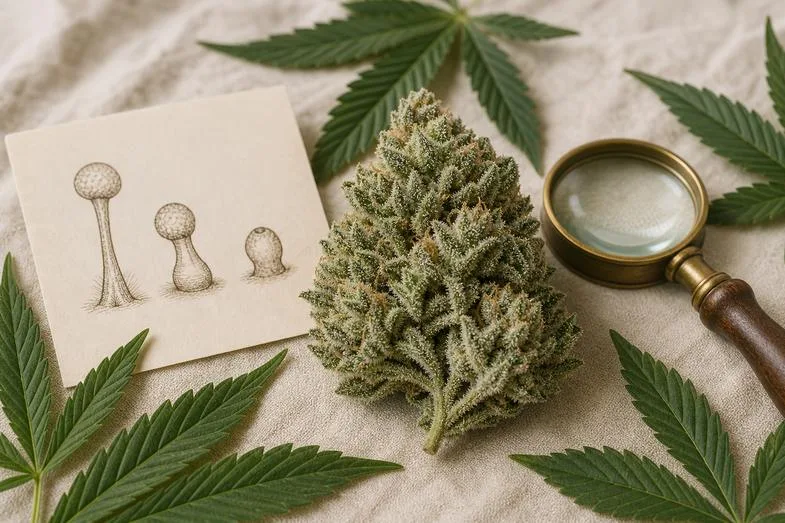
A bud that shows mostly clear heads under a loupe usually signals an early harvest; a bud with milky and amber heads in a mixed pattern usually signals a mature lot. The cannabinoid percentage on the certificate tends to align with this maturity reading: more developed trichome layers usually report higher cannabinoid figures, within the limits of the registered variety.
How trichome density reads on a catalog photo
Trichome density on a hemp bud appears on the catalog photograph as a silvery or pale amber frost that catches the light along the calyces. A heavily frosted bud carries a dense trichome layer; a lightly frosted bud carries a sparser layer. The visible frost is the macroscopic signature of the microscopic trichome structure, and it is one of the most reliable visual cues on a CBD flower listing.
Photography matters. A well-lit catalog photo on a neutral background lets the trichome layer read clearly; an over-filtered photo flattens the frost and reduces the visible information.
For a broader overview of the visual indicators that help assess flower quality, the article How to Know If My Weed Is of Good Quality? Here’s Everything You Need to Know offers additional insights into what to look for when examining cannabis flowers.
A page that shows a heavily frosted bud and reports a 14 percent CBD reading on the certificate sits in agreement; a page that shows a sparse trichome layer and reports a similar figure usually has more to explain.
Trichomes and the cannabinoid panel on the certificate
The cannabinoid panel on a CBD flower certificate is, in practical terms, a quantitative reading of what the trichomes have synthesised. The CBD percentage, the THC value, the CBG, CBN and CBC entries all come from the resin fraction concentrated in the trichome heads of the lot. A certificate that reports 14 percent CBD is reporting the cumulative output of all the glandular trichomes on the sampled inflorescences.
Our reading is that the photograph and the certificate work as two views of the same trichome reality. The photograph shows the visible side (frost density, light catch, surface coverage); the certificate shows the quantitative side (cannabinoid percentages by weight). A coherent page keeps the two views aligned.
A short history of trichome observation
The microscopic observation of plant trichomes has a long pedigree in European science. Antoine van Leeuwenhoek, the Dutch textile merchant and self-taught microscopist of Delft, built single-lens microscopes in the 1670s that reached magnifications of around 270 times, far beyond what compound microscopes of his era could achieve. He communicated his findings to the Royal Society of London through a series of more than 200 letters, starting in 1673, and was elected a Fellow of the Society in 1680.
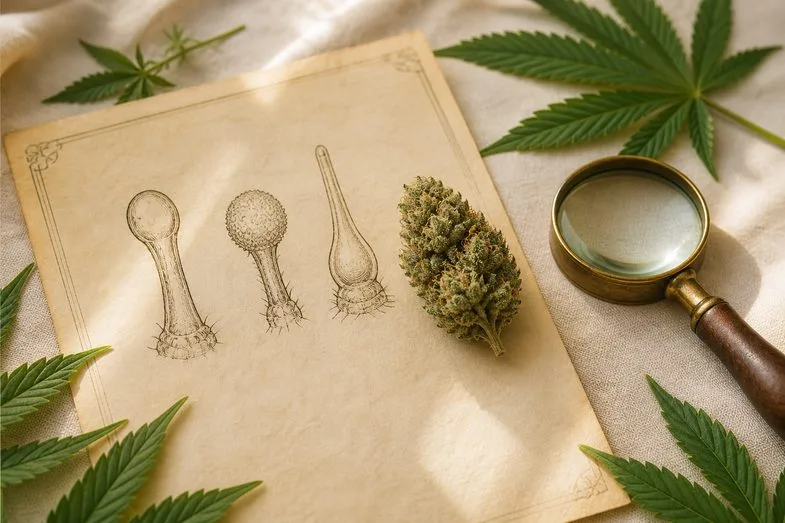
Leeuwenhoek’s observations covered a wide range of biological surfaces, including the epidermal hairs of plant material, and his single-lens approach gave a precision of vision that opened the way for the systematic botanical microscopy of the following centuries. A 2026 reader who picks up a ten-times loupe and looks at the trichome layer on a hemp bud sits in that observational tradition: a small lens, a steady hand and an interest in what the surface actually carries.
How Justbob keeps the trichome reading visible to readers
Justbob carries out constant analyses on all commercialised products and on every batch. The relevant documents are available inside each commercialised product page, so a reader who wants to confirm the cannabinoid breakdown, the THC threshold compliance or the trichome-related cannabinoid panel for a specific lot can open the certificate of analysis without leaving the catalog.
The visual side runs in parallel with the document side. A photograph that captures the trichome frost on the bud supports the cannabinoid percentage that the laboratory measured; the certificate confirms the trichome reading in quantitative terms; the EU industrial hemp catalogue framework keeps the regulatory part of the document on common ground.
The framework around all of this is the EU industrial hemp register, with THC kept below the 0.3% threshold harmonised at European level. The registered variety contributes the trichome density baseline; the post-harvest finishing protocol preserves the trichome layer through to the jar; the certificate closes the lot record.
Read also: CBD Flower Lab Report: What It Shows and Why It Matters
Compliance-safe wording on trichome-led pages
Compliance-safe wording for a trichome-led CBD flower page stays strictly descriptive of botany and chemistry. “CBD flower with a dense capitate-stalked trichome layer, mostly milky heads with a few amber, 14 percent CBD reading per lab document” describes the product. “Premium trichome-rich flower for unforgettable resin power” describes the marketer. The first earns the reader’s attention; the second sets off the signals that brought the page under review.
Hemp flowers are sold for technical, scientific and ornamental purposes only, in line with the EU industrial hemp framework. The trichome vocabulary, the resin density description and the cannabinoid percentages are part of how the product is positioned on the catalog. They are not directives, not benefits and not alternatives to other regulated product categories.
The test is simple. If the trichome description helps a reader read the photograph and the certificate, the page is using the words as botanical vocabulary. If the description invites a reader to do something with the product, the page has stepped outside the safe lane.
A short reading routine for trichomes on a hemp bud listing
Reading the trichome layer on a CBD flower listing is a quick discipline. Look at the catalog photograph for the silvery or amber frost on the calyces; identify the visible trichome forms if the resolution allows (capitate-stalked heads are the most photogenic); estimate the head colour mix (clear, milky, amber) if a close-up is available; cross-check the trichome density against the cannabinoid percentage on the certificate; confirm the THC value sits at or below the 0.3 percent threshold harmonised at European level.
🌿Once these visual cues become familiar, comparing CBD flowers becomes a more informed process. Explore our CBD flower selection to discover products where trichome appearance, cannabinoid profile, and quality information come together to provide a clearer understanding of each variety.
Frequently asked questions about what are trichomes
What are trichomes on a hemp plant?
Trichomes are small glandular hairs that develop on the epidermis of the hemp flower and the surrounding sugar leaves. The glandular kind synthesise and store the cannabinoid and terpene fraction of the variety, and they produce the silvery or amber frost that catches the light on a catalog photograph of a hemp bud.
What are the three main trichome forms on a hemp bud?
The three main trichome forms are bulbous (the smallest, under 30 microns, sitting flush on the surface), capitate-sessile (mid-size, around 30 to 100 microns, also sitting flush) and capitate-stalked (the largest, around 100 to 500 microns including the stalk, with a clear stem and a translucent head). The capitate-stalked form is the most photogenic and the one usually visible under a ten-times loupe.
What do the colours of trichome heads mean?
The trichome heads change colour as the hemp lot matures. Clear heads usually signal an early harvest; milky heads usually signal a more mature lot; amber heads appear in the final ripening stage. A bud with a mixed milky-and-amber pattern usually reads as a fully mature variety, with cannabinoid percentages near the variety baseline on the certificate.