Modified on: 15/06/2026
What a product photo can show and what it cannot
A hemp flower photo is the first thing you see on a listing, and it does a lot of work before you read a word. The catch is that a photo is persuasive: careful lighting and a flattering angle can make any bud look impressive. Visual checks are a short habit for reading what a photo actually shows, and knowing where it stops. On Justbob pages the photo is a starting point, with the label and the document carrying the rest.
-
 Max CBDAMNESIA CBD BOOSTStarting from: 0,85€/g
Glasshouse | CBD<40%
Grams5 10 20 50 100 200 400 -
Max CBDAK47 CBD BOOSTStarting from: 1,45€/g
Indoor | CBD<47%
Grams5 10 20 50 100 200 -
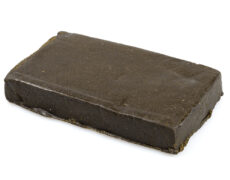
Max CBDCHARAS
CBD HASH | CBD<45%
Starting from:SUPER SALE -20%
0,90€0,70€/gGrams5 10 20 50 100 200 -
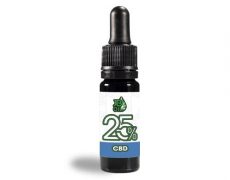
JB OIL 25%Starting from: 14,90€
CBD Oil 25%
The order is easy to remember: eye first, document last. Start with what you can see, then let the paperwork confirm it, and a photo stops being able to oversell.
What visual checks really cover
Visual checks are the parts of a product you can judge from a photo: the trim, the structure of the bud, the frost of trichomes and the spread of colour. They describe appearance, and appearance only. A visual check tells you what a flower looks like, not how it scores or what sits inside the document.
The honest framing is that the eye gathers clues and the paperwork settles them. A photo is evidence of appearance; it is not proof of anything beyond that. Keeping that line clear is the whole point of a visual check.
Trim, structure and trichome frost
A few features carry most of what a photo reveals:
- Trim: how closely the leaf has been cut back from the bud, visible as a neat or looser outline.
- Structure: how the bud is formed, from tight and compact to airy and open.
- Trichome frost: the fine, crystal-like covering on the surface, visible as a pale sheen.
- Pistils: the fine hairs, often orange or amber, threaded through the bud.
Each of these is a description, not a rating. A compact bud and an airy one differ in form, and neither is being ranked here; they are simply being read.
Why colour needs care
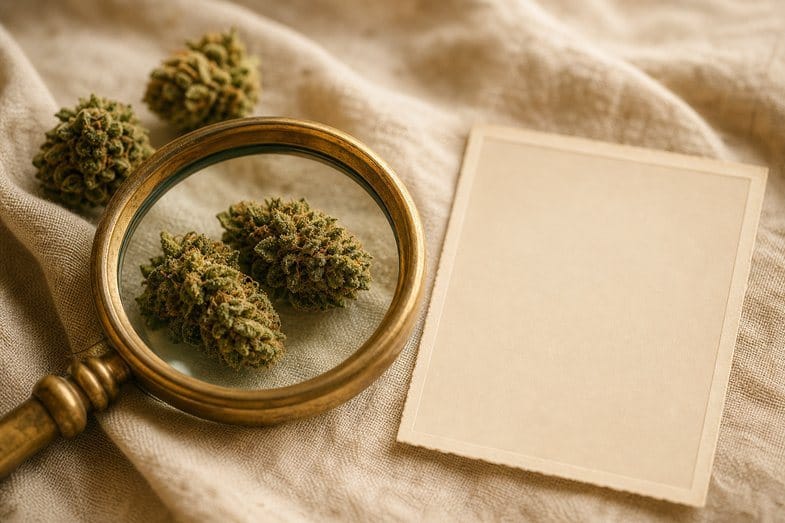
Colour is the cue a photo handles worst. Hemp flower ranges from deep green to pale, with flashes of purple or amber depending on the variety, but a photograph never shows colour neutrally. Lighting, white balance and the screen all shift what you see, so the same bud can look greener or warmer in two different photos.
This is why colour is best read as a rough impression, not a measurement. A photo can tell you a flower is broadly green or carries purple tones; it cannot tell you an exact shade, and an exact shade would not be a score anyway.
Read also: CBD Flower Certificates: What To Read First
Where photos learned to need a reference
Photographers solved this colour problem a long time ago, with a small card. In 1976, the researcher Calvin McCamy and two colleagues published the ColorChecker, a grid of standard colour patches placed in a shot so the colours could be calibrated afterwards. It exists precisely because a photograph cannot be trusted to render colour on its own.
That little chart carries a useful lesson for reading any product photo. If professionals need a reference card to trust colour in an image, a reader looking at a single listing photo should hold its colours loosely, and let the written page do the exact work.
Matching the photo to the page
A photo earns its place once it is matched to the rest of the listing. The CBD flower pages put the image next to the label figures and the linked document, so the appearance you see can be checked against the variety and the batch on record.
For the appearance features themselves, in more detail, our guide on Hemp Bud Appearance: What To Actually Check goes through each one, so a photo becomes easier to read at a glance.
Read also: Hemp Flower Glossary: Clear Product Terms
Visual checks on a Justbob page
Behind every Justbob listing, the commercialised product and its batch are analysed, and the certificate stays inside the product page. A reader can line up the photo with the registered variety, the CBD figure and the THC reading for that exact lot, from the same page.
Every hemp flower sits inside the EU industrial hemp framework, grown by EU producers from registered hemp varieties, with THC kept at or below the 0.3 percent threshold harmonised at European level. Hemp flower is offered for technical, scientific and ornamental purposes only. The photo is treated here as a visual reference, checked against the document rather than trusted on its own.
What a photo cannot show
A photo has a hard ceiling. It cannot show the cannabinoid figures, the THC reading or the contaminant screens, all of which live in the certificate of analysis. It cannot prove that a flower is good, because good is not something a picture can carry, and it stays on appearance, which is all an image can honestly show.
So the eye opens the page and the document closes it. A visual check is worth running because it is quick and honest, as long as it ends where it should, at the paperwork. For the regulator’s plain-language take, free of any product to sell, the Food Standards Agency CBD guidance sets out the public backdrop.
Frequently asked questions about hemp flower visual checks
What are hemp flower visual checks?
Hemp flower visual checks are a short habit for reading what a product photo shows: the trim, the structure of the bud, the frost of trichomes, the pistils and the spread of colour. They describe appearance only, and they work best as a first step, with the label and the certificate of analysis confirming the detail. A visual check reads a flower; it does not rank it.
Can photos prove quality?
No. A photo can show appearance, but it cannot prove that a flower is good. Lighting and angle flatter an image, and colour in particular shifts from one photo to the next, so a picture is a rough guide rather than a measurement. The figures that actually describe a lot live on the label and in the certificate of analysis, not in the photo.
Why compare photos with batch documents?
Because the photo and the document describe the same lot from two sides. The photo shows appearance; the certificate of analysis carries the cannabinoid panel, the THC reading against the 0.3 percent threshold harmonised at European level and the contaminant screens. Matching the variety and batch code on the label to the certificate confirms that the bud in the picture and the figures on the page belong together.