

Modified on: 27/05/2026
Reading hemp buds, stems and leaves as plant parts
A hemp plant is a small piece of botany packed with vocabulary. The visible parts of the plant, the buds at the top, the stems along the structure and the leaves on the sides, all have specific names and specific roles inside the catalog of European industrial hemp. This Justbob guide walks through hemp buds, stems and leaves as plant parts, with the precise vocabulary that travels onto a CBD product page.
-
 Max CBDAMNESIA CBD BOOSTStarting from: 0,85€/g
Glasshouse | CBD<40%
Grams5 10 20 50 100 200 400 -
Max CBDAK47 CBD BOOSTStarting from: 1,45€/g
Indoor | CBD<47%
Grams5 10 20 50 100 200 -
Max CBDCHARAS
CBD HASH | CBD<45%
Starting from:SUMMER SALE -10%
0,90€0,80€/gGrams5 10 20 50 100 200 -
JB OIL 25%Starting from: 14,90€
CBD Oil 25%
The aim is to give the reader a portable botanical map. After a few pages, the names of the parts and the relationships between them become legible at a glance.
What “hemp buds, stems and leaves” describes on a product page
Hemp buds, stems and leaves are the three main visible parts of the Cannabis sativa L. plant, and the three names appear regularly on CBD product pages, in catalog descriptions and on lab reports. The bud is the flowering structure at the top; the stem is the woody backbone that holds the plant together; the leaves are the broad, palmate fronds along the structure.
For a CBD flower reader, the three names function as a botanical glossary. Each part has its own composition, its own role in the plant biology and its own relevance for the product on the page.
In our view, the most useful CBD product pages keep the plant-part vocabulary explicit. A page that names the parts gives the reader a verifiable map; a page that uses generic words instead loses the botanical grounding.
The bud: the flowering part of the female plant
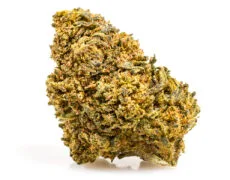
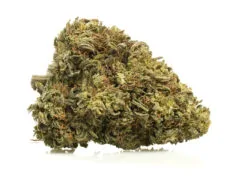
The bud is the flowering structure of the female hemp plant. It develops at the top of the main stem and at the tips of the lateral branches, with a structure made of small overlapping bracts that protect the developing seed and host the highest density of resin glands on the plant.
The bud is the part of the hemp plant that carries the most cannabinoids and the most terpenes. The compact structure, the visible resin coverage and the layered colour of the flower all come from this concentration. The bud is what a CBD flower page shows in the catalog photo and describes in the product copy.
For the reader, the bud is the visible signature of the product. The bud structure, the trim quality and the colour balance are all read directly from the photo, with the lab report confirming the cannabinoid breakdown.
The stem: the structural backbone
The stem is the woody central axis of the hemp plant. It can grow from a few centimetres in compact varieties to several metres in the taller industrial fibre varieties, with a hollow internal structure and a fibrous outer layer that has been used for fibre production across centuries.
The stem holds the plant upright and provides the vascular pathway between the roots, the leaves and the buds. Inside the stem, the bast fibres (the long fibres of the outer layer) and the hurd (the woody core) make up the two main material fractions used by the industrial hemp fibre tradition.
For the reader, the stem is mostly relevant on the agricultural side of the framework, where hemp is cultivated for fibre or for dual-purpose use. On a CBD flower product page, the stem is the structural background of the bud rather than the focus of the product.
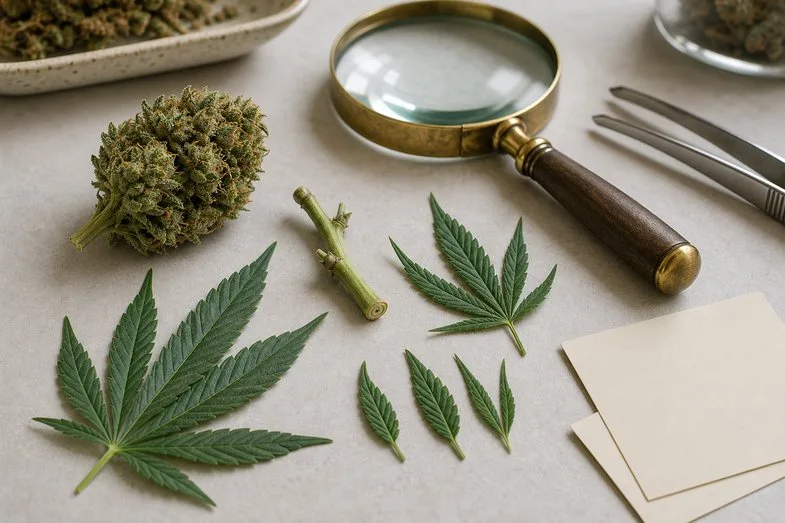
The leaves: fan leaves vs sugar leaves
Hemp leaves come in two recognisable varieties on a single plant: fan leaves and sugar leaves. The fan leaves are the large, palmate fronds with the iconic five-to-nine pointed lobes; they grow along the stem and the branches and are the most visually recognisable hemp feature for non-specialist readers. The sugar leaves are the smaller leaves that grow inside and around the bud, often coated with visible trichomes that give them a frosted appearance.
The fan leaves are the part of the plant that handles photosynthesis. They are large, broad and arranged in symmetrical pairs along the stem, with a distinctive palmate shape that Carl von Linnaeus described when he formally classified the species as Cannabis sativa in 1753.
The sugar leaves sit closer to the bud and inherit part of the resin coverage of the inflorescence. They carry a smaller fraction of cannabinoids and terpenes than the bud itself, but more than the fan leaves. On a CBD flower page, the sugar leaves often remain on the trimmed bud as part of the final structure.
Trichomes: the resin glands across all parts
The trichomes are the small resin glands that produce the cannabinoids and the terpenes of the hemp plant. They appear as tiny stalked structures, mostly on the bud and the surrounding sugar leaves, with smaller numbers on the fan leaves and almost none on the stems.
A close-up of a hemp bud usually shows the trichomes as fine glints under reasonable light. The density of trichomes is one of the visible cues that distinguishes a well-developed bud from a less mature one. The chemistry of the plant lives inside these small glands.
For the reader, the trichomes are what turn the botanical map into the cannabinoid map. The cannabinoid percentages on a lab report come from the analytical extraction of the trichome contents; the visible coverage on the photo gives an immediate sense of the resin density.
What stays in CBD flower products vs what gets trimmed
A CBD flower product is rarely the whole plant. The catalog usually carries the trimmed bud, with the fan leaves removed and the sugar leaves either kept or partially trimmed, depending on the producer’s standard. The stem fragments below the bud are usually discarded or kept short as a small base.
Trimming is a standard step in the production of CBD flower. A well-trimmed bud shows a compact structure, with the sugar leaves shortened and the fan leaves removed; a less trimmed bud keeps more leaf material around the flower, which changes the visual silhouette and the cannabinoid density per gram.
For the reader, the trim is one of the visible quality cues on a CBD flower page. The catalog photo should match the description: a “well-trimmed bud” should show clean edges; a “lightly trimmed bud” should show more leaf coverage; a “machine-trimmed bud” may show small uniformity differences compared to hand trimmed.
The role of bracts and pistils on the bud surface
The bud surface is not a uniform mass; it is built from small modified leaves called bracts and from the pistils that come out of them. The bracts are the protective layer around the developing seed; the pistils are the thread-like structures, usually orange to red, that emerge from the bracts during flowering.
The combination of bracts and pistils gives the bud its layered visual texture. Under a reasonable light, the bracts read as small, overlapping scales coated with trichomes; the pistils stand out as fine threads of contrasting colour. The proportion of bracts to pistils varies with the variety and the maturity at harvest.
For the reader, the bracts and pistils are part of the visual story of a CBD flower bud. The catalog photo should show the layered structure; a flat, uniform image may indicate post-processing rather than a fresh visible bud.
How plant parts shape the visual signature of CBD flower
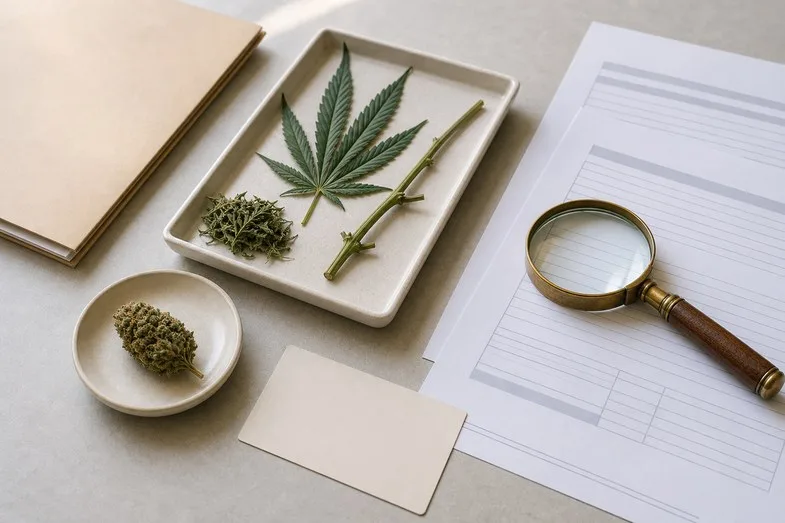
The visual signature of a CBD flower comes from the combination of the plant parts that remain in the trimmed product. The compact bud holds the most resin; the sugar leaves contribute a frosted edge; the small stem fragments give the structural connection between the parts; the trichomes catch the light across the whole surface.
A CBD flower page that names these parts in the product description is doing the botanical homework. A page that uses generic words like “premium nug” or “flashy flower” skips the botanical vocabulary and depends on marketing rather than on observable plant parts.
For the reader, the plant-part vocabulary is a verification tool. The names of the parts can be checked against the catalog photo and against the analytical document, where the cannabinoid breakdown reflects the part composition of the lot.
The agricultural framework behind hemp plant parts
Hemp plant parts sit inside the EU industrial hemp framework, which sets the cultivation rules for the whole plant. Regulation (EU) 2021/2115 references the Common Catalogue of Varieties and the THC threshold under CAP support; the framework applies to the cultivation regardless of which part is later used for which purpose.
The fibre tradition of Europe predates the modern CBD catalog by several centuries. A short historical note adds context: the Cordoaria Nacional in Lisbon, founded in the eighteenth century, produced large quantities of hemp rope for the Portuguese naval fleet, drawing on the bast fibre fraction of the stem. The plant has supported European industry for a very long time before the more recent CBD applications appeared on the catalog.
For the reader, this background gives the plant-part vocabulary a longer shelf than the catalog page might suggest. The buds, stems and leaves that appear on a CBD flower description today connect to a botanical and agricultural tradition documented across European history.
How Justbob documents plant-part vocabulary
Justbob carries out constant analyses on all commercialised products and on every batch. The relevant documents are available inside each commercialised product page, so a reader who wants to confirm the cannabinoid breakdown for a specific trimmed lot can open the certificate of analysis without leaving the catalog.
The reading routine is portable. Once a reader has cross-checked one lot against its analytical document and against the plant-part vocabulary on the page, the same approach works for the next lot. The catalog structure is consistent; the document standard is consistent; the botanical vocabulary is consistent across all CBD flower entries.
In our view, that consistency is what turns the plant-part names into a reading tool. The page invites a botanical comparison; the document confirms the cannabinoid layer; the variety on the label closes the loop with the EU industrial hemp framework.
Compliance-safe wording on hemp plant parts
Compliance-safe wording for hemp plant parts stays purely botanical and descriptive. “Trimmed Carmagnola bud with visible trichome coverage and small sugar leaves around the surface” describes the product. “Premium-grade nug for an unbeatable evening” describes the marketer.
CBD products are sold for technical, scientific and ornamental purposes only, in line with the EU industrial hemp framework. The plant-part names, the trim description and the cannabinoid percentages are part of how the product is positioned on the catalog. They are not directives, not benefits and not alternatives to anything else.
For the reader, the test is simple. If the wording helps map the plant parts of the product, the page is using the botanical vocabulary as documentation. If the wording invites you to do something with the product, the page has stepped outside the compliance-safe lane.
A closing reading habit for hemp plant parts
Reading hemp buds, stems and leaves as plant parts is a quick botanical discipline. Identify the bud as the flowering structure; recognise the stem as the structural backbone; distinguish fan leaves from sugar leaves; read the trichome coverage on the catalog photo; confirm the variety on the label against the EU Common Catalogue.
For wider regulatory context, the European Commission page on hemp is a useful entry point. It links to the Common Catalogue of Varieties, the Regulation (EU) 2021/2115 framework and the related agricultural documentation that covers the whole plant cycle.
A useful companion article on the visible side of the same plant is Cannabis Leaves vs CBD Flowers: What Is The Difference?, which sits beside this one for readers focused on the leaf-versus-flower distinction in the catalog.
Frequently asked questions about hemp buds, stems and leaves
What are the three main parts of the hemp plant?
The three main visible parts of the hemp plant are the bud, the stem and the leaves. The bud is the flowering structure of the female plant, the stem is the woody central axis that holds the structure upright, and the leaves come in two varieties (fan leaves on the stem and sugar leaves around the bud).
Where are the cannabinoids concentrated on the plant?
The cannabinoids are concentrated in the trichomes, the small resin glands that grow mostly on the bud and the sugar leaves. The fan leaves carry a smaller fraction; the stem carries almost none. The lab report for a lot reflects the part composition of the trimmed product.
Why do CBD flower products mostly carry the bud?
A CBD flower product usually carries the trimmed bud because the bud holds the highest density of trichomes and therefore the highest cannabinoid concentration per gram. The fan leaves are removed, the sugar leaves are often kept or partially trimmed and the stem fragments are usually discarded or kept short.