
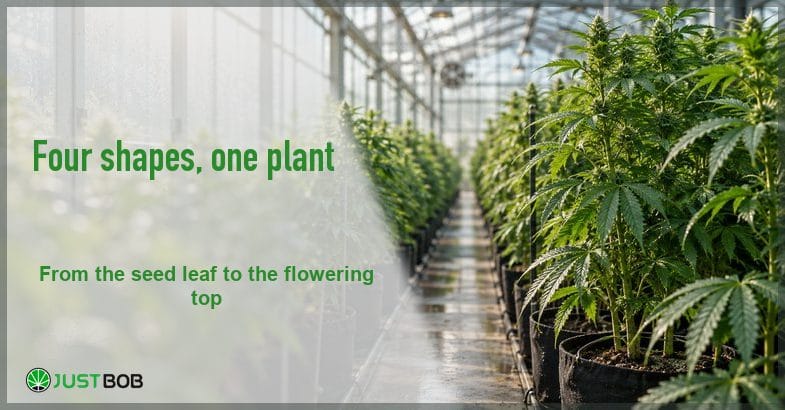
Published on: 04/11/2026
What does a cannabis plant look like? The answer changes three times before harvest
Ask ten people what a cannabis plant looks like and nine will draw the leaf. It is one of the most copied silhouettes in the world, printed on flags, stickers and shop windows. The trouble is that the leaf is a small part of the plant, and the part that changes least.
-
 Max CBDAMNESIA CBD BOOST
Glasshouse | CBD<40%
Starting from:BLACK MONTH -15%
0,85 €0,70 €/gGrams5 10 20 50 100 200 400 -
Max CBDAK47 CBD BOOSTStarting from: 1,45 €/g
Indoor | CBD<47%
Grams5 10 20 50 100 200 -
Max CBDCHARASStarting from: 0,90 €/g
CBD HASH | CBD<45%
Grams5 10 20 50 100 200 -
JB OIL 25%Starting from: 14,90 €
CBD Oil 25%

A cannabis plant does not hold one shape. It holds several, in sequence, and the differences between them are large enough that a photograph taken in June and one taken in September can look like two species. What follows takes those shapes in order, from a seed leaf the size of a fingernail to a mature flowering plant, with the detail worth looking at in each. It is a description of a plant, not a guide to growing one.
Why the one-line description never satisfies anybody
Botanically, Cannabis sativa L. is an annual, upright, mostly dioecious herb with palmate leaves and serrated leaflets. That sentence is correct and almost useless. It covers a 30 centimetre plant in a pot and a three metre plant in a field. It also says nothing about the two features people actually use to recognise cannabis plants: the arrangement of the leaves on the stem, and the way the flowers cluster at the top of each branch.
Height is the first thing to let go of. Depending on variety, day length and space, mature cannabis plants run from knee height to well above a person. A tall plant and a short plant can share the same genetics.
Cannabis growth stages, at a glance
| Stage | What you are looking at | The giveaway detail |
|---|---|---|
| Germination | A seed, then a white root, then a bent stem pushing up | The seed case often rides up on the seedling |
| Seedling | Two round leaves, then the first true leaf | The first true leaf usually has a single blade |
| Vegetative growth | Stem, branches, fan leaves, rapid height | Leaves usually sit in opposite pairs |
| Pre flowering stage | Small structures at the joints between stem and branch | Two white hairs, or a small round flower bud |
| Flowering | Female flowers clustering into dense groups | White hairs darken to orange and brown |
The stages overlap. A plant can be finishing its vegetative growth on the lower branches while the top is already flowering, which is one reason a single photograph rarely settles an argument.
The seedling: the two leaves that came with the seed
The first green a seedling shows is a pair of small, rounded, smooth-edged leaves. These are cotyledons, the seed leaves, and they were folded inside the seed the whole time. They carry no serrations and no fingers. People who expect the famous shape immediately are often disappointed here.
The first true leaves follow within days, usually as a pair, each a single blade with a toothed margin. The familiar hand-shaped leaf does not arrive fully formed: the leaflet count builds up across successive leaves, not on a leaf that is already open. A young plant that looks nothing like the icon is behaving perfectly normally.
Vegetative growth, when the plant starts to look like the drawing
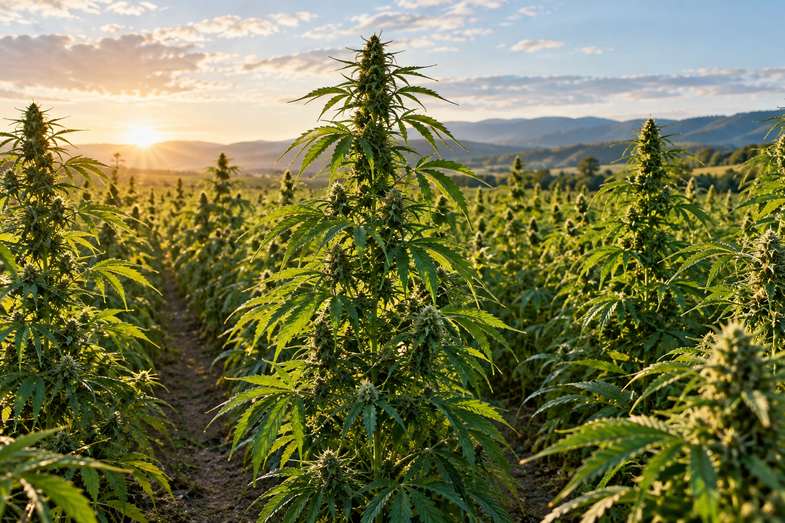
This is the stage most photographs show. The stem thickens and turns slightly square in section, side branches push out, and the plant puts on height quickly. Weed plants at this stage are all structure and leaf, with nothing at the tips yet.
Look at the joints. On a young seed-grown plant in vegetative growth the leaves and branches typically come out of the stem in opposite pairs, one on each side at the same height, each pair rotated ninety degrees from the one below. Near flowering that pattern often breaks and the arrangement becomes alternate, with single leaves staggered up the stem. It is a small detail that tells you roughly where in its life the plant is.
At the base of each leaf stalk sit two thin pointed stipules. They are easy to miss and they matter later, because the first sign of the plant’s sex appears in exactly that spot.
Fan leaves, and a finger count that keeps changing
The large leaves along the stem are the fan leaves, and they are the plant’s solar panels. Each one is palmate: several separate leaflets radiating from a single point, like fingers from a palm, every leaflet edged with teeth.
- The count is not fixed. A young plant may show one leaflet, then three, then five.
- Seven and nine are common on a healthy plant in full vegetative growth.
- Eleven or thirteen appear on some plants, usually on the largest leaves at the middle of the stem.
- The count drops again near the flowering tops, where leaves get smaller and simpler.
So the number of fingers is not a variety marker, and it is certainly not an age in weeks. It tells you which part of which plant you are looking at, and not much more.
The pre flowering stage, and the first honest sign of sex
Cannabis is normally dioecious: male and female parts sit on separate individuals rather than on the same plant. Before any flowers open, small structures appear at the nodes, tucked against those stipules. This is the pre flowering stage, and it is the earliest point at which the question can be answered by looking rather than guessing.
| At the node | Female cannabis plants | Male plants |
|---|---|---|
| Shape | A small teardrop-shaped bract | A small round or club-shaped flower bud |
| What emerges | Two fine white hairs, the stigmas of the cannabis pistils | Nothing at first; the buds later open and shed pollen |
| Later development | Bracts multiply and crowd into a dense cluster | Buds hang in loose bunches, like tiny grapes |
| Effect on the tops | Flowers thicken into solid groups | The plant stays open and airy at the tips |
The two white hairs are the detail worth memorising. They are stigmas, the receptive part of the female flower, and they are the reason a female top eventually looks fuzzy rather than smooth. A male plant, by contrast, never develops that fuzz, and to an eye trained only on posters it can look like a cannabis plant that failed. It has not failed. It is doing the other half of the job.
Read also: Male marijuana: uses and properties
Feminised seeds explain most of the photographs you see
Almost every image labelled as a cannabis plant online shows a female. That is not an accident of photography. Cannabis seeds sold as feminised, spelled feminized on most packets, are selected to produce female plants, so the gardens and greenhouses that get photographed are overwhelmingly female, and the male form is comparatively rare in pictures.
Occasionally a plant carries both kinds of structure at once. It is uncommon, it has its own name and its own set of tells, and it is a separate subject from the one here.
Read also: Hermaphrodite marijuana: what it is and how to recognize it
How a bud is actually built during flowering
Here is where most descriptions go wrong. A bud is not one flower. It is a crowd of them: dozens of small flowers packed so tightly along the last few centimetres of a branch that they read as a single mass. The dense group at the very top of the main stem has its own name in the trade, the cola.
Bud growth is visible week by week. Early flowering shows thin clusters with plenty of white hairs and gaps you can see through. As the flowering stage advances the gaps close, the clusters swell sideways as well as upward, and the white hairs darken through orange to a rust brown. That colour change is the one most people watch, though on its own it is not a precise measure of how far along the plant is.
Sugar leaves, bracts, and what a trimmer takes off
Two kinds of leaf sit inside a flowering top, and they are not interchangeable. The large fan leaves stick out well beyond the cluster. The small ones, half buried in it and often frosted with resin, are the sugar leaves.
Trimming is the removal of those leaves after harvest, and it is the reason dried flowers look tidier than the plant ever did. The material taken off is not waste, and it is sold in its own right: CBD trim is that mix of sieved leaves, small fragments and broken flower, resin still on it. Look at a bag of it and you are looking at the parts of the plant a photograph usually crops out.
Same plant, different light, and the buds lower down
Light does not reach the bottom of a plant the way it reaches the top. The flowers that form on the lower and inner branches receive less of it, and they tend to finish smaller and looser than the ones at the head of the stem. Same plant, same genetics, different position.
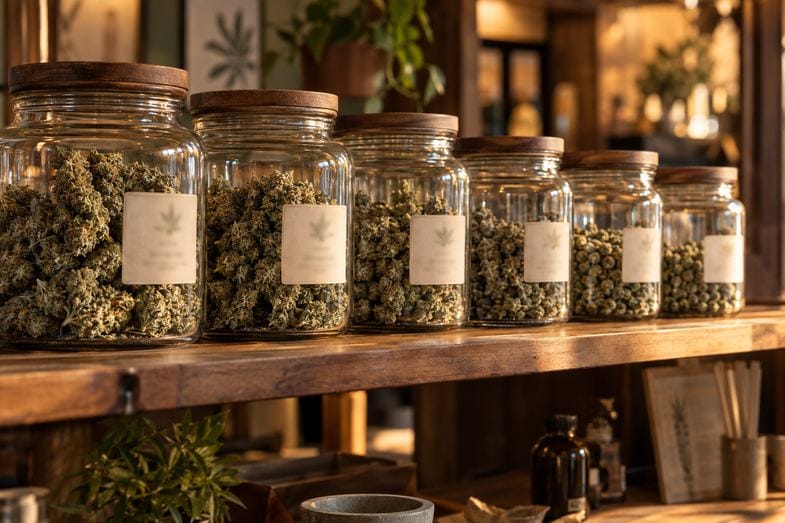
Buds are then sorted by hand at trimming, by size rather than by where on the plant a flower grew, and the smaller ones are packed under their own label as CBD small buds. The name describes the format, not a lower grade of plant. It is a useful reminder that a single cannabis plant does not produce one uniform product from top to bottom.
Trichomes, the frost you can see without a lens
Run your eye along a mature flowering top in good light and the surface glitters slightly. That sheen comes from trichomes. The conspicuous ones are the stalked glandular type, which rise from the bracts and sugar leaves on a short stalk and end in a rounded head. Smaller sessile glands and plain non-glandular hairs sit among them and do not catch the light in the same way.
At arm’s length they read as frost. Under a hand lens they turn out to be a forest of tiny mushrooms.
Their heads shift from clear to cloudy as the plant matures, and growers watch that shift closely. The simpler point is this. The frosted look is not dust, damp or a coating, it is plant anatomy, and it shows on a dried flower as clearly as on the living plant.
Indica against sativa: a shape that does not hold up
The received wisdom is tidy. Indica plants are short and stocky with broad leaflets; sativa plants are tall and open with narrow ones. You can find plants that match both descriptions. You can also find plenty that match neither, and modern crosses have mixed the two forms so thoroughly that the shape of a plant is a poor guide to what is written on its label.
Plant architecture is genuinely heritable, whatever the two-word labels then do with it. A 2026 study in The Plant Genome examined 145 Iranian landrace accessions using 233,000 SNPs and linked 91 genomic regions to 40 traits, flowering time and plant architecture among them. Shape, in other words, is written into the plant. It is not written into the two-word category most people reach for.
Where the confusion with lookalike plants ends
Palmate leaves with serrated edges are not unique to this species. Several ornamental and wild plants carry a similar outline and get photographed by mistake every summer, which is a topic in itself and one we have covered in plants that look like weed. The distinguishing features are rarely in the leaf. They are in the stipules at the leaf base, the opposite arrangement of young growth, and above all in the flowering tops, which nothing else reproduces.
One boundary is worth stating plainly, because the plant on this page is a botanical subject and not a product. The morphology described here covers the whole species, recreational varieties included. What we sell is European hemp: varieties entered in the EU common catalogue, grown by EU producers, kept under the 0.3 per cent THC threshold harmonised at European level and analysed batch by batch. The plants look alike because they are the same species. That is where the resemblance stops.
Frequently asked questions about what a cannabis plant looks like
What does a cannabis plant look like at each stage?
It looks like four different plants in sequence, starting with a seedling that shows two round seed leaves and then a single-bladed true leaf, no fingers yet. During vegetative growth it becomes the familiar shape, with palmate fan leaves in opposite pairs and rapid gains in height. At the pre flowering stage small structures appear at the nodes, either two fine white hairs or a small round flower bud. In flowering the tops fill with dense clusters and the white hairs darken to orange and brown. A photograph is only ever a snapshot of one of these four plants.
How many fingers does a cannabis leaf have?
It varies across a single plant, so the count is not an identifier. Seedlings usually start with one leaflet, then three, then five. Healthy plants in full vegetative growth commonly show seven or nine on their largest fan leaves, and some show eleven or thirteen. Near the flowering tops the leaves get smaller and the count falls back to three or one. Anyone quoting a fixed number for the species is describing one leaf, from one part of one plant.
How do you tell male and female cannabis plants apart?
Look at the nodes, the joints where a branch meets the stem, before any flowers open. Female cannabis plants produce a small teardrop-shaped bract from which two fine white hairs emerge, the stigmas. Male plants produce small round or club-shaped flower buds instead, which hang in loose bunches and later open to shed pollen. The clearest difference appears later at the tops of the plant. Females thicken into dense fuzzy clusters, while males stay open and airy at the tips.
What are the white hairs and the frost on cannabis buds?
They are two different structures. The white hairs are stigmas, the receptive part of each small female flower, and they darken to orange or rust brown as the plant matures. The frosted appearance comes mainly from stalked glandular trichomes, which rise on a short stalk from the bracts and the small sugar leaves inside a flowering top and end in a rounded head. They read as frost from arm’s length and look like tiny stalked mushrooms under a lens, with smaller sessile glands and plain hairs among them. Neither is a coating applied to the plant; both are parts of it.
Do indica and sativa plants look different?
The traditional description says indica plants are short and stocky with broad leaflets while sativa plants are tall and open with narrow ones, and some plants do match it. Many do not. Decades of crossing have blended the two forms, so shape is a weak guide to the name on a label. What is real is that plant architecture is inherited: a 2026 study of 145 cannabis landraces linked 91 genomic regions to 40 traits, including flowering time and the architecture of the plant itself. The label on a listing is a commercial category, and it is not a measurement of the plant in front of you.