

Published on: 24/10/2026
One name, two database entries: what Lemon Cherry Runtz really is
The lemon cherry runtz strain sounds like a precise designation, and it is not one. Two database entries carry the name: one on Leafly with almost no data attached, one in a genetics database with a full breeder specification. Whether they describe the same plant is not established anywhere.
-
 Max CBDAMNESIA CBD BOOSTStarting from: 0,85 €/g
Glasshouse | CBD<40%
Grams5 10 20 50 100 200 400 -
Max CBDAK47 CBD BOOST
Indoor | CBD<47%
Starting from:HALLOWEEN SALE -10%
1,45 €1,30 €/gGrams5 10 20 50 100 200 -
Max CBDCHARAS
CBD HASH | CBD<45%
Starting from:HALLOWEEN SALE -10%
0,90 €0,80 €/gGrams5 10 20 50 100 200 -
JB OIL 25%Starting from: 14,90 €
CBD Oil 25%




Keeping the two apart is most of the answer, and a third variety with a similar name adds to the confusion. None of the three entries is a compliant European hemp flower. A strain record and a hemp flower are two different things, and the rest of this article depends on keeping that in view.
Where the lemon cherry runtz strain comes from
Leafly carries an entry for Lemon Cherry Runtz, and it is unusually thin. The variety is filed as a hybrid with no split given, and the page publishes no parents and no THC figure. It does not even have its own photograph: the image shown is a stock picture of another plant. Twelve people have rated it, averaging 4.4, and eleven of them left a written review.
Everything Leafly reports comes from those twelve ratings. The top reported effects are energetic, uplifted and creative, the top reported flavours are lemon, diesel and berry, and the page summarises the strain as mostly energising. That is a review aggregate rather than a breeder specification, which is a distinction the rest of this article keeps returning to.
The detailed entry sits elsewhere. SeedFinder, a genetics database, registers a feminised release under this name from the breeder Dr Blaze, with a lineage, a flowering window and a THC content attached. Same name, far more detail, and a plant that can actually be described. Nothing on either page says the two entries are the same plant.
Read also: California weed strains: the origin of the best cannabis strains
The lineage behind the name: Lemon Tree crossed with Runtz
The registered cross is Lemon Tree x Runtz, and both halves are well documented on their own. That single line explains the name and most of what the breeder claims for this cultivar.
Runtz is the familiar half. Leafly files it as a hybrid at around 21 per cent THC, gives Gelato as its parent, and lists Gelato Zkittlez among its alternative names. It carries 1,138 ratings at an average of 4.6, rating higher than the Lemon Cherry Runtz entry does, and it is where the sweet, fruity register of this family comes from.
The citrus half is the one people overlook. Leafly and SeedFinder agree on its parents: Lemon Skunk crossed with Sour Diesel. It is listed at about 17 per cent THC, with lemon, citrus and diesel as its top reported flavours, and myrcene, pinene and caryophyllene as its terpenes. Leafly flags Lemon Tree and Runtz, the two parents of the registered cross, as higher in THC than its own site average.
Follow that back and the tree keeps going. It descends from Las Vegas Lemon Skunk, which traces to the original Skunk lines, while Sour Diesel comes down through Original Diesel from Chemdawg. That is a long way from the dessert register the name suggests.
The diesel note, and what it may be telling you
Leafly’s reviewers put diesel among the three dominant flavours. Nothing in the name suggests it, and Leafly publishes no parents that would account for it.
The registered cross offers one candidate explanation. Sour Diesel sits one generation up on the citrus side, and diesel is one of the three top flavours reported for that parent itself. If the Leafly entry and the SeedFinder release describe the same plant, the note has an obvious source. That correspondence is suggestive, and it is not proof: no source connects the two entries.
Dr Blaze describes the same cross as sweet citrus, cherry and berry over creamy vanilla, with earthy pine underneath, and names limonene, myrcene and caryophyllene as the terpenes. The release is given at 20 to 23 per cent THC, higher than the 17 per cent Leafly lists for Lemon Tree. Read alongside the review flavours, the profile that emerges is citrus and sweet fruit in front with something resinous behind. That is an unusual taste to find under a dessert name.
Lemon Cherry Runtz and Lemon Cherry Gelato are not the same plant
These two get treated as one variety, and they are not. The Gelato one is a Girl Scout Cookies and Sherbert cross, and Leafly documents it far more heavily: a far higher review count at 828 ratings against twelve, a published THC figure of 20 per cent, and a clear parentage. The reported experience points the other way too.
Leafly summarises the Gelato cross as mostly calming, with tingly, relaxed and giggly as the top reported effects, and lists caryophyllene, linalool and limonene as its terpenes. The Lemon Cherry Runtz entry is summarised as mostly energising, with energetic, uplifted and creative at the top instead, while relaxed does not appear in its top three.
They are not strangers, though, and this is where the naming confusion has a real basis. Leafly’s own family trees put Sherbert as a child of Girl Scout Cookies, Gelato as a child of Sherbert, and Runtz as a child of Gelato. So both names share the same Cookies and Sherbert ancestry, one directly and one through two more generations. What the Gelato cross does not have is the Lemon Tree side of the Dr Blaze release.
The label indica dominant hybrid is applied to this name fairly often, and it fits neither entry. Dr Blaze gives the cross as 50 per cent indica and 50 per cent sativa, and Leafly gives no split at all. The Gelato cross is not filed as an indica dominant hybrid either, so that is not where the label was borrowed from.
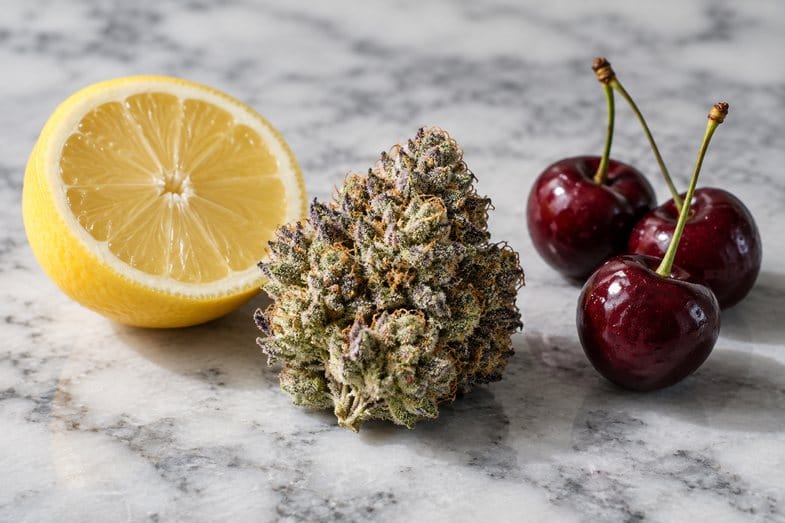
What the buds look like, and why nobody can tell you
Open the Leafly page expecting a picture of the flower and you get somebody else’s plant. That is the gap in the public record, and it is wider than it looks: the site holds no photograph of this variety and shows a stock image in its place. The SeedFinder entry has no gallery uploaded and no phenotypes recorded, and its Degustation section is empty: no effects, no smell and no taste have been logged by anyone for this cultivar.
So neither of the two entries offers a visual reference, and anything you read describing the colour, the resin coverage or the shape of these flowers was not written from one of them. Photographs do circulate under the Lemon Cherry Runtz name, on grower forums and retail listings, without a documented origin attached. For a name with this high a profile, that is a striking blank.
A record like this one is closer to a name tag than to a passport: it identifies nothing, it only labels. In our view that is the honest way to read it, and it is worth knowing which parts of a strain sheet are documented and which are filled in. Appearance, for this cultivar, is the second kind. What a seller actually states about a specific flower is the batch analysis. A listing in our boost weed range, for instance, publishes its cannabinoid figures next to the name rather than leaving the name to do the work.
Twelve ratings, and how far they stretch
Two sources describe the effects of this cannabis variety, and neither of them is describing anything on our shelves. The paragraphs below report what recreational growers and reviewers have written about the plant, which is not health information and not a product description.
The two available sources do not agree on the effects. The twelve ratings on Leafly aggregate to energetic, uplifted and creative, and the site’s own summary calls the strain mostly energising. Dr Blaze describes the registered cross as uplifting and creative alongside deep physical relaxation, without separating the two.
A sample of that size is very small. A single enthusiastic reviewer moves an average of that size noticeably, whereas the same review shifts the 828 ratings behind the Gelato cross far less. Treat the reported profile as an early sketch rather than a settled description, and read what those twelve people share as exactly that.
The THC figures follow the same pattern. Leafly publishes none, while Dr Blaze gives 20 to 23 per cent for the release, which sits close to the 21 per cent Leafly lists for Runtz itself. So the number depends entirely on which of the two entries a listing has copied, and only one of them publishes a number at all.
Every figure quoted above belongs to a recreational plant held in a strain database. Our own flowers are a different product, grown from EU Common Catalogue hemp varieties whose crop THC content is capped at 0.3 per cent, with each batch documented by its own analysis. None of the experience reported here belongs to them.
What Dr Blaze publishes about growing it
The agronomic figures quoted here come from the Dr Blaze entry, since Leafly publishes none. That entry puts flowering at 8-9 weeks indoors, which is about two months, and describes a plant that can be grown indoors or outdoors.
Yield is given as 450 to 500 grams per square metre indoors, and 400 to 450 grams per plant outdoors. The breeder describes a compact plant that responds well to canopy training, and recommends a Mediterranean climate or a controlled indoor environment. The Leafly entry offers no agronomic data whatsoever, so there is nothing there to compare these figures against.
A 50/50 hybrid finishing in eight to nine weeks is unremarkable, and that is the point. The breeder calls it forgiving rather than demanding. No independent grow reports have been uploaded to test that claim.

Why strain names are unreliable in the first place
Two entries under one cannabis name is not an unusual situation. Names of this kind are not entered in a varietal register, the way the EU Common Catalogue records agricultural varieties. Nothing stops two breeders from using the same name, or one breeder from renaming a plant after a higher profile relative.
The problem has been measured, at least in one market. A 2019 genetic study of samples from legal dispensaries in the United States, Genetic tools weed out misconceptions of strain reliability in Cannabis sativa, found genetic inconsistencies within most of the named strains it sampled. It also found no clear genetic support for the sativa, indica and hybrid categories used in online databases, the indica dominant hybrid label included. Its authors offer mislabelling and renaming among the explanations.
Read the family names as aroma families rather than as identity documents. The vocabulary that comes with them is worth knowing, and our hemp flower genetics glossary sets out what the recurring terms mean. Reading a lineage tells you more than reading a name.
Reading a citrus name on a hemp label
A lemon and cherry reference on one of our labels points at an aroma, and it brings nothing else along with it. No strain sheet travels with the name, and no genetic claim is being made by using it. What we actually sell is EU Common Catalogue hemp, kept within the European legal threshold.
On a CBD flower listing, that citrus reference sets an expectation about smell and nothing else. The cannabinoid figures, the variety and the legal status all come from the batch paperwork, which is where anyone checking the product should be looking.
The short version, entry by entry
Leafly’s Lemon Cherry Runtz entry is a hybrid with no parents, no split and no THC figure, rated by twelve people as energetic, uplifted and creative, with lemon, diesel and berry as the reported flavours. The Dr Blaze release registered on SeedFinder under the same name is Lemon Tree crossed with Runtz, a 50/50 hybrid at 20 to 23 per cent THC, flowering in 8-9 weeks, with sweet citrus and cherry over creamy vanilla. The Gelato namesake is a separate cannabis plant, Girl Scout Cookies crossed with Sherbert, far better documented, and its reported effects run to relaxed and calming instead. Check which of the three entries a listing means before trusting any number attached to it, because the lemon cherry runtz strain name on its own settles nothing.
Frequently asked questions about the Lemon Cherry Runtz strain
What is the lemon cherry runtz strain?
Two entries carry the name, and they are not equally documented. Leafly files Lemon Cherry Runtz as a hybrid but publishes no parents, no indica to sativa split and no THC figure, resting entirely on twelve user ratings. SeedFinder registers a feminised release from the breeder Dr Blaze under the same name, given as Lemon Tree crossed with Runtz, 50 per cent indica and 50 per cent sativa, at 20 to 23 per cent THC. Nothing on either page establishes that the two describe the same plant: one is a review aggregate, the other a breeder specification. Any listing quoting hard numbers is quoting the second one.
What does Lemon Cherry Runtz taste like?
The two entries describe it in similar terms. Dr Blaze gives sweet citrus, cherry and berry over creamy vanilla with earthy pine underneath, naming limonene, myrcene and caryophyllene as the terpenes behind that profile. Leafly’s reviewers list lemon, diesel and berry as the three dominant flavours. The diesel note is not in the name, and Leafly publishes no parents that would account for it. Sour Diesel does sit one generation up on the citrus side of the Dr Blaze cross, which would explain it if the two entries describe the same plant.
Is Lemon Cherry Runtz the same as Lemon Cherry Gelato?
Leafly gives the Gelato one 828 ratings, a published THC figure of 20 per cent, a Girl Scout Cookies and Sherbert lineage, and caryophyllene, linalool and limonene as its listed terpenes. Its reported effects are tingly, relaxed and giggly, and the site summarises it as mostly calming. The Lemon Cherry Runtz entry has twelve ratings, no published parents, and a summary of mostly energising. So no, and the two are not documented to the same standard either. The two do share an ancestry further back, since Leafly traces Runtz to Gelato, Gelato to Sherbert and Sherbert to Girl Scout Cookies, but only the Dr Blaze release carries the Lemon Tree side.
What effects are reported for Lemon Cherry Runtz?
The twelve ratings on Leafly aggregate to energetic, uplifted and creative, and the site summarises the strain as mostly energising. Dr Blaze describes the registered cross as uplifting and creative alongside deep physical relaxation, without separating the two. Twelve ratings is a small enough sample that one enthusiastic reviewer shifts the average noticeably, so this is best read as an early sketch. All of it describes recreational plants recorded in databases and breeder catalogues, not the hemp we sell, which is grown under the 0.3 per cent THC limit for EU hemp and carries its own batch analysis.
What is the flowering time of Lemon Cherry Runtz?
The Dr Blaze entry gives 8 to 9 weeks indoors, which is 56 to 63 days, for a plant that can be grown indoors or outdoors. Yield is listed at 450 to 500 grams per square metre indoors and 400 to 450 grams per plant outdoors, on a compact structure that the breeder says responds well to canopy training. A Mediterranean climate or a controlled indoor environment is what the entry recommends. Those are the only figures in circulation, since Leafly publishes no agronomic data for this variety at all, and no independent grow reports have been uploaded against that single breeder sheet.