
Published on: 05/03/2026
Through precise pruning and structured branching, growers enhance symmetry, consistency, and overall plant performance
In the evolving world of hemp and cannabis cultivation, innovation rarely comes from laboratories alone. Often, it emerges from growers observing plants, experimenting with structure, and asking a simple question: how can we guide natural growth to achieve better balance and quality?
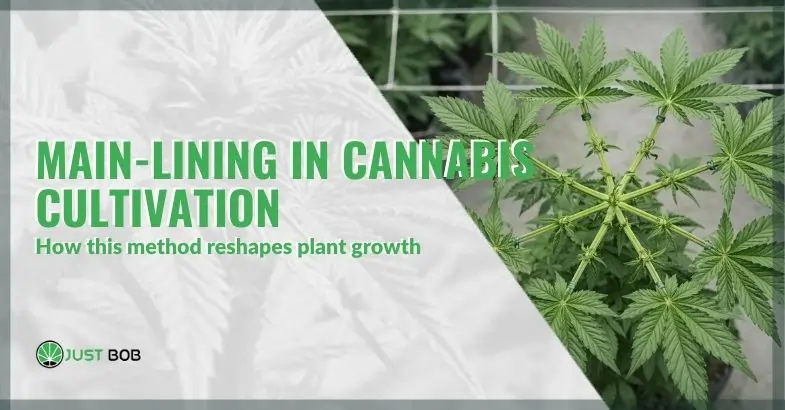
Among the most talked-about plant training techniques in recent years is main-lining, a method that radically reshapes the architecture of the cannabis plant to optimize symmetry, airflow, and light distribution.
-
 Max CBD
AMNESIA CBD BOOST
Glasshouse | CBD<40%
Starting from:WINTER SALE - 10%
0,85€0,75€/gGrams5 10 20 50 100 200 400 -
Max CBD
AK47 CBD BOOST
Indoor | CBD<47%
Starting from:SUPER SALE -20%
1,45€1,15€/gGrams5 10 20 50 100 200 -
Max CBD
CHARAS
Starting from: 0,90€/gCBD HASH | CBD<45%
Grams5 10 20 50 100 200 -
JB OIL 25%
Starting from: 14,90€CBD Oil 25%

As interest in CBD-rich cultivars and compliant varieties of cannabis expands across Europe, cultivation techniques have become just as important as genetics. Whether the goal is producing high-quality inflorescences for technical use or developing aromatic CBD cannabis varieties within legal THC limits, structure matters. Main-lining is not merely about increasing yield; it’s about precision, uniformity, and plant physiology.
This comprehensive guide explores how main-lining works, what it does at a botanical level, and why it has gained such attention among professional and hobby growers alike. We’ll look at the science behind apical dominance, the practical steps involved, the impact on cannabinoid-rich flowers, and the broader context of compliant hemp cultivation.
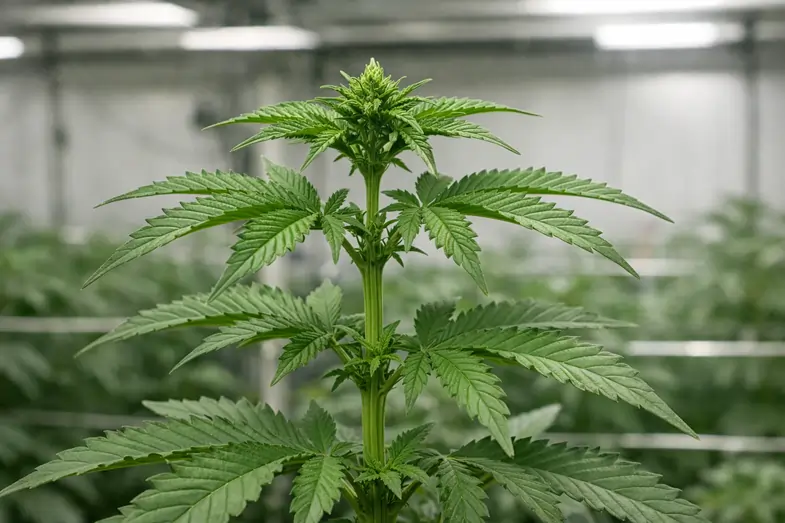
The botanical logic behind main-lining: apical dominance and hormonal control
To understand main-lining, we must first understand how a cannabis plant naturally grows.
Like many dicotyledonous plants, cannabis expresses what botanists call apical dominance. This phenomenon occurs when the main central stem, through the activity of growth hormones such as auxins, suppresses the growth of lateral branches. In simple terms, the plant prioritizes one dominant top.
In wild or untrained conditions, this growth strategy allows cannabis to stretch upward quickly, competing for sunlight. However, from a cultivation standpoint, especially in controlled indoor or greenhouse environments, this vertical bias can create uneven canopy development. The central cola may receive optimal light exposure, while lower branches remain underdeveloped.
Main-lining intervenes directly in this hormonal hierarchy.
By topping the plant early and removing lower growth strategically, the cultivator disrupts apical dominance and forces the plant to redistribute auxins evenly across multiple branches. The result is a symmetrical structure where each main branch receives similar hormonal signals and, therefore, similar growth potential.
In the context of modern legal weed production, where consistency and visual uniformity of inflorescences are essential for collectors and technical markets, this structural control becomes particularly valuable. A plant shaped through main-lining often produces colas of nearly identical size and density, enhancing aesthetic and structural coherence.
From a physiological perspective, the method also improves internal airflow and light penetration. By creating a structured manifold — essentially a symmetrical branching network — growers ensure that energy distribution is not monopolized by a single apex but balanced across the plant’s architecture. This redistribution can influence not only bud size but also the plant’s ability to efficiently perform photosynthesis.
The practical process: how main-lining is performed step by step
While the concept may sound technical, the execution of main-lining follows a logical sequence. The process typically begins during the vegetative phase, when the plant has developed four to six nodes. At this stage, the grower performs the first topping cut, removing the apical tip above the third node. This immediately breaks apical dominance and creates two primary branches.
Unlike simple topping, main-lining goes further. The grower removes lower growth from the first and second nodes, leaving only the third node’s pair of branches.
These two branches become the foundation of the manifold. They are gently tied down horizontally to encourage lateral expansion.
As the plant recovers and each branch develops several nodes, the process is repeated. Each branch is topped again, doubling the number of main colas. Through careful repetition, growers can create four, eight, or even sixteen symmetrical tops. The key lies in patience and precise pruning, allowing the plant to heal between interventions.
When cultivating compliant hemp varieties destined for CBD weed markets, timing and plant health are critical. Over-stressing the plant may compromise overall vigor or reduce floral density. Main-lining requires attentive care, including stable environmental conditions and adequate nutrient management to support recovery.
One of the advantages of this technique is that it reduces the need for excessive staking or structural support later in flowering. Because the branches are evenly spaced and trained early, the canopy tends to remain balanced. This balance ensures that artificial lighting in indoor setups or natural sunlight in greenhouses reaches each cola evenly.
Although it may extend the vegetative period slightly due to recovery time, many cultivators consider the trade-off worthwhile. The resulting structure often simplifies harvest and trimming, producing consistent, well-formed inflorescences suitable for technical uses or aromatic appreciation.
Read also: Growing marijuana outdoors: typical characteristics of outdoor varieties include the following
How main-lining influences flower development and cannabinoid expression
The relationship between plant training and cannabinoid production is complex. Cannabinoid synthesis occurs primarily in the trichomes of female flowers, and environmental factors such as light intensity, temperature, and genetics play central roles. However, plant structure indirectly affects these variables.
By promoting an even canopy, main-lining ensures uniform light exposure across all primary colas. Uneven canopies can result in shaded lower buds that develop fewer trichomes. When each top receives similar light levels, the plant can allocate resources more consistently.
In CBD-rich cultivars, uniformity of flower size and density contributes to predictable cannabinoid distribution. While training methods do not alter genetic cannabinoid potential, they may influence the plant’s efficiency in expressing that potential across all flowering sites.
Airflow is another critical factor.
Dense, untrained plants may develop microclimates within the canopy that increase humidity and the risk of mold. A structured manifold allows air to circulate freely, reducing stress factors that could otherwise impair flower quality.
There is also a subtle metabolic dimension to consider. When energy is not concentrated in a single dominant cola, secondary branches receive equal carbohydrate allocation. This balanced energy distribution can support consistent resin development.
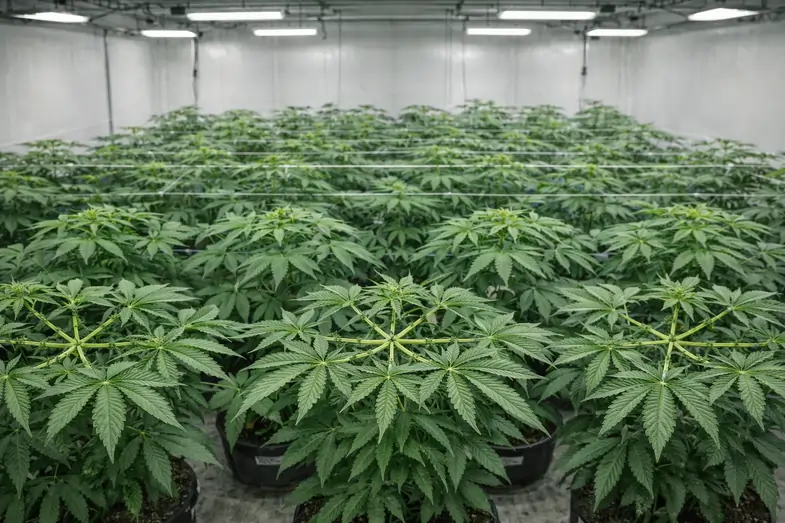
Comparing main-lining with other training techniques
Cannabis cultivation includes a wide range of plant training methods. Low-stress training (LST), topping, supercropping, and Screen of Green (ScrOG) are all widely practiced. Main-lining stands out because it combines structural pruning with symmetry-focused canopy design.
Low-stress training typically involves bending branches without cutting, gradually shaping the plant. While effective, it may not produce the same level of structural uniformity as main-lining. Supercropping involves physically stressing stems to redirect growth, but it does not inherently create symmetrical manifolds.
ScrOG systems rely on a horizontal screen to distribute branches, achieving canopy uniformity through external support rather than internal structural planning. Main-lining, by contrast, builds symmetry into the plant’s core architecture from the beginning.
For cultivators working with high-quality genetics intended for premium legal hash or CBD-rich extracts, structural control can influence resin consistency. A plant with evenly distributed flowering sites simplifies selective harvesting and quality grading.
Another consideration is scalability. Main-lining is particularly well-suited for small to medium cultivation environments where individual plant attention is feasible. In large-scale industrial hemp operations, the labor required for precise pruning may be less practical. However, boutique growers focused on artisanal quality often appreciate the precision it offers.
Risks, challenges, and best practices for compliant cultivation
No cultivation method is without risk.
Main-lining requires careful timing and plant health monitoring. Performing topping cuts too early or too late can compromise structural balance. Over-pruning may slow vegetative development or increase susceptibility to stress.
Because the method involves multiple recovery phases, environmental stability becomes essential. Fluctuations in temperature or nutrient imbalance during healing periods can weaken the plant. Adequate lighting, consistent irrigation, and proper substrate management are key to success.
In the context of regulated European hemp cultivation, compliance remains paramount. Only certified seeds of approved varieties may be used for legal production. Growers must ensure that THC levels remain within statutory limits. Techniques like main-lining do not exempt producers from regulatory responsibilities.
For those interested in CBD extracts or CBD oil, plant structure indirectly influences extraction efficiency by affecting flower density and uniform maturation. However, cannabinoid content must always be verified through laboratory analysis.
Read also: What is grafting of cannabis and how is it used in modern cultivation techniques
Shaping symmetry: where botanical precision meets cultivation mastery
Main-lining is more than a pruning technique; it is a deliberate reshaping of cannabis plant architecture rooted in botanical science. By disrupting apical dominance and redistributing hormonal signals, growers create symmetrical manifolds that optimize light exposure, airflow, and structural balance.
The result is a plant with evenly developed colas, improved canopy management, and consistent flower formation.
We have explored how this method functions at a physiological level, how it is performed in practice, and how it compares to other training systems. We have examined its relevance within compliant cannabis cultivation and its indirect impact on cannabinoid-rich flower development. While it requires patience and precision, main-lining offers cultivators a refined approach to plant management that emphasizes quality, uniformity, and structural harmony.
For those curious about the broader world of CBD, aromatic inflorescences, and certified products, exploring reputable sources is essential. If you want to discover carefully selected genetics and high-quality technical products, you can always take a look at the JustBob shop and explore the wide range of certified options available.
Main-lining in cannabis cultivation: takeaways
- Main-lining strategically disrupts apical dominance to redistribute hormonal signals across symmetrical branches, transforming the plant’s natural vertical bias into a balanced manifold that optimizes light exposure, airflow, and uniform cola development.
- The method combines precise topping and structured pruning during the vegetative phase, requiring controlled recovery periods and stable environmental conditions, but rewarding growers with structural consistency, simplified canopy management, and evenly matured inflorescences.
- While main-lining does not alter genetic cannabinoid potential, its architectural precision supports more uniform trichome development and resource allocation, making it particularly valuable for CBD-rich cultivars and quality-focused, compliant cultivation contexts.
Main-lining in cannabis cultivation: FAQ
What is main-lining in cannabis cultivation?
Main-lining is a plant training technique that restructures cannabis growth by breaking apical dominance early in the vegetative phase. Through strategic topping and symmetrical pruning, growers create a balanced manifold of evenly distributed branches. This results in uniform canopy development, improved light penetration, and more consistent flower formation.
How does main-lining affect plant growth and flower uniformity?
By redistributing growth hormones such as auxins across multiple branches, main-lining encourages symmetrical development instead of a single dominant cola. This balanced architecture allows each primary top to receive similar light exposure and airflow, which can promote consistent bud size and density across the plant without altering its genetic cannabinoid potential.
Is main-lining suitable for CBD-rich and compliant hemp cultivars?
Main-lining can be applied to CBD-rich and compliant hemp varieties, provided that growers maintain proper plant health and environmental stability. While the technique does not change genetic cannabinoid content, it can improve structural uniformity and canopy management, which may contribute to more consistent flower quality within regulated cultivation frameworks.