
Published on: 07/11/2026
Two origin stories, one dessert name: reading the black cherry runtz strain
Ask three catalogues where the black cherry runtz strain comes from and you will get three answers, and none of them quite lines up with the next. That disagreement is not a footnote to the variety. It is the most useful thing to understand about it, because the name travels further than the paperwork behind it does.
-
 Max CBDAMNESIA CBD BOOST
Glasshouse | CBD<40%
Starting from:BLACK MONTH -15%
0,85 €0,70 €/gGrams5 10 20 50 100 200 400 -
Max CBDAK47 CBD BOOSTStarting from: 1,45 €/g
Indoor | CBD<47%
Grams5 10 20 50 100 200 -
Max CBDCHARASStarting from: 0,90 €/g
CBD HASH | CBD<45%
Grams5 10 20 50 100 200 -
JB OIL 25%Starting from: 14,90 €
CBD Oil 25%

Where the genetics are said to come from, what the aroma is built on, how the buds present, and how it sits next to its close relatives: those are the four things worth pinning down. One boundary runs underneath all of them. What a strain database records about a recreational cannabis variety is a separate thing from what a compliant European hemp jar contains, and the two should never be read as one.
Where the black cherry runtz strain comes from
The lineage is contested, and honestly so. The cross that breeder listings most often give is Black Cherry Pie and Pink Runtz, and that pairing fits the aroma, though a shared scent is a hint about ancestry rather than proof of it. A second reading files it on the Runtz side of the family instead, treating it as a dark phenotype in the orbit of the original Runtz, whose parents are usually given as Zkittlez and Gelato. The same name covers both, so two sheets for black cherry runtz can disagree on the parents without either one being obviously wrong.
Trace the grandparents and the record grows murkier, because the listings do not agree there either. Some place Pink Runtz on the Zkittlez and Gelato base that defines the wider Runtz group; others give it different parents again. Black Cherry Pie is generally tied to a Cherry Pie thread, itself usually traced to Granddaddy Purple crossed with an F1 Durban line. The deeper into the tree you go, the less settled the record gets. Put those together and you have a fruit-forward branch grafted onto the candy sweetness the Runtz name is known for. That combination is what the aroma keeps pointing back to, more than any single parent does.
The pattern here is the same one that runs through most of the modern dessert and candy varieties: they were selected and named for how they smell, and their names track aroma more reliably than they track parentage. Black cherry runtz is no exception, and its paperwork ends up looser than its reputation.
Balanced hybrid or indica dominant: what the label claims
Here the listings contradict themselves, sometimes inside a single sheet. The same entry will call black cherry runtz an indica dominant hybrid and then, a line later, put the split at 50 per cent indica and 50 per cent sativa, the textbook description of a balanced hybrid. Both statements cannot hold at once, so the label works better as a loose signal than a firm measurement.
It helps to be clear about what the phrase is even describing. Indica dominant, where it is used accurately, points at heritage and plant shape: shorter, broader plants, wide leaflets, densely packed flowers. It is a note about growth habit and ancestry, not a specification you can trust to two decimal places. The safest way to read black cherry runtz is as a fruit-heavy hybrid whose exact indica-to-sativa split the listings simply do not agree on. Two competing origin stories tend to leave that kind of gap.
Black cherry runtz flavour profile and the terpenes behind it
The aroma is the whole reason the name exists, and it is where the descriptions actually agree. Breeder catalogues and grower reviews land on the same shortlist: cherry first, then a sweet, candied middle, a note the listings often write down as pie crust, and a soft floral edge underneath. A common way of describing the arc is a sweetness on the way in, fruity notes through the middle, and a slight earthiness on the tail. The tart, cherry-forward top is what separates it on the nose from the plainer candy of the wider Runtz group.
Reviewers who compare it to its relatives tend to reach for the same reference points: the dark cherry and sweet berry of the Black Cherry Pie side, set over the citrus-and-candy base the Runtz line is built on. Across those write-ups, limonene is named more often than any other terpene. Those aromas come from terpenes the plant makes as it matures, and the enzymes behind them are now well mapped. Work on terpene synthases in Cannabis sativa describes a large, versatile family of synthase genes, which is why the scent shifts so much from one variety to the next. For the biology rather than the tasting notes, our guide to what terpenes are walks through it.
Read also: Indica or sativa marijuana: here are the differences
What the buds look like
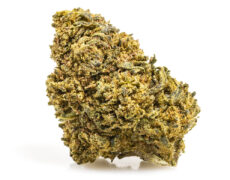
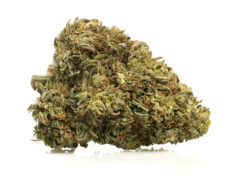
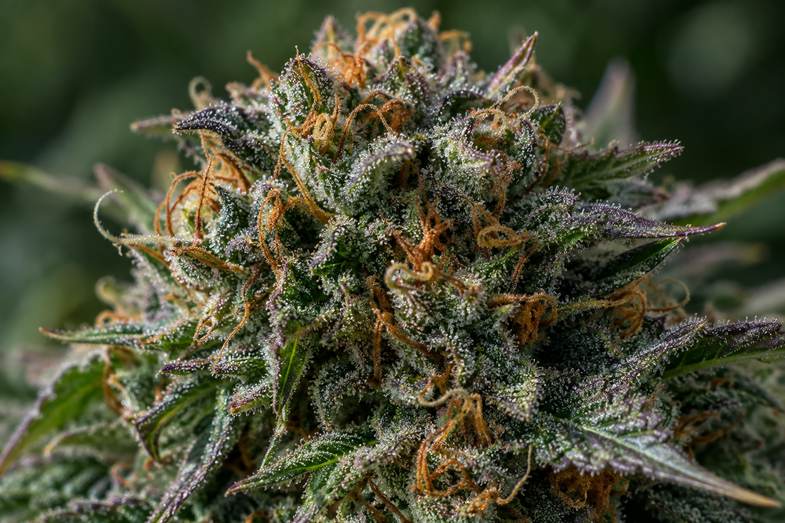
Appearance carries a lot of the identification before you read a single label. Photographs published under the name show dense, colourful flowers with the compact build the candy varieties tend to throw. The calyxes stack tightly, so the bud looks solid and well filled, and the better examples hold a deep, dark green base that the photographs show shot through with cooler violet tones.
Then there is the resin. Listings for black cherry runtz consistently mention heavy resin production, a trichome coat thick enough to dull the surface colour and lend the flower a frosted look. It is the sort of coverage that photographs well and, more to the point, tells you the variety was selected with the aromatic glands front of mind, since that is where the terpenes are concentrated.
What grower reviews report about the effects
Everything below refers to the recreational cannabis variety as strain databases, breeder catalogues and grower reviews report it. It describes none of the products on sale here, and it is not health information of any kind.
Most of what gets reported comes down to the potency figures. Catalogues place black cherry runtz at 19 to 29 per cent THC, with most listings settling around the 25 per cent mark, and CBD recorded at under one per cent. Reviewers writing about the recreational plant describe it in the register you would expect from those numbers, reaching for words like relaxing, euphoric and uplifting, and a general note of high potency runs through the write-ups. As with the genetics, the accounts are not unanimous, and individual reviews pull in different directions.
That range is also where the line has to be drawn. Those numbers belong to recreational plants logged in databases and breeder catalogues, raised without the rules a European crop follows. Hemp grown in the EU is a separate product: it comes from EU Common Catalogue varieties, stays under the legal THC threshold, and is judged by its batch analysis instead of a strain sheet. None of the effects described above transfer to it.
Flowering time and how the plant behaves
The grow figures come from the breeder listings, and they are reasonably consistent. Flowering is generally given as 8 to 10 weeks, with an outdoor harvest landing in early autumn in temperate climates. Yields are quoted at up to around 500 grams per square metre indoors and up to roughly 600 grams per plant outdoors under good conditions. That places it in the productive middle of the candy-variety range, well away from either extreme.
The listings describe the plant structure on the indica-leaning side: compact, bushy growth with tightly packed flowering sites. Dense plants like that usually benefit from some canopy management so light reaches the lower flowers. That is ordinary horticulture, nothing specific to this variety.
Black cherry runtz against cherry runtz, black runtz and pink runtz
The runtz names multiply quickly, and they are easy to run together. A rough map, using the descriptions the catalogues publish for each:
- Cherry Runtz, given by breeder listings as Runtz crossed with Cherry Pie, is listed nearer 75 per cent indica, with rose, berry and lavender notes and a flowering time around ten weeks. It is the cleaner cherry-and-floral cousin.
- Black Runtz is usually treated as a dark phenotype of the original Runtz, carrying the Zkittlez and Gelato parents and a creamy, citrus-led sweetness with limonene out front.
- Pink Runtz sits on the sweeter, candy end of the group and is one of the parents most often named for black cherry runtz itself.
- Black Cherry Runtz is the one that adds the tart, dark-cherry top over that candy base, the note the others do not carry in the same way.
Because several of these circulate as feminised seed as well as flower, the parents named alongside a listing matter far more than the name over it. If you are reading a feminised seed description, the cross written underneath tells you what you are actually looking at; the name on top only tells you which aroma family the breeder was aiming for.
What a runtz name means on a European hemp label
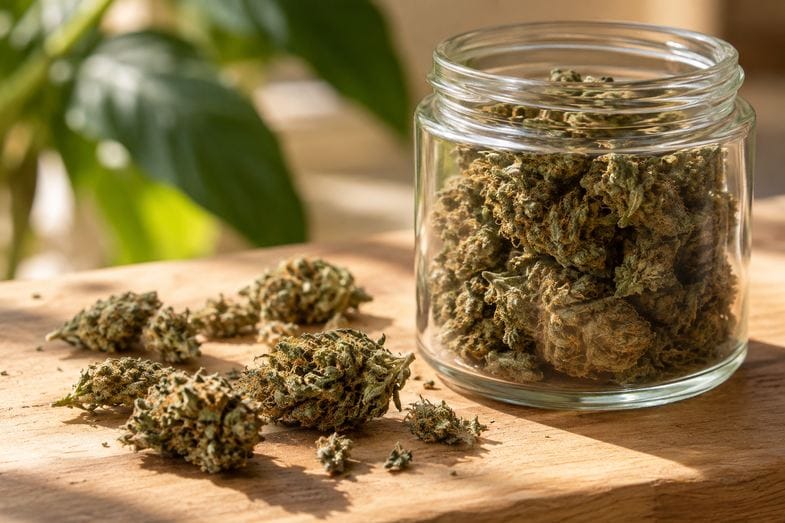
When a name like black cherry runtz turns up on a compliant European hemp listing, whether that is full flower or a jar of small buds, it is pointing at an aroma family and little else. It is not carrying the recreational strain sheet across with it, and it is not a claim about the plant’s genetics or its potency. The plant behind a European listing is hemp, grown from EU Common Catalogue varieties and held within the European legal threshold, and the batch documentation, not the name, is what describes what is in the jar.
So a runtz name on a CBD flower listing reads as an aroma reference and nothing more. It tells you which scent register to expect, in the same way an aroma note on any label does. Everything factual about the product itself comes from the analysis that travels with the batch, and that analysis is the only part worth reading as a specification.
The short version
Black cherry runtz is a fruit-forward member of the Runtz family whose paperwork does not fully agree with itself. Breeder listings give the genetics most often as Black Cherry Pie crossed with Pink Runtz, with a competing account placing it on the Zkittlez-and-Gelato Runtz side. The same listings label it both indica dominant and 50/50 balanced, and put flowering at 8 to 10 weeks. The aroma is the constant across the descriptions: dark cherry and pie crust over a sweet, floral candy base, with limonene the terpene named most often. On a European hemp listing, though, only the batch analysis pins down what is actually in the jar.
Frequently asked questions about the black cherry runtz strain
What is the black cherry runtz strain?
It is a fruit-forward variety in the Runtz family, and the databases do not fully agree on its parents. The cross that breeder listings most often give is Black Cherry Pie crossed with Pink Runtz, and the aroma sits closer to that pairing. A second account files it on the Runtz side, near the Zkittlez and Gelato base of the original Runtz. It is described in strain databases and breeder catalogues, and that record is separate from any European hemp product.
What is the black cherry runtz flavour and aroma profile?
Cherry first, then a sweet, candied middle the listings often call pie crust, with a soft floral edge and a slight earthiness on the tail. Reviewers describe a dark cherry and sweet berry character from the Black Cherry Pie side over the citrus-and-candy base of the Runtz line, with limonene named more often than any other terpene. It is the tart, cherry-forward top that separates it from the plainer candy of the wider group.
Is black cherry runtz an indica or a balanced hybrid?
The sources disagree, sometimes within one listing. Several sheets call it an indica dominant hybrid and then give a 50 per cent indica to 50 per cent sativa split, the textbook balanced hybrid. The honest reading is a fruit-heavy hybrid whose exact indica-to-sativa split the listings do not agree on, so the label reads best as a note on heritage and growth habit, not a precise figure.
What THC level is reported for black cherry runtz?
Breeder catalogues place the recreational variety at about 19 to 29 per cent THC, with most listings around 25 per cent, and CBD under one per cent. Those figures describe recreational plants recorded in databases and catalogues, not European hemp products. European hemp is grown under the legal THC threshold, and its batch analysis, not a strain sheet, is what describes it.
How is black cherry runtz different from cherry runtz and black runtz?
They are close relatives with different crosses. Cherry Runtz is listed by breeder catalogues as Runtz crossed with Cherry Pie, nearer 75 per cent indica with rose and berry notes. Black Runtz is usually a dark phenotype of the original Runtz, carrying its Zkittlez and Gelato parents and a creamy, citrus-led sweetness. Black cherry runtz is the one that adds a tart, dark-cherry top over the candy base, and the lineage attached to a listing identifies it more reliably than the shared name can.