

Modified on: 28/08/2026
Reading cannabis in art history through symbols and botany
Cannabis sativa L. has a long visible history. The plant has been illustrated in herbals, painted in landscape scenes, drawn in botanical works and represented in cultural objects across centuries of European visual tradition. This Justbob guide walks through cannabis in art history as a botanical and cultural reference, with the symbols and the contexts that have surrounded the plant over time.
-
 Max CBDAMNESIA CBD BOOSTStarting from: 0,85€/g
Glasshouse | CBD<40%
Grams5 10 20 50 100 200 400 -
Max CBDAK47 CBD BOOSTStarting from: 1,45€/g
Indoor | CBD<47%
Grams5 10 20 50 100 200 -
Max CBDCHARAS
CBD HASH | CBD<45%
Starting from:SUMMER SALE -10%
0,90€0,80€/gGrams5 10 20 50 100 200 -
JB OIL 25%Starting from: 14,90€
CBD Oil 25%



The aim is to set a clear context. After a few examples, the difference between cannabis as a botanical illustration, as a fibre reference and as a cultural symbol becomes recognisable in any visual source.
What “cannabis in art history” actually describes
Cannabis in art history encompasses the visual representations of the hemp plant across European and broader Mediterranean traditions. This includes botanical illustration, focused on the precise depiction of the plant for scientific reference, landscape painting, which portrays hemp fields and harvesting scenes, and symbolic representation, where cannabis forms part of broader iconographic systems.
For readers exploring CBD flowers, this art history layer is the long visual shelf that sits behind the modern catalog photo. The way a hemp plant is illustrated today on a product page draws on centuries of botanical drawing conventions.
In our view, the most useful CBD product pages connect the contemporary photo to the wider botanical iconography. The plant did not appear on a catalog page in 2026 out of nowhere; it has been drawn, painted and described for a very long time.
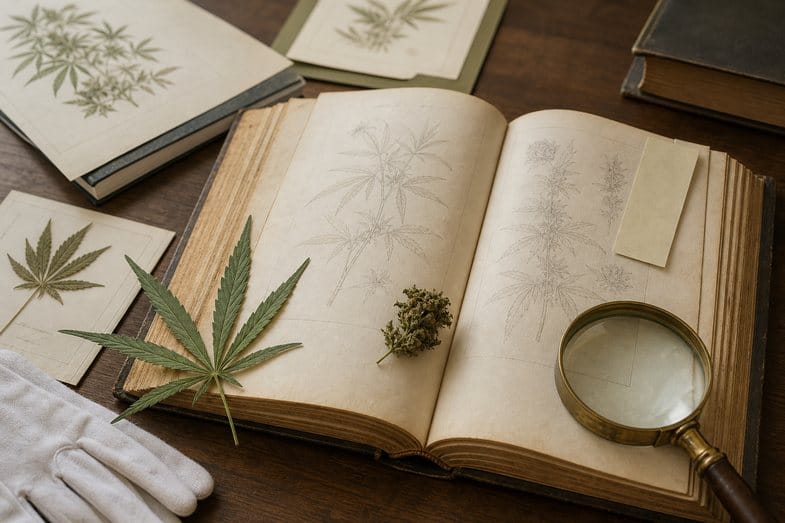
Botanical illustration: cannabis in early European herbals
Botanical illustration represent the earliest visual record of cannabis in European art history. Herbals, books that documented plants for identification and agricultural reference, featured cannabis from the late classical period onwards. These illustrations served both as identification guides and as references for the agricultural and material uses
The conventions of botanical illustration remained recognisable across centuries. A typical cannabis plate depicts the entire plant or selected parts, such as the leaves, inflorescences, or seeds, often accompanied by annotations describing its morphology and, in some cases, notes on its documented material uses. The distinctive palmate structure of the leaves, with their five to nine pointed lobes, makes cannabis readily identifiable even in highly stylised representations.
For the reader, this tradition of botanical illustration provides a visual bridge between the historical record and the modern catalogue. The same distinctive botanical features continue to serve as points of recognition, connecting early representations of the plant with its contemporary visual documentation.
Dioscorides and De Materia Medica: classical sources
The earliest detailed European description of cannabis appears in De Materia Medica, the five-volume Greek reference work by Pedanius Dioscorides, written in the first century CE, around 50–70 CE.
The text describes the plant under the names kannabis emeros (cultivated) and kannabis agria (wild), with references to its use for fibre as well as to its seeds.
The work circulated throughout the Mediterranean and European libraries for more than a thousand years, with illustrated manuscript copies produced from late antiquity through the medieval period. The Vienna Dioscorides, a Byzantine illuminated manuscript dated to around 512 CE, contains some of the earliest surviving illustrations of documented plants in the European tradition.
For the reader, Dioscorides is the classical anchor of cannabis representation. The plant entered the European herbal-reference tradition through this text and remained part of the documented herbal vocabulary for the entire history that followed.
Medieval European herbals and the cannabis plate
Medieval European herbals continued the classical tradition through illustrated manuscript copies and, from the late fifteenth century onward, through printed botanical books. The Tractatus de Herbis, a medieval herbal preserved in several manuscript and printed traditions, included cannabis among its documented plants, alongside other species of agricultural and medicinal importance.
The visual conventions of these herbals are readily recognisable: a single plant depicted on each page, with its characteristic features, such as the leaves, stem, and inflorescence, clearly visible. These illustrations were often accompanied by short Latin or vernacular annotations describing the plant’s documented uses, material roles, or geographic distribution. In cannabis plates, particular emphasis was typically placed on the distinctive palmate leaves and the inflorescence at the top of the stem.
For the reader, the medieval herbal tradition provides a visual link between Dioscorides and modern botanical illustration. The same plant, identified through the same recognisable features, was depicted across centuries by herbalists, monks, apothecaries, and naturalists, preserving a continuous visual record of cannabis in European botanical culture.
Carl von Linnaeus and the 1753 classification
In 1753, the Swedish naturalist Carl von Linnaeus formally classified the species as Cannabis sativa L. in his work Species Plantarum, a foundational text of modern botanical taxonomy. This classification established the plant’s scientific name and placed it within the broader Linnaean system that continues to structure the classification of plant species today.
The Linnaean classification marked both a scientific and visual milestone. Botanical illustrations produced after 1753 increasingly followed more systematic conventions, with greater attention to reproductive structures and species-level characteristics used to distinguish one plant from another. As a result, the visual record of cannabis became more precise and taxonomically organised.
For the reader, Linnaeus represents the formal foundation of the modern botanical name. Every reference to Cannabis sativa L., including those found on contemporary CBD product labels, can be traced back to the 1753 classification and to the botanical tradition that developed from it.
Hemp in landscape painting: fields and harvest scenes
Beyond botanical illustration, cannabis appears in European landscape painting as part of hemp field scenes. The plant was widely cultivated for fibre across the continent from the medieval period through the nineteenth century, and painters who depicted rural landscapes occasionally included hemp fields alongside cereals, flax and other agricultural crops.
The visual signature of a hemp field in a landscape painting is a stand of tall plants with palmate leaves and visible inflorescences at the top, usually painted in summer or early autumn. The presence of hemp in a rural scene is a documentary detail of the agricultural landscape of the time.
Seen from the catalogue side, the landscape painting tradition gives cannabis its agricultural face. The plant was a working crop across Europe, and the visual record of those fields remains part of the cultural memory of European hemp.
That working history is also reflected in the long tradition of hemp as a source of fibre, rope, canvas, and paper, linking the plant depicted in the field to the materials it supplied for centuries.
For a broader overview of this material tradition, see our article on Hemp Herbal Tradition: A History in Materials.
Hemp canvas and the painting tradition
Hemp also played a parallel role in art history as a material rather than as a subject. Hemp canvas, a woven fabric made from hemp bast fibres, was used as a support for oil painting across European traditions, alongside linen canvas. From the late medieval period through the nineteenth century, making the plant part of the material history of European art.
The Cordoaria Nacional in Lisbon, founded in the eighteenth century, was one of the major European producers of hemp rope and cordage for the Portuguese naval fleet. The same fibre tradition that supplied the ropes used by Portuguese ships also contributed to the production of canvas and other materials used during that period.
From a material perspective, the canvas tradition adds another layer to the history of cannabis in art. The plant did not only appear as a subject in botanical and landscape imagery; its fibres also became part of the physical fabric of European painting, connecting the agricultural history of hemp with the material culture of art.

Botanical symbolism in cannabis representation
Cannabis carries different layers of botanical symbolism across cultures and historical periods. In European herbal iconography, the plant often appeared alongside other useful agricultural species, reflecting its role as a working crop valued for its fibre, seeds, and other practical uses. In broader cultural traditions, cannabis has also been associated with fertility, craftsmanship, and the wider tradition of herbal knowledge.
These symbolic meanings vary according to both period and context. A medieval herbal illustration emphasises the plant’s agricultural and herbal uses, while a nineteenth-century botanical illustration focuses on species-level characteristics within the Linnaean system. A contemporary catalogue photograph, by contrast, draws attention to the distinctive visual features of a particular variety.
An iconographic reading therefore adds another layer to the visual record. Looking at cannabis in art history is not only about identifying the plant itself, but also about understanding the cultural and symbolic context in which it was represented. These changing contexts are closely connected to the plant’s long history, from its early origins and movement across different regions to its evolving cultural significance.
For a broader look at this history, see our article on the origins and early history of cannabis.
How cannabis appears on contemporary catalog photography
The visual conventions of contemporary CBD product photography draw on a long tradition of botanical observation and illustration. A well-composed catalogue photograph of a CBD flower bud highlights its trichome coverage, bud structure, colour, and other visible characteristics that help define the variety. In this sense, contemporary product photography applies the same attention to morphological detail that botanical illustrators once brought to their plates.
The continuity is easy to recognise. A hemp plate from Sowerby’s English Botany (1790–1814) and a contemporary Justbob product photograph both follow a similar principle: to present the plant as clearly and accurately as possible, with its recognisable features visible to the viewer. The medium and technology have changed, but the underlying practice of careful visual observation remains.
This continuity places contemporary catalogue photography within a much longer botanical visual tradition. A product photograph is therefore not simply a piece of commercial imagery; it can also be understood as a modern expression of a visual practice that has documented and classified cannabis for centuries.
How Justbob frames botanical heritage
Justbob carries out constant analyses on all commercialised products and on every batch. The relevant documents are available directly on each product page, allowing readers to verify the variety, cannabinoid profile, and compliance with the applicable THC threshold for a specific lot by consulting its certificate of analysis without leaving the catalogue.
This makes the same reading approach easy to apply across different products. Once a reader has checked a batch against its analytical document and explored the botanical references presented on the page, the process can be repeated for the next variety. The catalogue structure, documentation, and botanical reference points remain consistent throughout.
In this sense, consistency is what connects the contemporary catalogue page to the longer history of cannabis documentation. The page provides the botanical context, the certificate of analysis confirms the cannabinoid profile, and the variety shown on the label connects the product to the European regulatory framework for industrial hemp.
Compliance-safe wording on cannabis as a cultural reference
Compliance-safe language for cannabis in art history remains within a botanical and cultural framework. A description such as “Hemp plant illustrated as a palmate-leaved Cannabis sativa L. in the European herbal tradition, with documented presence in herbals and landscape painting” focuses on the plant’s visual and historical representation. By contrast, expressions such as “iconic art-grade flower with timeless appeal” shift from documentation into marketing language.
CBD products are sold for technical, scientific, and ornamental purposes only, in accordance with the applicable European industrial hemp framework. Botanical illustrations, historical references, and cultural associations can therefore be used to provide context and document how the plant has been represented over time. They should not be presented as instructions, benefits, or substitutes for any other use or product.
For the reader, the distinction is straightforward. If a cultural reference helps explain or interpret the visual and historical record of the plant, it remains within a documentary context. If the reference encourages the reader to take a particular action with the product, it moves beyond that context and into a different type of communication.
A closing reading habit for cannabis in art history
Reading cannabis through art history and a contemporary catalogue page can become a simple and practical cultural exercise. Start by recognising the botanical features, such as the palmate leaves, inflorescence, and distinctive morphology. Then identify the variety against the Linnaean botanical reference, check the applicable cultivation framework through the EU industrial hemp catalogue, and finally cross-check the specific lot using its analytical document.
This approach brings togetherbotanical observation, historical context, and contemporary documentation, connecting the visual record of cannabis with the way the plant is identified and documented today.
🌿Ready to explore the modern catalogue? Discover the visual and documented characteristics of CBD Hash in our dedicated collection.
Frequently asked questions about cannabis in art history
When did cannabis first appear in European art history?
The earliest detailed European descriptions of cannabis appear in classical pharmacological texts, with Dioscorides’ De Materia Medica (first century CE) as one of the most influential sources. Illustrated manuscript copies, including the Vienna Dioscorides around 512 CE, carried the visual record into the medieval and Renaissance periods.
What role did hemp play in the European painting tradition?
Hemp played two roles: as a subject (in botanical illustration and in landscape painting that depicted hemp fields) and as a material (hemp canvas was a standard support for oil painting across European traditions, alongside linen canvas). The Cordoaria Nacional in Lisbon was a notable producer of hemp rope and cordage for the Portuguese fleet from the eighteenth century.
How does Linnaeus connect to cannabis in art history?
In 1753, Carl von Linnaeus formally classified the species as Cannabis sativa L. in Species Plantarum, the foundational text of modern botanical taxonomy. The classification anchors every contemporary “Cannabis sativa L.” reference on a CBD product label and shaped the conventions of botanical illustration after that date.